Deficit Reduction Is Key to Improving Affordability
Americans face many affordability challenges. High inflation, increasing interest rates, rising housing costs, growing health costs, elevated gas prices, and uneven wage growth are putting significant pressure on household budgets. Many Americans report the high cost of living as the biggest obstacle to their aspirations.
Whereas many proposals that claim to improve affordability merely shift costs – and sometimes increase costs in the process – thoughtful fiscal improvements can meaningfully reduce cost-of-living burdens and boost income growth.
In this paper, we explain how responsible fiscal policy rooted in thoughtful near- and long-term deficit reduction can improve affordability. Specifically, it can:
- Temper inflation by easing economy-wide demand, moderating inflation expectations, and in some cases boosting supply.
- Lower interest rates on mortgages, car loans, student loans, and consumer credit by reducing debt issuance, debt risk, and inflationary pressures.
- Reduce the cost of health care, housing, education, and other essentials by addressing government-imposed or -influenced price pressures.
- Boost income and wealth by reducing crowd-out of the private investment that serves as an engine of economic growth and labor productivity.
- Prevent the next affordability crisis by restoring solvency of the Social Security and Medicare trust funds, leaving the country better prepared for the next recession, and/or averting a potential fiscal crisis.
Fiscal policy alone cannot solve all affordability challenges. Sound monetary policy, regulatory policy, housing policy, energy policy, trade policy, foreign policy, and labor and education policy – especially at the state and local level – will be paramount. But responsible fiscal policy can play an important role.
Conversely, expansionary fiscal policy – attempts to ease affordability concerns with subsidies, tax cuts, or spending measures financed by borrowed funds – is likely to worsen affordability challenges over time by boosting inflation, interest rates, and the cost of what is being subsidized. These costs are unlikely to be worth any near-term benefits.
Key Facts on Debt and Affordability
|
Deficit Reduction Can Temper Inflation
The inflation rate has been above its 2% target for over five-and-a-half years now, with prices having risen by 24%, rather than the 11% target over that period. Excessive federal borrowing during the COVID pandemic, in combination with numerous supply shocks and loose monetary policy, was a key contributor. And though inflation has come down from its 2022 high, we project the inflation rate will remain significantly above target this year, at about 3.5%.
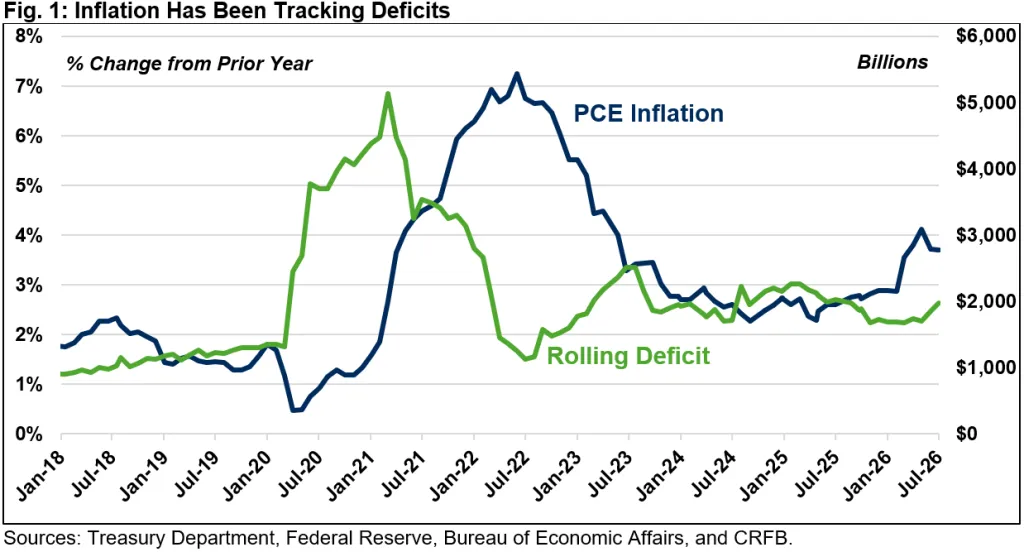
Although the Federal Reserve is generally best suited to fight inflation through monetary policy, fiscal policy can play an important role in assisting the Federal Reserve in keeping inflation at bay. When interest rates remain well above the zero lower bound and the economy is performing near its productive capacity, deficit reduction can reduce excess demand and slow price growth.
In our 2022 paper, Fiscal Policy in a Time of High Inflation, we explained that inflation-fighting fiscal policy can “ensure all federal actions are rowing in the same direction; reduce recessionary pressures and support stronger economic growth; diversify and limit the economic pain from inflation-reducing actions; and reduce the budgetary cost of fighting inflation.” In particular, higher taxes or smaller transfers reduce excessive consumer spending – and the pressure it puts on inflation – while reductions to government purchases reduce demand more directly.
In addition to tempering demand, deficit reduction can also boost supply, including by reducing “crowd out” of private investment and – depending on the specifics – can further boost supply and reduce prices through other channels.1 Deficit reduction can further reduce inflation by lowering self-reinforcing inflation expectations to the extent it reduces the likelihood that future policymakers will aim to inflate away the national debt.2
Deficit Reduction Lowers Interest Rates
In addition to reducing the inflation that Americans face on goods and services, deficit reduction can lower the interest rates paid on mortgages, car loans, student loans, credit card bills, and other debt. Today, a typical homebuyer faces an interest rate of almost 7% on a 30-year mortgage – up from less than 3% in early 2021 and an average of 5% over the prior two decades.
Deficit reduction reduces interest rates through two channels. First, lower deficits reduce inflationary pressure and thus make it easier for the Federal Reserve to cut short-term interest rates (or reduce the need for the Fed to increase rates). Second, a lower stock of debt reduces the interest rates the Treasury needs to offer on long-term debt in order to attract buyers.3 Because other borrowing pegs to Treasury bond yields, lower debt reduces interest rates more broadly.
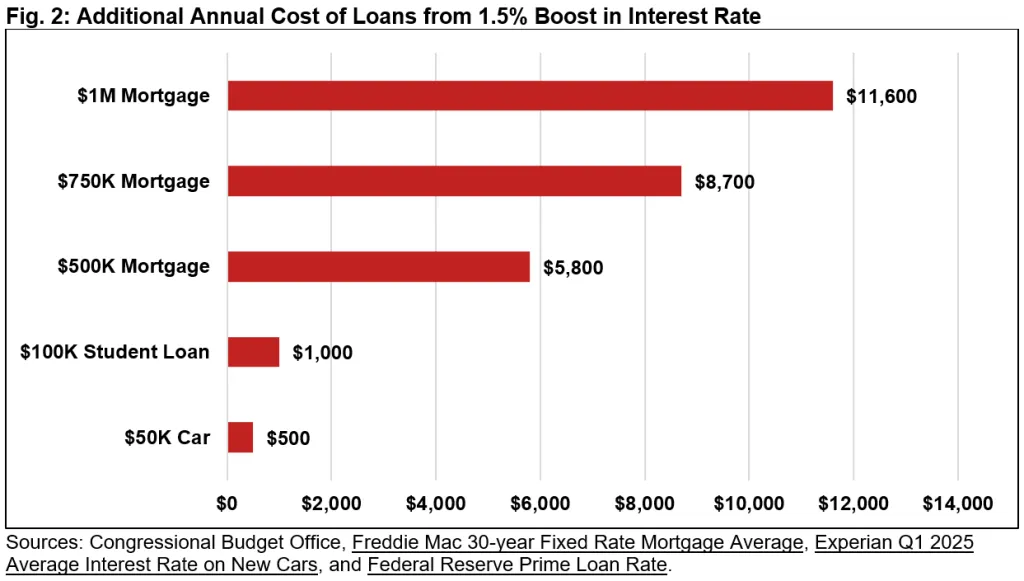
The Congressional Budget Office (CBO) estimates that every 1 percentage point reduction in the debt-to-GDP ratio reduces interest rates by 2 basis points, while other estimators have found even larger effects. This suggests that interest rates are about 1.5 percentages points higher than what they would be if the debt-to-GDP ratio were at 2001 levels and had not tripled over the last quarter century.
To get a sense of what this means for ordinary households, a 1.5 percentage point increase in the interest rate of a new $500,000 mortgage would increase annual costs by nearly $6,000 – and the same increase for a new $100,000 student loan would add $1,000 to annual costs.
Deficit Reduction Can Reduce the Cost of Health Care and Other Essentials
Thoughtful and well-designed deficit reduction can go beyond lower economy-wide inflation and interest rates and reduce the cost of specific goods and services where the government already has a significant influence or involvement or where significant market distortions exist.
In markets where the government is a major purchaser, it can use its market power or rate-setting authority to reduce overall prices. In heavily-subsidized parts of the economy, government can reduce or reform tax breaks or transfers so they do less to drive up costs, at least at the margin. Where monopolies or market inefficiencies exist, government can use fiscal or regulatory reforms to promote competition and reduce costs. And in some cases, fiscal policy can help boost supply for goods, services, capital, or labor and bring down costs in that way.
Government’s influence on costs is nowhere more evident than in health care. Health care spending consumes 18% of GDP – over $17,000 per person – with over one-third of the costs paid for by the federal government, nearly half provided through federal or federal-state health care programs, and nearly all subsidized by the federal government in some way.
The high and rising cost of health care is central to this country’s affordability challenges. As the federal government pays more to provide and subsidize health care, seniors and working-age adults are paying more in premiums and cost sharing and wage growth is suffering as employers dedicate an increasing share of compensation to health insurance premiums.
Federal policy can thus help slow health care cost growth, reducing costs for beneficiaries and the federal government at the same time. Within Medicare, for example, policies to lower drug prices, reduce Medicare Advantage overpayments, restrict supplemental coverage, or reform provider payment (such as by adopting site-neutral payments) can reduce premiums and coinsurance for Medicare beneficiaries, lower deficits, and provide a helpful signal to the private sector to follow in Medicare’s lead. Other health reforms – including changes to tax treatment and policies to improve transparency, discourage consolidations, address monopoly pricing, or contain commercial prices – can also reduce overall costs.
Beyond health care, thoughtful deficit reduction in other parts of the budget and tax code can help lower costs and improve affordability. In the case of higher education, reforms to student loans, Pell Grants, and various tax breaks can put downward pressure on tuition costs.4 Within housing, evidence suggests that limits to the Low-Income Housing Tax Credit and mortgage interest deduction can reduce housing costs.5 And smarter farm, energy, and construction policy can lower prices for goods that both the government and consumers purchase – reducing costs for both.
Inflated costs for health care and many other goods cause strain for both government and household budgets, and policymakers have plenty of opportunities to bring these costs down.
Deficit Reduction Boosts Income and Wealth
The challenge of affordability includes both expenses households face and income available to meet those costs. Deficit reduction, in addition to lowering costs, boosts those incomes.
CBO estimates that every dollar of federal borrowing “crowds out” about 33 cents of private investment. Less investment means fewer machines, buildings, equipment, and software – and less research and development – making workers less productive and depressing wages and income. The corollary is that deficit reduction can boost long-term income growth. In CBO’s 2025 long-term outlook, they estimate that stabilizing debt as a share of GDP would boost real (inflation-adjusted) per-person income growth by one-tenth over the next three decades compared to their baseline and over 44% compared to a high debt scenario where revenue and non-health, non-Social Security primary spending return to their historical average.
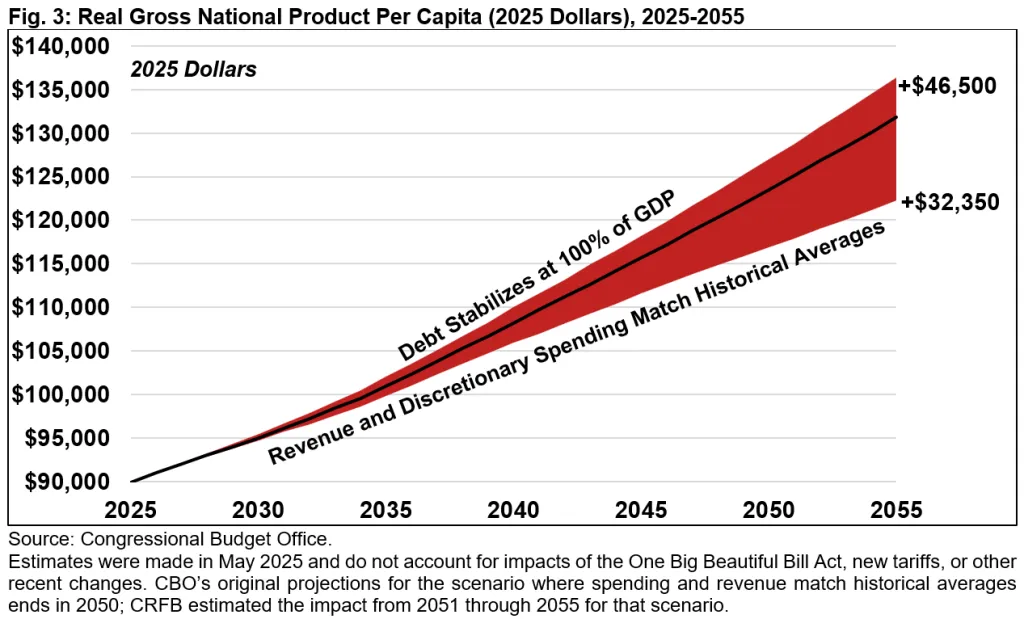
To put these numbers in context, income per person would grow by $46,500 over the next three decades – in today’s dollars – with a stable debt, as opposed to $32,350 with rapidly rising debt. On average, people will thus enjoy $14,250 more annual income from stable debt – nearly $36,000 per household – as compared to rapidly rising debt.
Thoughtful deficit reduction could boost incomes even further to the extent tax and spending reforms encourage or reduce barriers to work, savings, investment, or research and thus strengthen economic growth. For example, we previously estimated that a pro-growth Social Security reform plan could boost incomes by 8% after 30 years, or about $10,500 per person.
Preventing the Next Affordability Crisis
In addition to improving today’s affordability challenges, thoughtful deficit reduction can help prevent tomorrow’s. Between the looming insolvency of major trust funds, the possibility of another recession, and the growing risk of a debt spiral, the next affordability crisis may be just around the corner. A strong fiscal foundation can prevent or help the nation to weather the crisis.
For example, new revenues and cost reductions targeted at Social Security and Medicare can restore solvency to these two trust funds and prevent an affordability crisis for seniors facing sharp and immediate cuts in benefits.
According to the Social Security and Medicare Trustees, the Social Security retirement trust fund is just six years from insolvency and the Medicare Hospital Insurance (HI) trust fund is less than seven years. Upon insolvency, the law requires Social Security benefits to be immediately cut by an estimated 22% to match revenue. If applied to today’s benefits, this would be roughly equivalent to a $500 cut in monthly benefits per retiree – about the entire monthly grocery bill for the average retired household. Just six months later, Medicare payments are projected to be cut by an estimated 11%, compromising access to health care for many seniors.
Deficit reduction can also leave the country better prepared for the next recession. Recessions cause tremendous affordability challenges by generating high rates of unemployment, slowing income growth, and reducing the value of housing, retirement accounts, and other investments. Governments can help provide relief and stimulate an economic recovery with more borrowing but may have trouble doing so if already deeply in debt.
Since the Global Financial Crisis and COVID-19 recessions, debt increased by a combined 65% of GDP; we entered both crises in much stronger fiscal positions. High deficits, debt, interest rates, and inflationary pressures will make it challenging to borrow during the next recession without reigniting inflation, greatly increasing the cost of borrowing, or sparking a backlash in financial markets. Deficit reduction today can allow for more borrowing when it is truly needed.
Deficit reduction today could also prevent a fiscal crisis, where the national debt grows so high or so quickly that investors lose confidence and a sharp economic shock ensues. A sovereign debt crisis could take many forms – including a financial crisis, an inflation crisis, an austerity crisis, a currency crisis, or a default crisis.
Any of these scenarios would spark an affordability crisis, whether through exploding unemployment rates, crashing asset values, surging inflation, falling incomes, sharp and unexpected increases in taxes and cuts in government support, or some combination. Deficit reduction is the best way to reassure markets and avert such a crisis.
Conclusion
Today’s affordability challenges stem in part from rapid increases in borrowing facilitated by both parties since the start of the COVID-19 pandemic and highlight how sometimes well-meaning efforts to help Americans’ pocketbooks can exacerbate the very concerns they aim to address. Tax cuts and benefit increases can temporarily enrich households, but attempts to excessively paper over affordability challenges can often worsen them over the long run.
In response to the current concerns over affordability, many policymakers have proposed doubling down on this failed strategy – providing new subsidies, tax cuts, or dividend payments, that may have political appeal but are likely to worsen inflation, boost interest rates, and increase underlying prices.
Instead, policymakers should pursue deficit reduction with a specific focus on lowering costs and boosting incomes. Deficit reduction can help the Federal Reserve to bring inflation under control; can lower interest rates to make it easier for people to afford homes, cars, or a college education; and – if structured appropriately – can help lower the costs of health care, housing, education, and other essentials currently subsidized by the government. Deficit reduction can also boost wages and incomes, increase wealth, and prevent or prepare for the next affordability crisis.
Responsible deficit reduction is not just an abstract concern for fiscal policymakers focused on bringing spending and revenue in line; it is one of the most powerful levers policymakers have to make daily life more affordable for American families.
1 The Federal Reserve fights inflation by increasing interest rates; however, there is a risk this will cause a recession. If fiscal policy works in the same direction as monetary policy and reduces the burden on interest rates, it can reduce that risk. Fiscal policy can also be more targeted than monetary policy; for instance, policymakers could choose to increase tax revenue by broadening tax bases, which also eliminates economic distortions and increases growth.
2 Under one theory, the Fiscal Theory of the Price Level, inflation occurs when the overall amount of government debt is more than the public believes the government can repay. Expectations that government will ultimately inflate away some of the debt lead to higher near-term prices. See John Cochrane, The Fiscal Theory of the Price Level, Princeton University Press, 2021.
3 When the Treasury borrows to cover the deficit, it draws from the same pool of savings that funds private investments – including mortgages, car loans and small business loans. When deficits increase and the Treasury needs to borrow more, it has to offer higher interest rates to attract more savings away from other investments.
4 One review of the literature estimated a $1 increase in student loan subsidies increased tuition rates as much as $0.60. Congress implemented significant new caps on student loans for graduate and professional students (which were previously unlimited) in the One Big Beautiful Bill Act, which are expected to lower tuition costs.
5 The Low-Income Housing Tax Credit is projected to add $16 billion to deficits in 2026 and has been found to subsidize units that are 16% to 20% more expensive per square foot than the industry average and have little impact on rents because they crowd out unsubsidized housing construction.