Getting to 3%
Deficits are expected to total more than 6% of Gross Domestic Product (GDP) over the next decade, far exceeding the level needed to stabilize or reduce the national debt. Despite this dangerous fiscal trajectory, the U.S. lacks any type of fiscal target. Reducing deficits to 3% of GDP would be sufficient to put debt on a downward path relative to the economy while at the same time remaining realistic enough to be achievable. The Committee for a Responsible Federal Budget is part of a growing bipartisan chorus of support around a 3% fiscal target for the nation, which has grown to include policymakers, business leaders, editorial boards, organizations, and other influential voices.
Read our paper making the case for a 3% GDP deficit target here.

House Budget Committee Holds Hearing on 3% Target
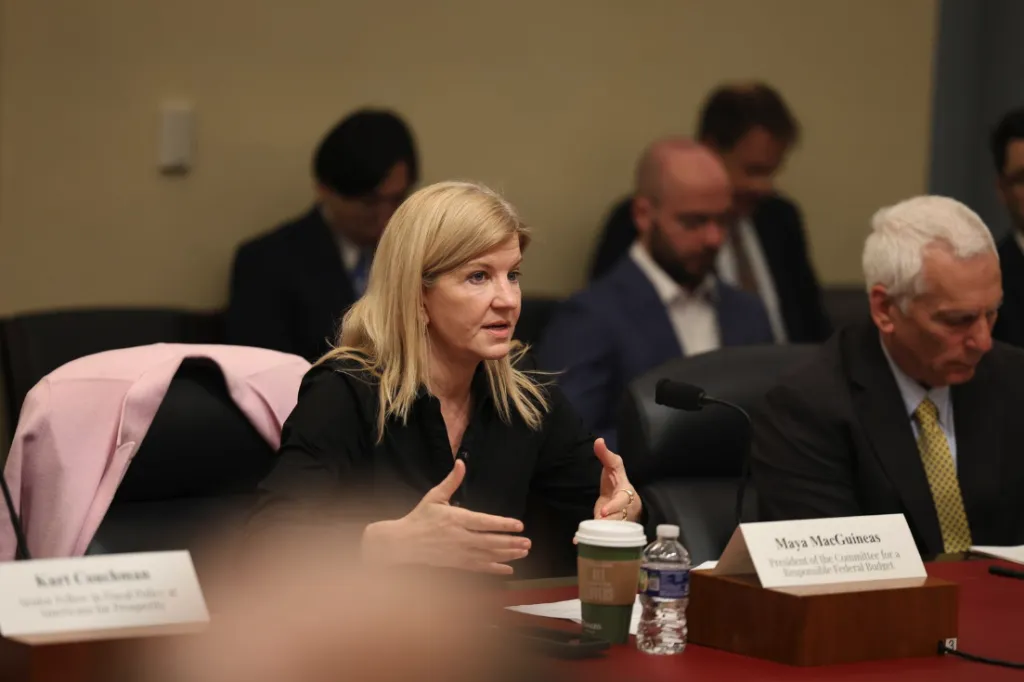
On March 26, 2026, the House Budget Committee held a hearing titled "The Best Metric to Reverse the Curse: A 3% Deficit-to-GDP Path to Fiscal Sustainability." The hearing featured testimony from Committee for a Responsible Federal Budget President Maya MacGuineas on the nation's increasingly unsustainable fiscal situation and making the case for why a 3% deficit-to-GDP target could help stabilize the nation's debt while setting a marker on fiscal responsibility. MacGuineas was joined by other witnesses including Jonathan Burks from the Bipartisan Policy Center, Kurt Couchman from Americans for Prosperity, and Jared Bernstein, former Chair of the Council of Economic Advisors.
MacGuineas's written testimony can be found here. You can watch the full hearing here.
CRFB Board Open Letter Endorsing 3%
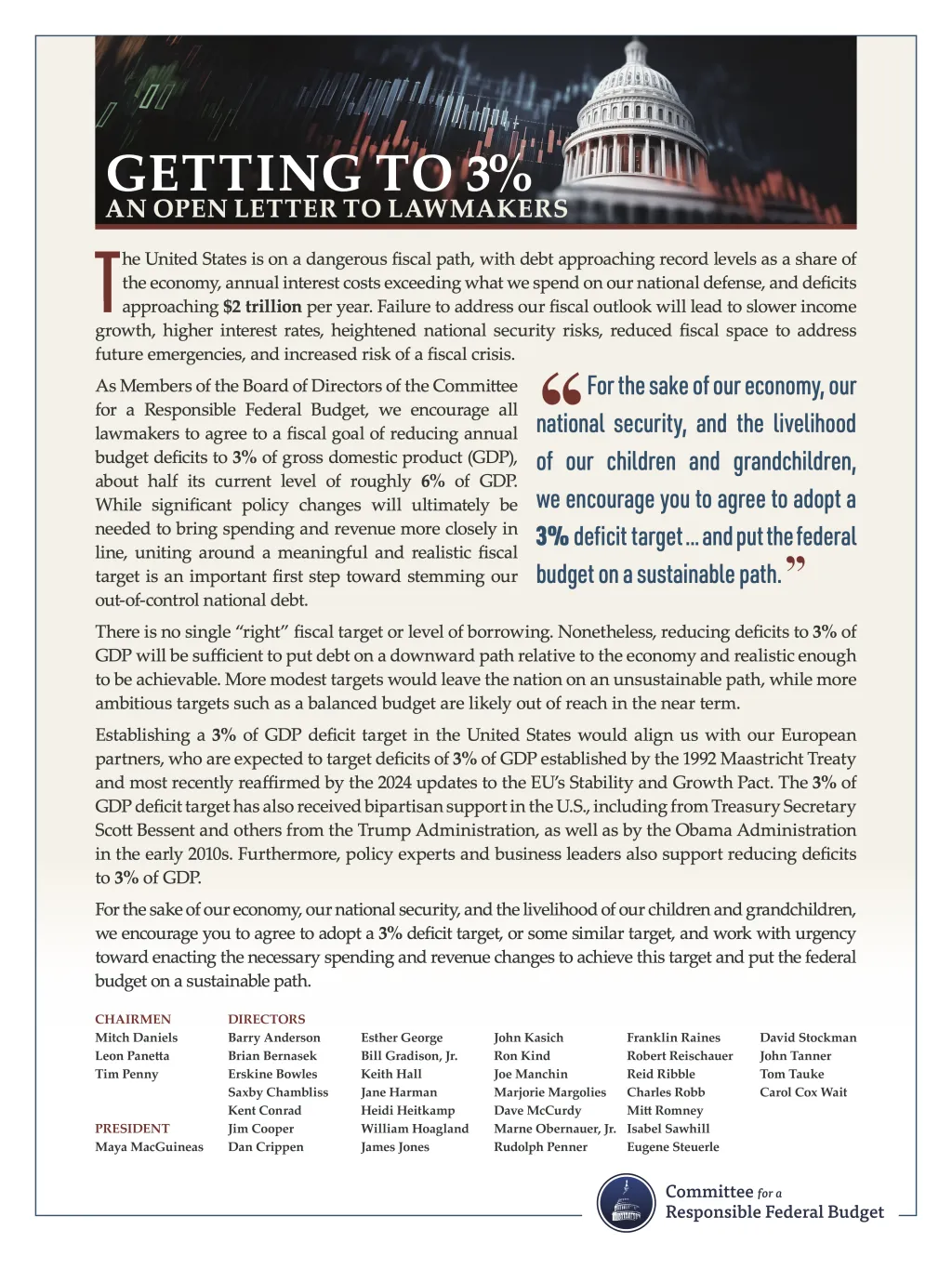
In November 2025, the Board of Directors for the Committee for a Responsible Federal Budget released an open letter calling on lawmakers to adopt the fiscal goal of bringing budget deficits down to 3% of GDP.
The letter makes the case to lawmakers for a 3% deficit-to-GDP fiscal target, specifically noting that establishing a 3% deficit-to-GDP target would align the United States with similar fiscal goals expected of European partners abroad, as well as enjoy bipartisan support at home.
The Committee's Co-Chairs (former Governor Mitch Daniels, former Secretary Leon Panetta, and former Rep. Tim Penny), Committee President Maya MacGuineas, and more than thirty of the Committee's Directors signed onto the open letter. You can find the full letter here.
Bipartisan Fiscal Forum 3% Resolution
In January, Bipartisan Fiscal Forum (BFF) Co-Chairs Representatives Bill Huizenga (R-MI), Scott Peters (D-CA), were joined by Representatives Lloyd Smucker (R-PA), Mike Quigley (D-IL), and the entire BFF Steering Committee in introducing a resolution in support of a 3% deficit-to-GDP target.
The resolution expresses the sense of the House of Representatives that the United States should reduce and maintain the federal unified budget deficit at or below 3% of GDP while acknowledging that the deficit for fiscal year 2025 was roughly 6% of GDP and interest costs are now projected to total over $1 trillion each year going forward. It also declares that the national debt represents a threat to national security and economic growth and risks increasing interest rates and the cost of living. Finally, it outlines potential enforcement mechanisms, laying the groundwork for the next steps Congress can take to reach the 3% deficit-to-GDP target.
You can find more information on the resolution here.
Senate Introduction of 3% Fiscal Goal
In the Senate, Senators Kevin Cramer (R-ND) and Angus King (I-ME), joined by Senators David McCormick (R-PA) and Gary Peters (D-MI), introduced a resolution calling for setting a target of reducing deficits to 3% of Gross Domestic Product (GDP). The resolution resembles a House version introduced by Representatives Bill Huizenga (R-MI), Scott Peters (D-CA), Lloyd Smucker (R-PA), Mike Quigley (D-IL) and others in the Bipartisan Fiscal Forum.
MacGuineas's statement can be found here.
Editorial Board Endorsements of 3%

"Getting back to a deficit of 3% of GDP would go a long way to stabilize the debt-to-GDP ratio, which has increased from roughly 65% before the 2008 financial crisis to roughly 120% today..."
“This effort is not chest-thumping by budget hawks demanding a balanced budget immediately. It is bipartisan recognition that the path the deficit is on undercuts the federal government’s ability to function...”
Read the full endorsement on The Washington Post's website

“A new report by the nonpartisan Congressional Budget Office projects deficits of about twice that size over the next 10 years, sufficient to keep the debt burden on an accelerating upward trajectory — reaching 120% of GDP by 2036 and 175% by 2056. The need to get off this road to disaster should be uncontroversial.”
“Once upon a time, a budget deficit of 3% of GDP — with the economy at or close to full employment and growing well — would’ve been regarded as excessive, and 6% as simply insane. But Washington has grown comfortable with such irresponsibility. It’s good that this resolution has attracted initial support from both Republicans and Democrats, but they’re too few and the idea is still a long way from becoming reality. Better to act on it now, before it’s too late...”
Read the full endorsement on Bloomberg's website
Influential Voices on the 3% Target
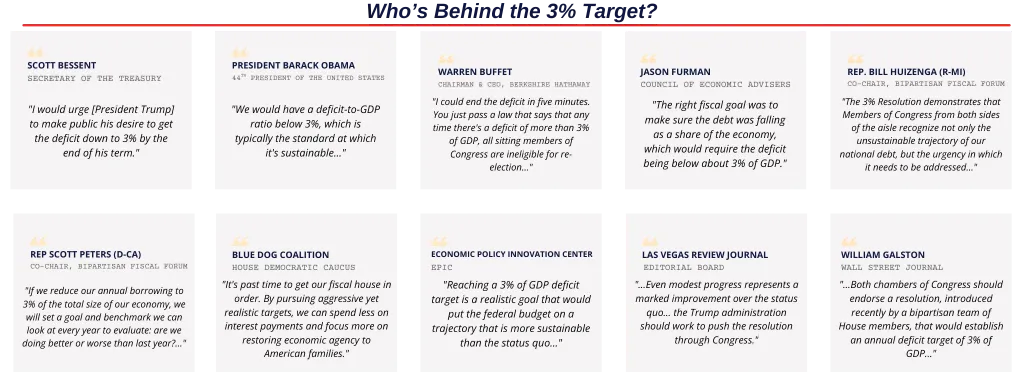
Support for a 3% deficit-to-GDP target is broad and bipartisan. The fiscal target is supported by approximately 40 former government officials, including senators, Members of Congress, Office of Management and Budget directors, Congressional Budget Office directors, governors, and other senior budget and economic officials. Outside government – private-sector leaders, thought leaders, and organizations – from Warren Buffett and Ray Dalio to The Washington Post and Bloomberg Editorial Boards have argued that a 3% deficit would meaningfully improve the nation’s fiscal outlook.
Below are some of those who have spoken in support of a 3% deficit-to-GDP target. You can find a more comprehensive list here.