Don't Count on Growth to Fix the Debt
Strong economic growth will be needed to help fix the debt problems the country faces, and lawmakers should take growth effects into consideration when evaluating policy changes. A 0.1 percentage point increase in the average annual growth rate, for instance, would reduce deficits by about $220 billion over the next decade and reduce projected debt by 1.6% of Gross Domestic Product (GDP) by 2036.
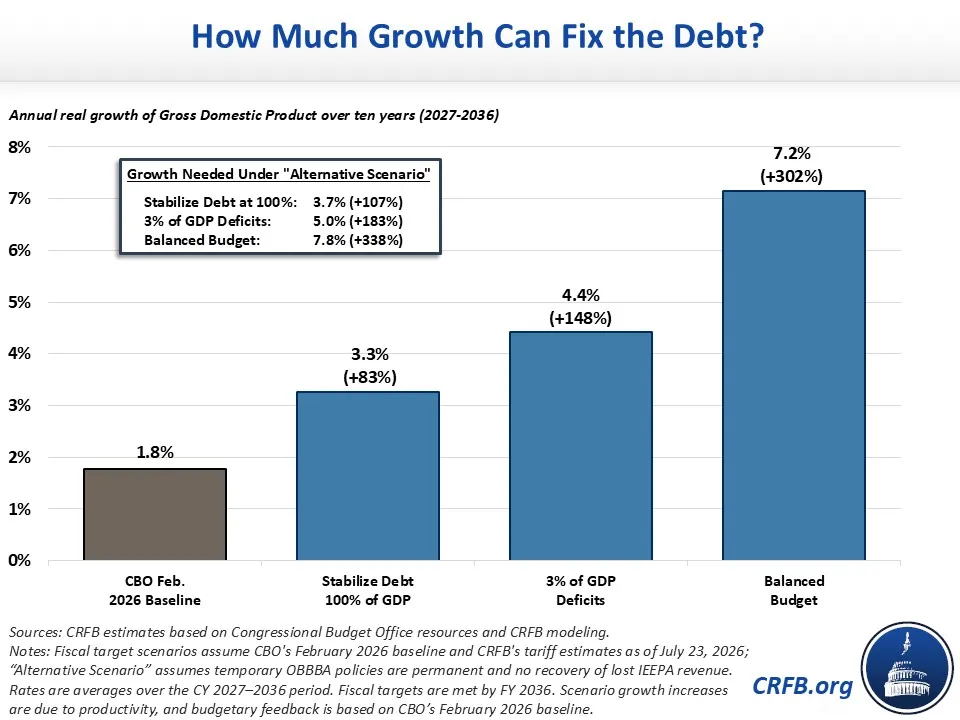
However, it is nearly inconceivable that economic growth alone will fix our fiscal problems. The U.S. economy would need to grow 83% faster than currently projected to put the debt on a sustainable path – an unprecedented, sustained surge in the growth rate.
Some key facts:
- Under current law, we project debt will rise from 100% of GDP today to 122% by 2036, while budget deficits will grow to 6.9% of GDP.
- The U.S. would need sustained, broad-based growth of 3.3% per year – 83% higher than CBO’s projected growth rate of 1.8% – to hold debt to 100% of GDP.
- The growth rate would need to average 4.4% (2.5 times projections) to reduce deficits to the target 3% of GDP by 2036 and 7.2% (4 times projections) to balance the budget.
- Under an alternative scenario where temporary policies are made permanent and certain tariffs disappear, the U.S. would need sustained growth of 3.7% per year (2.1 times projections) to stabilize the debt, 5.0% per year (2.8 times projections) to reduce deficits to 3% of GDP, and 7.8% per year (4.4 times projections) to balance the budget.
- The necessary level of growth would need to be significantly higher if additional growth largely accrued to (lower taxed) capital.
- The growth rate would need to be higher if faster growth came from new deficit-increasing tax cuts or spending increases or caused disruptions that resulted in a fiscal response – since additional growth would be needed to finance new spending and tax cuts as well as contain current debt levels.
Although sustained annual real economic growth above 3% is not impossible given the potential of artificial intelligence, it would likely be unprecedented. The U.S. economy has grown 3% or more in four years out of the last 20 and has not once had two years of consecutive 3% growth in that period.1 Although 3% growth was much more common historically, in our 2017 paper, How Fast Can America Grow?, we showed that this growth was driven largely by favorable demographics and the expansion of women in the workforce, neither of which could be replicated in the context of America’s current aging population.
In light of low birth rates and the resulting slowdown in labor force growth, achieving sustained 3%-plus growth today would require record productivity growth. Specifically, stabilizing the debt at current levels would require average potential total factor productivity growth of around 2.5% per year over the next decade. That’s 2.5 times as much as the 1.0% average over the last two decades. And it’s significantly higher than the previous post-war ten-year record of 1.9%, between 1959 and 1968 in the midst of the final wave of an ongoing trend in electrification, consumer appliances, and completion of the highway transportation system.
While the growth rate can vary wildly from year to year, most credible estimates project that the growth rate will average around 2% over the next decade and beyond.
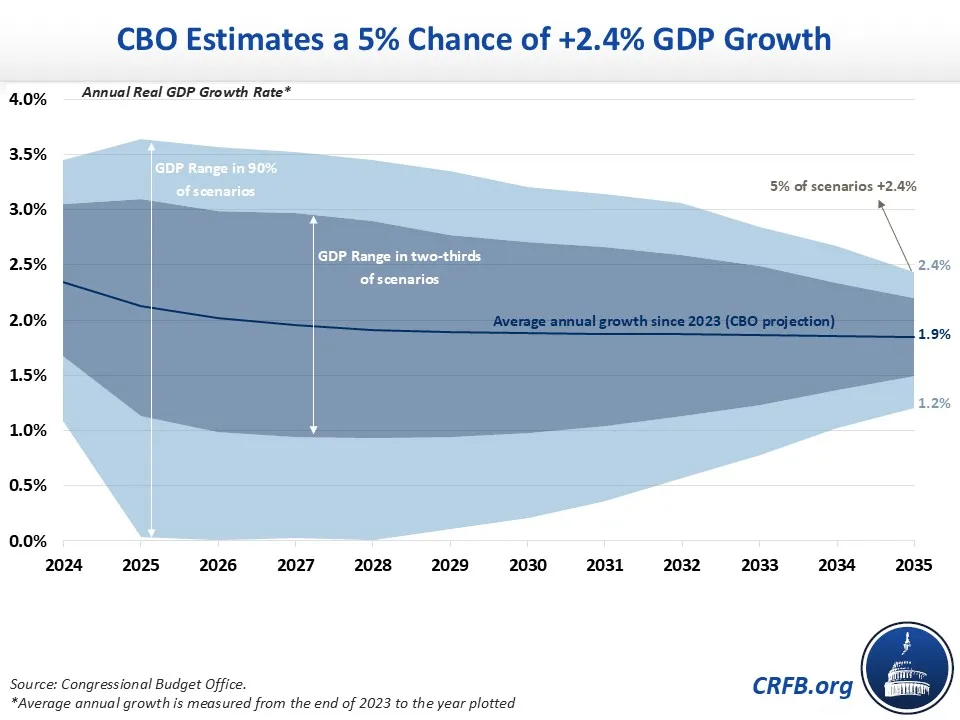
Running 1,000 different scenarios under current law, the Congressional Budget Office found that by 2036, the average annual real GDP growth rate from 2024 would be 2.6% or less in 95% of possible outcomes; an analysis in 2025 (depicted in the chart below) found a similar outcome. This suggests an extremely low likelihood of economic growth of 3% or above.
It is of course theoretically possible that the advancement of AI does lead to unprecedented levels of economic growth – as several recent papers have predicted – but this is not something to expect or count on.
Previous revolutionary advances in technology, such as electricity, the internet, and cloud computing, never produced productivity gains strong enough to double growth rate estimates – nor did initial annual gains continue permanently. Most projections find AI’s total gains will fall well short of bringing economic growth above 3% per year on a sustained basis. For example, CBO projects AI will boost economic growth by roughly 0.1 percentage points per year over the next decade; Penn Wharton Budget Model (PWBM) estimates a peak boost of 0.2 percentage points by mid 2030s; and economists at Goldman Sachs estimate an increase of 0.4 percentage points to the GDP growth rate, reaching 2.3% by the end of ten years.
And should AI boost economic growth far past these levels, it is likely to also substantially push up interest rates as well as shift significant income from labor to capital. Because the effective marginal tax rate on labor is projected to average 28% and the marginal rate on capital is closer to 14%, growth in capital income would only generate about half as much revenue as growth from labor income. Such growth could also create significant socioeconomic disruptions that prompt a fiscal policy response involving new spending or tax relief, consuming some or perhaps even all of the fiscal gains from stronger growth.
Realistically, it is extremely unlikely that the U.S. will be able to grow its way out of our debt burden. Putting the debt on a sustainable path will require meaningful reforms to spending and revenue policies – ideally ones that are pro-growth, which would further improve debt sustainability as well as the lives of ordinary Americans.
In the improbable scenario that economic growth does explode and substantially less deficit reduction is needed, enacting tax and spending changes today will give future policymakers the opportunity to allocate that fiscal space toward the priorities of tomorrow, rather than the priorities of today and yesteryear.
Relying on unrealistic expectations of economic growth should not be a substitute for concrete and meaningful reforms.
1 Measured by Q4/Q4 growth, the economy grew 3% in 2013, 3.4% in 2019, 5.8% in 2021 coming out of the COVID recession, and 3.4% in 2023. Using average annual growth, only 2021 experienced above 3% growth.