Reforming Medicare Supplemental Insurance
Nearly 90% of beneficiaries on Traditional Medicare (TM) have some type of supplemental insurance to help defray out-of-pocket costs such as deductibles, co-payments and coinsurance.1 Although these plans improve cost predictability and offer protection from catastrophic medical expenses, they also significantly boost total spending for both beneficiaries and the federal government. Thoughtful reforms can lower overall health care costs while continuing to protect seniors from unaffordable medical bills.
The Medicare program currently insures about 70 million beneficiaries, at a federal cost of about $1 trillion a year, rising to a projected $2 trillion within a decade.2 Nearly 30 million beneficiaries are enrolled in Traditional Medicare (TM), a government-run fee-for-service insurance plan with wide provider coverage but significant cost sharing and no limits on out-of-pocket costs. In 2025, TM Part A and B (hospital and physician insurance) spent roughly a combined $500 billion on health care and related expenses, with about $350 billion paid by the federal government, $150 billion covered by beneficiary premiums, and an additional $75 billion charged through out-of-pocket deductibles, co-payments and coinsurance.3
To defray or avoid out-of-pocket costs, the vast majority of TM beneficiaries are enrolled in supplemental insurance through either Medigap, employer-provided retiree health plans, the Federal Employees Health Benefit (FEHB) program, TRICARE for Life (TFL), or Medicaid. These plans cover most or all point-of-service health care cost sharing for inpatient and office visits, insulating beneficiaries from the cost sharing required by Medicare.4
Unfortunately, these supplemental insurance plans drive up medical spending – for beneficiaries and the government – both because they blunt the incentives of cost sharing on utilization and because their high administrative costs and profits are passed onto beneficiaries in the form of higher premiums.
We estimate curbing supplemental insurance could produce $200 to $250 billion of federal savings and save beneficiaries an additional $150 to $200 billion over the next decade, reducing National Health Expenditures by $350 to $450 billion.5
Supplemental Insurance’s Role in Medicare Cost Sharing
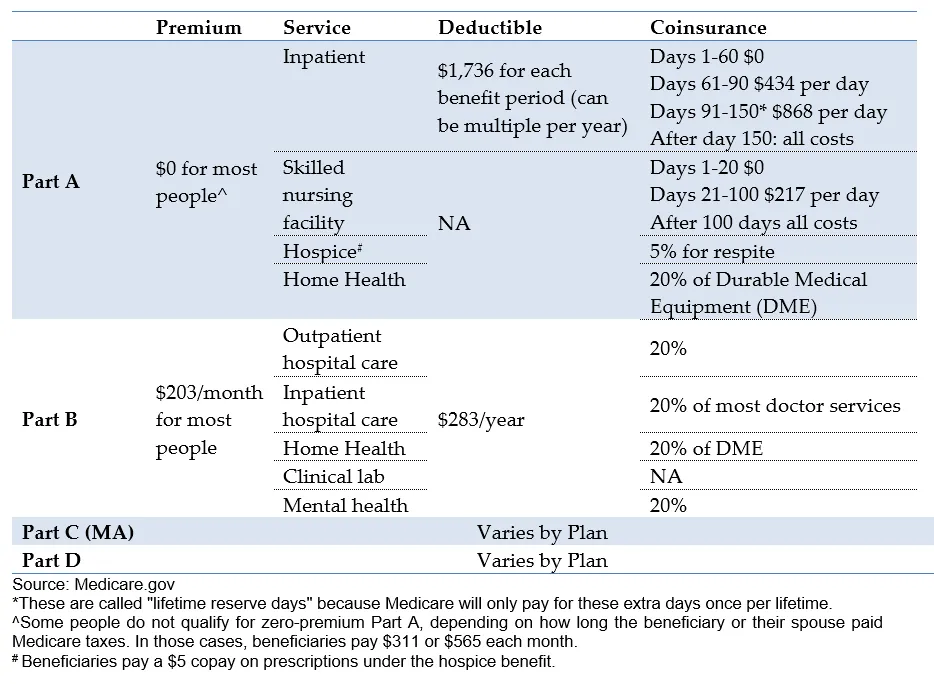
Traditional Medicare (TM) imposes significant, if uneven, cost sharing on its beneficiaries. This includes a $1,736 per episode deductible in Part A, a complicated per-day coinsurance system for post-acute care (up to $217), a $283 annual deductible for Medicare Part B, and a 20% co-insurance on many outpatient services (see Appendix I). Unlike nearly all private insurance, Medicare lacks an annual limit on out-of-pocket costs (a catastrophic cap), meaning those with long hospital stays could end up paying tens of thousands of dollars over the course of a year.
In practice, few TM beneficiaries face these out-of-pocket costs directly, due to the prevalence of wrap-around supplemental plans. In fact, 87% have some type of supplemental coverage. Over 40% of TM beneficiaries purchase Medigap plans: private, standardized, regulated plans for which beneficiaries pay monthly premiums – with the most popular plan covering nearly all out-of-pocket costs.6
Another 15% of beneficiaries have similarly generous supplemental coverage provided by the federal government through the Federal Employees Health Benefits (FEHB) program or TRICARE for Life (TFL). An additional 15% have supplemental coverage through employer-provided retiree health plans that cover substantial cost sharing but tend to be somewhat less generous.7 Finally, 14% of TM beneficiaries are dually eligible for Medicaid, which provides wraparound coverage and pays cost sharing.
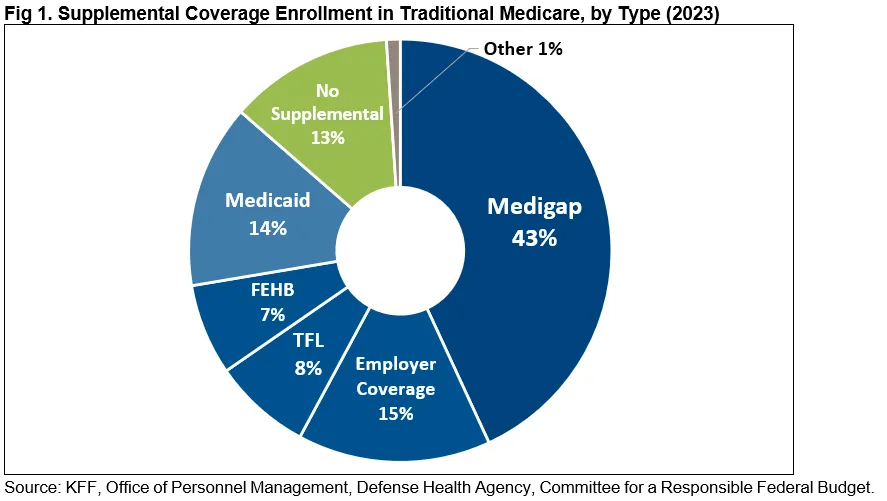
Importantly, over half of beneficiaries are enrolled in Medicare Advantage (MA) instead of TM. MA plans are required to include catastrophic caps for in-network expenses and often have lower deductibles and cost sharing than TM, but narrower networks and more utilization controls.8
Supplemental Insurance Boosts Federal Health Care Costs
TM has few tools to manage care or establish networks, so it relies on pricing and cost sharing to keep costs at bay.9 Supplemental coverage undermines the effectiveness of cost sharing, driving up federal Medicare spending and depleting the Hospital Insurance (HI) trust fund.
In addition to reducing the federal government’s share of Medicare costs, cost sharing is meant to provide a speed bump to reduce or prevent overconsumption of care. Absent any apparent costs, patients may understandably overconsume health care through repeated appointments, tests, and scans.10 Nearly all types of insurance include some level of cost sharing to address this “moral hazard.”11 But it may be particularly important for TM because fee-for-service incentivizes providers to offer more care and generally lacks other cost-control measures such as networks, prior authorization, or care management.12
Medicare’s current cost-sharing rules are widely recognized as imperfect and in many ways problematic but nonetheless exist in large part to limit the overutilization of care. Supplemental insurance drives up federal costs by undermining Medicare’s benefit design and largely or fully shielding beneficiaries from this cost sharing.
Evidence suggests that the impact of supplemental coverage on cost is large. One study from the Medicare Payment Advisory Commission (MedPAC) found that enrollment in a Medigap plan is associated with increased spending of 27% while enrollment in employer health plans increased spending by 14%.13 A more recent study found that Medigap increased individual Medicare spending by more than 20%.14 These studies are consistent with other estimates and adjust for the fact that those with higher potential health costs may be more likely to enroll in supplemental insurance.15
This higher utilization drives up the cost of TM, and through higher benchmarks, Medicare Advantage (MA). It also boosts federal spending on Medicaid, FEHB, and TRICARE for Life; and reduces revenue by driving up the tax-preferred cost of retiree health plans.
As an illustrative example, if Medicare Part A and B are 20% more expensive as a result of supplemental coverage, that amounts to more than $2 trillion of spending over the next decade. If they are only 10% more expensive, this would still amount to over $1 trillion. For reference, the Medicare HI program’s 75-year solvency gap totals 12% of HI spending.
Importantly, the higher federal costs come with benefits in the form of additional health care services. For high-value care, the benefit may even exceed the financial cost. However, evidence suggests that a meaningful portion of health care provides little or no health benefit, while some low-value care may even harm patients with unnecessary side-effects, cascading care, and distress.16,17 Economic theory suggests consumers will be most likely to forgo care with the least value to them when facing some of the costs. While theory may not always match reality and distinguishing between high- and low-value care is difficult, a dollar increase in health care spending is nonetheless likely to produce less than a dollar of welfare benefit.18
Supplemental Insurance Boosts Beneficiary Health Costs
In addition to driving up federal health care spending, supplemental plans drive up beneficiary health care costs, as beneficiaries in aggregate face new and increased premiums well in excess of the cost sharing the plans help them to avoid.
Most beneficiaries who purchase their own supplemental plans pay more in Medigap premiums than they do in base Medicare premiums. In 2023, the average monthly Medigap premium was $217, compared to the $165 monthly Part B premium and an average premium of about $32 for the Medicare drug benefit. Since then, Medigap premiums have seen double-digit annual hikes.19
The combined Medigap and Part B premiums beneficiaries face are significantly higher than what beneficiaries would have paid in deductibles, copays, and other cost sharing absent Medigap coverage, both for the average beneficiary and in the aggregate.
Higher beneficiary costs are driven in part by the same factors that drive federal spending – higher induced utilization. As supplemental coverage masks cost sharing and drives greater use of care, it boosts both Part B premiums – which are calculated as a proportion of total costs – and the premiums of the supplemental plans themselves.
High administrative costs and profits further boost premiums, well beyond what plans pay to cover cost sharing. Of the $240 billion beneficiaries spent on Medigap premiums between 2015 and 2024, only $190 billion went to covering Medicare cost sharing – meaning seniors spent an extra $50 billion in premiums beyond what they received in benefits.20 Whereas premiums to fund higher utilization may theoretically be worth the cost, premiums to fund administrative costs and profits are harder to justify.
The 79% average “medical loss ratio” (MLR) over the past decade is below the 85% minimum generally required for complex insurance plans like MA and Medicaid, despite the fact that Medigap does not build provider networks, implement utilization controls like prior authorization, negotiate prices, or undertake other common administrative tasks.21 Although some of this premium reflects the risk taken on by the insurance plan, much reflects direct profits and royalties, along with advertising. For example, AARP effectively imposes a premium surcharge of up to 6% to market Medigap plans operated by UnitedHealth.22
Employer-sponsored supplemental plans are likely driving up premiums in a proportion similar to Medigap. Although much of these costs are not paid by current beneficiaries, the cost is borne by future beneficiaries in the form of lower wages to fund these more generous benefits.
A Framework to Restrict Supplemental Coverage
Thoughtful supplemental coverage reforms can lower federal health care costs and reduce out of pocket spending for seniors, while maintaining protections against catastrophic costs. Over the years, there have been several proposals to reform supplemental insurance. In 2015, Congress took a first step by prohibiting Medigap plans from covering the Part B deductible ($283 in 2026) for new enrollees, starting in 2020.23
Many experts and policymakers from across the ideological spectrum have proposed going further. For example, several of President Obama’s budgets proposed a 15% surcharge added to Part B premiums for beneficiaries that purchase the most generous Medigap plans.24 Similarly, MedPAC recommended reforms to cost sharing that would impose a catastrophic cap as well as a surcharge on supplemental insurance premiums to recoup some of the costs imposed on the Medicare program from the insurance itself.25 And a plan from health economist Jonathan Gruber would impose up to a 45% excise tax on the cost of a Medigap and other supplemental plans.26
Rather than relying on surtaxes or charges to discourage the use of wrap-around plans, the bipartisan Simpson-Bowles Fiscal Commission proposed a more direct restriction that would ban Medigap plans from covering the first $500 of cost sharing (in 2010 dollars; $740 today) and limit the plans to covering only half of the next $5,000 (in 2010 dollars, $7,400 today) of cost sharing, while modifying TFL plans to match this design as well.27 The Congressional Budget Office (CBO) Budget Options analyzes a similar change, which would restrict Medigap policies from paying the first $850 of an enrollee's cost sharing (in 2024 dollars) and limit coverage to 50 percent of the next $7,650.28
Many of these proposals focus strictly on Medigap plans, ignoring the similar problems created by other supplemental coverage. In order to provide a more comprehensive supplemental coverage reform, the following framework could build on the most recent CBO Budget Option:
- Prohibit Medigap, retiree health plans, FEHB wraparound plans, and TRICARE for Life from covering the first $850 of beneficiary costs per year, across Part A and Part B.
- After beneficiaries reach the $850 minimum, limit these supplemental plans to covering 50% of cost sharing for the next $7,650 (that is, up to $8,500).
- Require retiree health, FEHB, and TFL plans rebate their savings to beneficiaries through Medicare premium subsidies, health savings account deposits, or another mechanism.
- Reduce MA benchmarks to account for lower TM costs, as already required under the law.
While the exact parameters can be adjusted, this framework would balance protecting beneficiaries against high costs and preventing supplemental coverage from substantially driving up costs through overutilization and higher administrative costs and profits. This proposal would effectively limit out of pocket costs to no more than $4,675 per year. It would also maintain cost sharing coverage for low-income beneficiaries through Medicaid and allow MA plans to continue to set their own cost sharing in the context of a managed care regime.
Supplemental Coverage Reform Would Lower Government and Beneficiary Costs
Restricting supplemental Medicare coverage could significantly reduce health care costs for both the federal government and for beneficiaries. In very rough terms, we estimate the framework outlined above would save the federal government $200 to $250 billion over a decade and reduce beneficiary and other private costs by an additional $150 to $200 billion.
CBO estimated restricting Medigap plans from covering the first $850 of costs or more than half of additional costs up to $8,500 would save $116 billion through 2034.29 We find this would translate into over $150 billion in savings using CBO’s latest baseline through 2036. We also roughly estimate another $50 to $100 billion of Medicare savings from applying similar restrictions to TFL, FEHB and other employer-sponsored retiree coverage – assuming the amount employers save is rebated to the beneficiary.
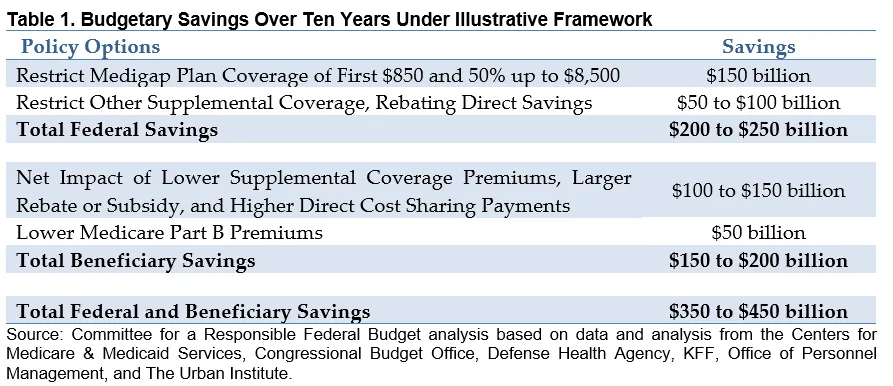
Due to lower utilization and lower Part B and supplemental insurance premiums, we estimate beneficiary costs would fall by $150 to $200 billion. Beneficiaries would pay significantly more in direct cost sharing but would face much lower Medigap premiums and receive supplemental plan rebates or subsidies; Part B premiums would also fall by about $50 billion. To help ensure access to care, a small portion of the federal savings could be used to expand Medicare Savings Programs that support lower income beneficiaries’ cost sharing.30
In 2011, KFF analyzed a similar proposal and found average costs would decline by 21%, with four-fifths of Medigap beneficiaries seeing premium declines that exceed cost sharing increases.31 Costs would generally be higher for beneficiaries in years with significant medical expenses.
Federal savings could be even greater as lower MA benchmarks and Medigap premiums lead some potential MA beneficiaries to instead enroll in TM.32 Restrictions to supplemental plans could also increase political support for payment reforms, such as site-neutral payment, by more directly exposing beneficiaries to cost inefficiencies. These reforms would further lower costs for beneficiaries and the federal government, which could spill over into the commercial market.
Other Considerations and Downstream Effects
Allocating savings to employer-sponsored retiree plans, FEHB, and TFL. While supplemental plan restrictions would directly reduce premiums for those enrolled in Medigap, savings from other supplemental plan restrictions would mainly accrue to the employer or the federal government. Diminishing the value of retiree health plans for beneficiaries and generating savings for their former employer may be viewed as unfair, since these benefits were essentially part of the workers’ compensation packages. To keep beneficiaries whole, we recommend employer-sponsored plans be required to calculate the reduction in plans’ actuarial value and apply a commensurate benefit to enrollees. The benefit could take the form of a dollar-for-dollar decrease in the beneficiary portion of the plan premiums (if such premiums exist), a subsidy of the Medicare Part B and D premiums, a deposit into a form of health savings account that could cover Medicare cost sharing (and perhaps premiums), or some combination.
Medicare Advantage. Those enrolled in MA are generally not allowed to enroll in supplemental coverage, since MA plans themselves include out-of-pocket limits and require less in-network cost sharing than TM. Policymakers should reduce overpayments to MA plans, which will total an estimated $1.3 trillion over the next decade compared to TM. However, we do not recommend limiting MA plans to match the cost-sharing restrictions for supplemental plans. The potential utilization effects of lower MA cost sharing are mitigated or offset by plans’ limited networks and utilization controls such as prior authorization. At the same time, it is important that MA benchmarks be reduced – as the law already requires – based on the TM savings from our proposal.33 Plans may respond to these lower benchmarks with increased cost sharing. These benchmark reductions, in combination with lower Medigap premiums, may also drive some beneficiaries from MA to TM.
Lower-Income Beneficiaries. Although restricting supplemental coverage will reduce total out-of-pocket costs, many beneficiaries would pay more. This could be particularly challenging for low-income beneficiaries, who not only tend to have higher health care needs but are also less able or unable to manage unpredictable fluctuations in out-of-pocket costs and could forgo necessary care they cannot afford. For this reason, we do not apply restrictions to low-income “dual-eligible” seniors whose cost sharing is covered by Medicaid supplemental coverage. For low-income beneficiaries who do not qualify for Medicaid, policymakers could consider expanding existing cost sharing subsidy programs, establishing a graduated, income-based out-of-pocket maximum, or creating a Medicaid buy-in option.
Cost Sharing Reforms and High Value Care. Ideally, reforms to supplemental insurance should be paired with reforms to Medicare cost sharing and benefits design. This could include the establishment of an out-of-pocket cap – which essentially is provided by supplemental plans at extra cost under current law – as well a broader rationalization of Part A and B cost sharing. Cost sharing reforms, in combination with supplemental coverage limits, should also steer enrollees toward high value care where possible so that increased overall cost-consciousness does not lead to large reductions in necessary care.34
Conclusion
It is no surprise that patients with minimal financial exposure tend to overconsume health care, particularly in a fee-for-service program that pays clinicians for volume. TM includes cost sharing rules designed (albeit poorly) to balance the “moral hazard” created by insurance against the goal of protecting beneficiaries against high or unexpected medical costs. However, supplemental wrap-around coverage disrupts this balance, undermining Medicare’s built in cost-control.
By shielding beneficiaries from most or all cost sharing, Medigap and other supplemental insurance plans boost health care utilization, driving up Medicare spending and increasing costs for taxpayers and the Medicare HI trust fund.
Higher utilization, along with high administrative costs and profits, also drives up costs paid by beneficiaries – with higher premiums well in excess of reductions in cost sharing and much of those premiums going toward marketing and profits as opposed to administration of the insurance itself.
Thoughtful reforms can maintain supplemental coverage against catastrophic costs, while reducing early-dollar coverage in a way that lowers health care costs for the federal government and beneficiaries alike. The reform outlined in this paper would reduce federal budget deficits by an estimated $200 to $250 billion over ten years and would reduce beneficiary costs by an estimated $150 to $200 billion over the same time period, net of higher direct cost sharing.
Reforms to supplemental insurance would also result in less provision of care, and policymakers should carefully consider this trade-off. Although some forgone care will be necessary or important, much of forgone care will be of lower value than the dollars saved and some will provide little, no, or even negative benefit to patients.
To maximize the benefits of supplemental coverage restrictions, policymakers should also pursue controls, quality standards, and other reforms to help ensure that beneficiaries get the high value care they need, along with reforms to rationalize Medicare’s cost sharing regime and drive beneficiaries toward high-value care.
As Medicare costs are expected to top $1 trillion annually and the budget deficit reaches record highs, policymakers should consider all options on the table to reduce spending. Reforming supplemental insurance will reduce costs for the federal government and for beneficiaries, alike.
Appendix I: Traditional Medicare Cost Sharing, 2026
1 Nancy Ochieng, Juliette Cubanski, and Tricia Neuman, “A Snapshot of Sources of Coverage Among Medicare Beneficiaries,” KFF, Dec 19, 2025, https://www.kff.org/medicare/a-snapshot-of-sources-of-coverage-among-medicare-beneficiaries/.
2 In 2024, Medicare covered 59.5 million seniors, 573,000 people with end state renal disease, and 7.1 million people with disabilities. Center for Medicare & Medicaid Services (CMS), “Medicare Monthly Enrollment,” April 2026, https://data.cms.gov/summary-statistics-on-beneficiary-enrollment/medicare-and-medicaid-reports/medicare-monthly-enrollment.
3 Congressional Budget Office (CBO), “Baseline Projections Medicare, February 2026, https://www.cbo.gov/system/files/2026-02/51302-2026-02-medicare.pdf. Centers for Medicare & Medicaid Program Statistics, 2023, https://catalog.data.gov/dataset/cms-program-statistics-medicare-part-a-part-b-all-types-of-service?from_hint=eyJxIjoibWVkaWNhcmUgY29zdCBzaGFyaW5nIiwic29ydCI6InJlbGV2YW5jZSJ9.
4 Michele Malloy, "Medigap: Background and Statistics," Congressional Research Service (CRS), May 12, 2023, https://www.congress.gov/crs-product/R47552.
5 A draft of this brief was presented at the Hoover Institution's Medicare Budget Policy Options conference.
6 Nancy Ochieng, Juliette Cubanski, and Tricia Neuman, “A Snapshot of Sources of Coverage Among Medicare Beneficiaries,” KFF, Dec 19, 2025, https://www.kff.org/medicare/a-snapshot-of-sources-of-coverage-among-medicare-beneficiaries/. Beneficiaries have a choice among ten types of plans with various coverage levels, though the most popular Medigap plan, Plan G, covers nearly all Medicare out-of-pocket costs. Two plans, C and F, are no longer available to new beneficiaries. Centers for Medicare & Medicaid Services, “Compare Medigap Plan Benefits,” https://www.medicare.gov/health-drug-plans/medigap/basics/compare-plan-benefits.
7 Office of Personnel Management, “FY 2023 Congressional Budget Justification and Annual Performance Plan,” March 2022, page 145, https://www.opm.gov/about-us/reports-publications/agency-archive/congressional-budget-justification-fy2023.pdf. Chief Data and Analytics Office, “Fiscal Year 2024 TRICARE Program Evaluation Report,” Defense Health Agency: Department of Defense, Sep 23, 2025, page 12, https://dha.mil/Reference-Library/f/y/2/FY2024-TRICARE-Program-Evaluation-Report and “Frequently Asked Questions,” TRICARE, https://tricare.mil/FAQs/TFL/TFL_What-is.
8 In addition to plans purchased by beneficiaries, TFL, or employers, Medicare beneficiaries with lower incomes are eligible for cost sharing support through Medicaid. Under law, Medicaid covers different amounts of cost sharing for qualifying beneficiaries depending on income and availability of funds. See Medicaid and CHIP Payment and Access Commission (MACPAC), “State Medicaid Payment Policies for Medicare Cost Sharing,” August 2025, https://www.macpac.gov/wp-content/uploads/2025/08/2025.08-Policy-in-Brief-State-Medicaid-Payment-Policies-for-Medicare-Cost-Sharing.pdf. Center for Medicare & Medicaid Services (CMS), “Medicare Monthly Enrollment,” April 2026, https://data.cms.gov/summary-statistics-on-beneficiary-enrollment/medicare-and-medicaid-reports/medicare-monthly-enrollment. MedPAC, “Medicare beneficiary and other payer financial liability,” July 2025, https://www.medpac.gov/wp-content/uploads/2025/07/July2025_MedPAC_DataBook_Sec3_SEC.pdf.
9 An exception is the Accountable Care Organization (ACO) program. CMS enrolls some beneficiaries in ACOs, groups of providers that are held accountable for care and quality and are rewarded with shared savings when they meet certain benchmarks. ACOs coordinate care and thus may apply some processes that result in less quantity of care. MedPAC, “Accountable Care Organization Payment Systems,” https://www.medpac.gov/wp-content/uploads/2024/10/MedPAC_Payment_Basics_25_ACOs_FINAL_SEC.pdf.
10 “The RAND Health Insurance Experiment (HIE) remains one of the most comprehensive studies to date on the relationship between insurance structure and healthcare utilization. The study demonstrated a clear inverse relationship between the level of cost sharing and the utilization of healthcare services: participants with full insurance coverage (zero cost sharing) utilized significantly more healthcare services than those in high cost sharing plans. The elasticity of health care demand in response to out-of-pocket costs was evident, as individuals with higher cost sharing obligations reduced their use of both necessary and unnecessary medical services. The RAND Health Insurance Experiment conclusively demonstrated the existence of moral hazard in health care: as consumer cost sharing decreases, health care utilization and overall spending increase.” Daniela Huțu, Carmen Marinela Cumpăt, Andreea Grădinaru, Bogdan Rusu, “The Impact of Moral Hazard on Healthcare Utilization in Public Hospitals from Romania: Evidence from Patient Behaviors and Insurance Systems,” Healthcare (Basel), Dec 12, 2024, https://pmc.ncbi.nlm.nih.gov/articles/PMC11675956/. Manning et al., “Health Insurance and the Demand for Medical Care: Evidence from a Randomized Experiment,” RAND, 1988, https://www.rand.org/pubs/reports/R3476.html.
11 Liran Einav and Amy Finkelstein, “Moral Hazard in Health Insurance: What We Know and How We Know It,” Journal of the European Economic Association, Volume 16, Issue 4, August 2018, Pages 957–982, https://doi.org/10.1093/jeea/jvy017.
12 CMS enrolls some beneficiaries in ACOs, which are groups of providers that are held accountable for care and quality, and are rewarded with shared savings when they meet certain benchmarks. ACOs coordinate care and thus may apply some processes that result in less quantity of care. MedPAC, “Accountable Care Organization Payment Systems,” https://www.medpac.gov/wp-content/uploads/2024/10/MedPAC_Payment_Basics_25_ACOs_FINAL_SEC.pdf.
13 Christopher Hogan, “Exploring the Effects of Secondary Coverage on Medicare Spending for the Elderly,” A report by Direct Research, LLC, for the Medicare Payment Advisory Commission, August 2014, https://www.medpac.gov/wp-content/uploads/import_data/scrape_files/docs/default-source/contractor-reports/august2014_secondaryinsurance_contractor.pdf
14 Marika Cabral and Neale Mahoney, “Externalities and Taxation of Supplemental Insurance: A Study of Medicare and Medigap,” American Economic Journal: Applied Economics 11(2): 37–73, April 2019, https://doi.org/10.1257/app.20160350.
15 Adam Atherly, “The Effect of Medicare Supplemental Insurance on Medicare Expenditures,” International Journal of Health Care Finance and Economics, vol. 2, no. 2 (June 2002), pp. 137–162, www.jstor.org/stable/3528916; Susan L. Ettner, “Adverse Selection and the Purchase of Medigap Insurance by the Elderly,” Journal of Health Economics, vol. 16, no. 5, October 1997, pp. 543–562, https://doi.org/10.1016/S0167-6296(97)00011-8. One study estimated a smaller difference in spending among beneficiaries with and without supplemental coverage. See Jeff Lemieux, Teresa Chovan, and Karen Health, “Medigap Coverage and Medicare Spending: A Second Look,” Health Affairs, vol. 27, no. 2, March/April 2008, pp. 469–477, http://dx.doi.org/10.1377/hlthaff.27.2.469. Duchovny et al., “CBO’s Medicare Beneficiary Cost-Sharing Model: A Technical Description.” Congressional Budget Office, October 2019, https://www.cbo.gov/system/files/2019-10/55659-CBO-medicare-beneficiary-cost-sharing-model.pdf.
16 A review of the literature on wasteful healthcare spending found the median calculated value of overuse of services was $451 billion in a year, with one estimate as high as $835 billion. Speer et al., “Excess Medical Care Spending: The Categories, Magnitude, and Opportunity Costs of Wasteful Spending in the United States,” American Journal of Public Health, Dec 2020, https://pubmed.ncbi.nlm.nih.gov/33058700/.
17 Kim et al., “An Evidence Review of Low-Value Care Recommendations: Inconsistency and Lack of Economic Evidence Considered,” Feb 23, 2021, https://pmc.ncbi.nlm.nih.gov/articles/PMC8606489/. Medicare Payment Advisory Commission (MedPAC), “Use of Low-Value Care in Medicare is Substantial,” May 27, 2015, https://www.medpac.gov/use-of-low-value-care-in-medicare-is-substantial.
18 Distinguishing between high- and low-value care is difficult and often person-specific. Some cost-sharing regimes – including in private insurance and MA – differentiate cost sharing by service in order to encourage higher-value care and discourage lower-value care. However, with regard to supplemental insurance, the combination of plan standardization, medical loss ratio limits, and cost shifting onto Medicare give supplemental plans little incentive or ability to employ such tactics.
19 Julie Appleby, “Medigap premiums leap, and consumers have few alternatives,” CBS News, April 22, 2026, https://www.cbsnews.com/news/medigap-medicare-supplemental-premiums-cost-increase/.
20 CRFB analysis of, National Association of Insurance Commissioners, page 9 https://content.naic.org/sites/default/files/publication-med-bb-medicare-loss-report.pdf.
21 Notably, the medical loss ratio (MLR) in 2024 was meaningfully higher at 84.5%. However, high premium increases in the last couple of years suggests it may have since fallen toward historical levels. National Association of Insurance Commissioners, page 9 https://content.naic.org/sites/default/files/publication-med-bb-medicare-loss-report.pdf.
22 KFF Health News, “AARP’s Billion-Dollar Bounty,” June 6, 2022, https://kffhealthnews.org/aging/aarp-health-marketing-partnerships-medicare-medigap. See also, UnitedHealth Medicare Supplemental Insurance filings in Vermont and Rhode Island.
23 Starting January 1, 2020, plans C and F – which offer first-dollar coverage – were no longer available to new beneficiaries. Congressional Research Service, “The Medicare Access and CHIP Reauthorization Act of 2015 (MACRA; P.L. 114-10),” November 10, 2015, page 42, https://www.congress.gov/crs_external_products/R/PDF/R43962/R43962.12.pdf. H.R.2 - Medicare Access and CHIP Reauthorization Act Of 2015. 2015. Vol. SEC. 401. Limitation On Certain Medigap Policies For Newly Eligible Medicare Beneficiaries, https://www.congress.gov/bill/114th-congress/house-bill/2/text/statute?format=txt.
24 Office of Management and Budget, “Fiscal Year 2014 Budget of the U.S. Government,” April 10, 2013, https://www.govinfo.gov/content/pkg/BUDGET-2014-BUD/pdf/BUDGET-2014-BUD.pdf.
25 Among its recommendations for benefit redesign, MedPAC endorsed “no change in beneficiaries’ aggregate cost-sharing liability.” Medicare Payment Advisory Commission, “Medicare and the Health Care Delivery System,” June 15, 2012, page 20, https://www.medpac.gov/wp-content/uploads/import_data/scrape_files/docs/default-source/reports/jun12_entirereport.pdf. MedPAC recently noted this recommendation in its June 2026 report to Congress. MedPAC, “Medicare and the Health Care Delivery System,” June 2026, https://www.medpac.gov/wp-content/uploads/2026/06/Jun26_MedPAC_Report_To_Congress_SEC.pdf.
26 Jonathan Gruber, “Proposal 3: Restructuring Cost Sharing and Supplemental Insurance for Medicare,” The Hamilton Project at the Brookings Institution, February 2013, pages 3-4, https://www.brookings.edu/wp-content/uploads/2016/06/THP_15WaysFedBudget_Prop3.pdf.
27 The National Commission On Fiscal Responsibility and Reform, “The Moment of Truth,” December 2010, https://www.ssa.gov/history/reports/ObamaFiscal/TheMomentofTruth12_1_2010.pdf.
28 Congressional Budget Office, “Change the Cost-Sharing Rules for Medicare and Restrict Medigap Insurance,” Dec 12, 2024, https://www.cbo.gov/budget-options/60904.
29 Ibid.
30 CMS, Medicare Savings Programs, https://www.medicare.gov/basics/costs/help/medicare-savings-programs.
31 “Medigap Reforms: Potential Effects of Benefit Restrictions on Medicare Spending and Beneficiary Costs,” KFF, July 2011, https://www.kff.org/wp-content/uploads/2013/01/8208.pdf.
32 Unlike TM, MA plans already include a catastrophic cap and often cover supplemental benefits like vision, dental, and hearing. MA may not be combined with supplemental Medigap plans. Survey data suggests many beneficiaries enroll in MA because supplemental benefits are included without additional premiums, and sometimes with lower premiums. Reforming supplemental insurance may encourage a higher share of beneficiaries to remain in TM both because Medigap premiums would decrease, and because MA plans may not be able to offer as generous premiums or auxiliary benefits with lower benchmarks. According to the Congressional Budget Office, MA plans cost the federal government about 15% more than TM for a given beneficiary, and so higher enrollment in TM would reduce federal costs. CBO, “Federal Subsidies for Health Insurance, 2026 to 2036,” July 2026, https://www.cbo.gov/system/files/2026-07/62539-Health-Insurance.pdf.
33 Congressional Research Service (CRS), “Medicare Advantage (MA): Proposed Benchmark Update and Other Adjustments for CY2027 in Brief,” Mar 12, 2026, https://www.congress.gov/crs-product/R48882.
34 Christopher T. Robertson, “Exposed: Why Our Health Insurance Is Incomplete And What Can Be Done About It,” Harvard University Press, 2019, https://www.dropbox.com/scl/fi/t72dbvvvlt15cmxkhfrly/Full-Text-of-Exposed-book.pdf?rlkey=t0lcqdh0bb2w6l427n6dnd14d&st=vb0piuzb&dl=1.