"First 100 Days" Agenda Could Cost More Than $4 Trillion
Looking forward to the 120th Congress, House Democrats have called for action in the first 100 days “to reverse the Medicaid cuts, restore SNAP funding, extend the Affordable Care Act tax credits, eradicate the Trump tariffs and stop the reckless war of choice in Iran.” There is currently a robust conversation within the party over whether to offset their agenda.
Both parties have recently called for enacting a number of costly priorities. Without offsets, these changes could worsen our nation’s already dismal fiscal picture.
The “First 100 Days” proposals, in particular, could carry significant costs. Specifically, we estimate:
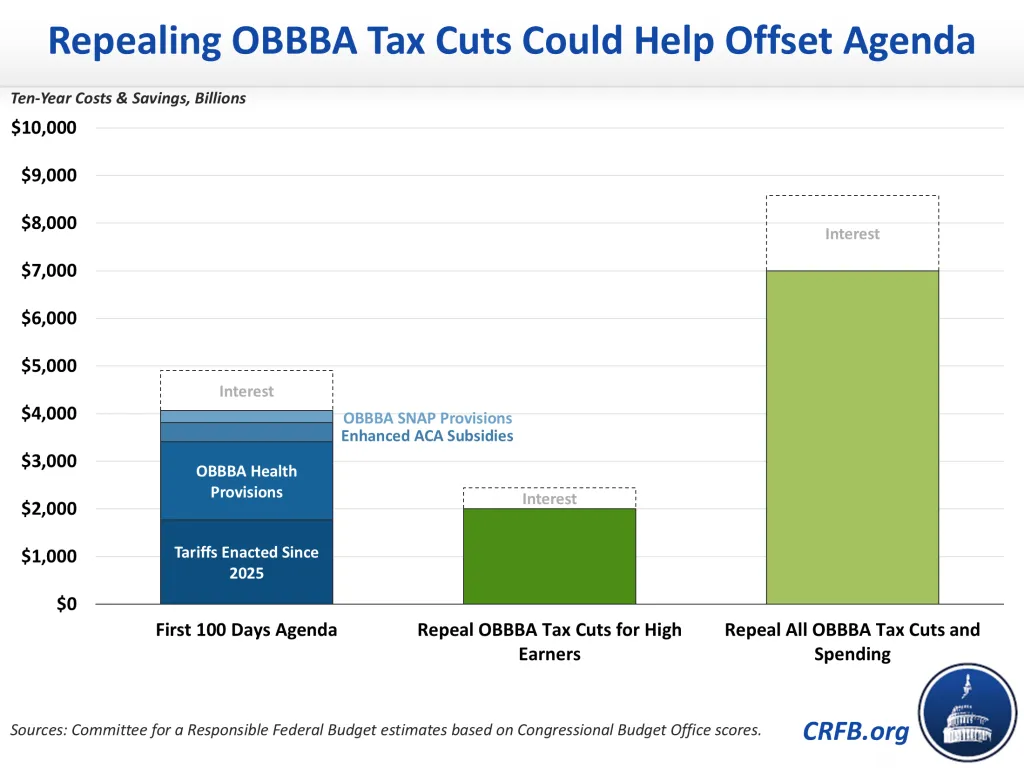
- The First 100 Days policies would cost $4.1 trillion through 2037.
- Without offsets, the policies would add $4.9 trillion to the debt through 2037 with interest costs.1
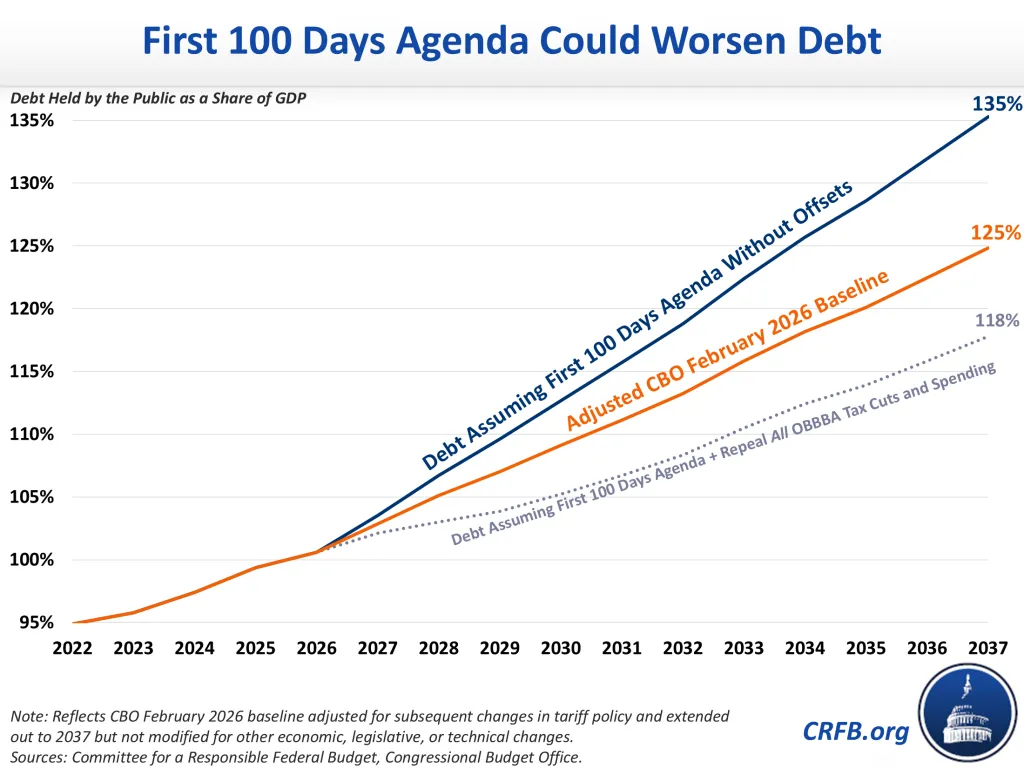
- The policies would increase projected debt in 2037 by 10% of Gross Domestic Product (GDP) to 135% of GDP, without offsets, versus 125% of GDP under an adjusted CBO baseline.
- Ending the conflict in Iran could avoid roughly $30 billion per year in future borrowing that might be necessary to fund a long-term conflict but does not reduce funding in the baseline and therefore would not generate savings.
- To avoid worsening the debt, lawmakers could consider better targeting this agenda and offsetting new costs (ideally twice over). For example, repealing the One Big Beautiful Bill Act’s (OBBBA) tax cuts for high earners would generate about $2 trillion of savings – enough to offset an agenda scaled back by half.
- Repealing all of the tax cuts and spending increase in OBBBA – including its low-income and middle-class tax cuts – would generate about $7 trillion. That would be enough to pay for the First 100 Days agenda 1.7 times over but still leave debt rising to 118% of GDP.
Potential Cost of First 100 Days Agenda
| Policy | FY 2027-2037 |
|---|---|
| Reverse OBBBA Health Provisions | $1.6 trillion' |
| Cancel Provider Tax and State Directed Payment Limits | $600 billion |
| Remove Medicaid Work Requirements | $485 billion |
| Repeal ACA Program Integrity Measures and Eligibility and Enrollment Restrictions | $340 billion |
| Reverse Other OBBBA Health Changes | $250 billion |
| Reverse OBBBA SNAP Provisions | $250 billion |
| Reverse State Payment Requirement for Administrative Costs and SNAP Overpayments | $95 billion |
| Repeal Expansion of SNAP Work Requirements | $70 billion |
| Restore Executive Authority to Update Thrifty Food Plan (TFP) | $55 billion |
| Reverse Other OBBBA Changes to SNAP | $30 billion |
| Restore Enhanced ACA Subsidies in Effect from 2021-2025 | $405 billion |
| Remove Tariffs Enacted Since 2025 | $1.8 trillion |
| Repeal Country-Specific ‘Section 301’ Tariffs | $955 billion |
| Repeal Goods-Specific ‘Section 232’ Tariffs | $780 billion |
| Repeal ‘Section 338’ Tariffs on Certain Canadian Imports | $35 billion |
| End the War in Iran | * |
| Primary Deficit Impact | $4.1 trillion |
| Debt Service Costs, Assuming No Offsets | $840 billion |
| Total Deficit Impact | $4.9 trillion |
| Memo: Change in Debt | +10% of GDP |
| Memo: Savings from Repealing OBBBA Tax Cuts for High Earners | $2 trillion |
| Memo: Savings from Repealing All OBBBA Tax Cuts and Spending Increases | $7 trillion |
Totals rounded to the nearest $5 billion. OBBBA = One Big Beautiful Bill Act. Interaction effects are included in "Other OBBBA Health Changes" and "Expansion of SNAP Work Requirements" for health provisions and SNAP, respectively.
'Estimates are conservative, as they do not account for higher underlying projected Medicaid costs nor CMS’s most recent estimates of the potential SDP counterfactual.
*The direct effects of ending the war in Iran would be to prevent deficit increases rather than to reduce deficits, though some indirect effects could lead to deficit reduction.
Source: Committee for a Responsible Federal Budget based on estimates from the Congressional Budget Office.
Without offsets, the $4.9 trillion deficit impact of the First 100 Days agenda would boost debt from 100% of GDP today to 135% of GDP by 2037, compared to 125% under current law. Deficits under this scenario would double from $2 trillion today to $4 trillion by 2037, compared to $3.3 trillion under current law. As a share of GDP, the deficit would rise from 6.2% of GDP in FY 2026 to 8.2% by 2037, above current law projections of 6.9% and far above the 3% of GDP deficit target needed to ensure long-term debt sustainability.
While some of the changes in the First 100 Days agenda may offer temporary relief to U.S. consumers, the continued expansion deficits threatens to worsen affordability challenges by driving up underlying inflation, boosting interest rates, increasing overall health care costs, and slowing wage growth.
Instead, focusing on a more targeted agenda and including it as part of a deficit reduction plan offers the opportunity to improve affordability and sustainability at the same time. The U.S. is already on the precipice of a debt spiral, and the risk of a fiscal crisis is rising. Policymakers should not worsen this situation.
The analysis below offers more detail on the First 100 Days agenda.
Reversing the Medicaid Cuts
Although OBBBA added substantially to deficits, it included a number of offsets to mitigate that cost, particularly in Medicaid and other health care spending. House Democrats have said they want to “reverse Trump’s Medicaid cuts,” which we interpret to mean repealing the entire health care title of OBBBA as was proposed in legislation considered in the Senate and similar legislation developed in the House. In total, we estimate this would cost $1.6 trillion through 2037, based on CBO’s original score. This is a conservative estimate that does not account for recent upward revisions in projected per-enrollee Medicaid costs or higher recent estimates of savings from limits on State Directed Payments.
More than one-third of these costs would come from repealing OBBBA’s restrictions on provider tax schemes often used by states to inflate their Medicaid match and limits to prevent states from using State Directed Payments to pay hospitals and other providers at commercial rates, instead capping rates based on Medicare payment levels. The next largest source of cost comes from reversing newly mandated work requirements, which require beneficiaries in the Medicaid expansion population to prove 80 hours of community engagement per month before and during enrollment.2
This plan would also reverse a number of other Medicaid changes that increased the frequency of redeterminations, limited auto-enrolling Medicare dual eligibles, required cost sharing, and restricted coverage of certain immigrants, among other changes. We also assume it would repeal the rural health transformation program and changes to safe harbor regulations for telehealth services.
Although much of the focus has been on Medicaid, we assume the First 100 Days agenda would also reverse the Affordable Care Act (ACA) related changes in OBBBA based on recent legislative proposals. In particular, this would mean reversing restrictions on eligibility based on immigration status, required eligibility verification, and disallowed claiming if enrolled during the special enrollment period. It would also mean reinstating limitations on recapture of advance payment, which OBBBA lifted, and cancelling some other program integrity measures.
Restoring SNAP Funding
In addition to reducing Medicaid and ACA costs, OBBBA included a number of changes to reduce the cost of the Supplemental Nutrition Assistance Program (SNAP), sometimes called food stamps. Democrats have called for restoring SNAP funding in the first 100 days, which we interpret to mean reversing all of these changes. In total, we estimate this would cost $250 billion through 2037.
About two-fifths of these costs would come from the federal government covering spending shifted to the states under OBBBA. In particular, OBBBA increased the state share of administrative spending from 50% to 75% and required additional contributions from states with higher payment error rates.
More than one-quarter of the costs would come from reversing the work requirement expansions under OBBBA, which raised the age limit under which the requirement applies from 54 to 64, removed exemptions for parents of children between 14 and 17 years old, and removed special exemptions for veterans, adults under 24 who aged out of foster care, and people experiencing homelessness. A similar share of the costs would come from restoring the President’s authority to redesign the Thrifty Food Plan used to index SNAP benefits every five years without regard to cost neutrality. In 2021, President Biden used this authority to increase benefits by 21% and added $180 billion to deficits.
Restoring Enhanced ACA Health Subsidies
Under the 2010 Affordable Care Act (ACA), many Americans buying health insurance on the individual market can receive an income-based federal subsidy that limits the net premium of a standard plan to between 2% and about 10% of their income. The American Rescue Plan Act temporarily expanded these subsidies to limit the net premium to between 0% and 8.5% of income – including for those above 400% of the poverty line who are not currently eligible. This enhanced subsidy was extended through 2025 under the Inflation Reduction Act (IRA) but expired at the end of last year.
Democrats have called for extending these subsidies, which we interpret to mean a restoration to ARP/IRA parameters. We estimate these changes would increase deficits by $405 billion through 2037 without modifications or offsets.
Ending the Tariffs
Since taking office in the beginning of 2025, President Trump has used his executive authority to enact and implement a wide-ranging set of tariffs, which have generated meaningful new revenue. Although the Supreme Court ruled many of these tariffs illegal, the President has replaced some of those tariffs with new ones.
Today, there are three sets of these new tariffs in effect. The first, Section 232, imposed duties on imports of goods, notably steel, aluminum, copper, autos, and pharmaceuticals. The second, under Section 301, imposes broad-based 10% or 12.5% tariffs on imports from 60 countries, including China and EU member nations. A third set of tariffs, Section 338, placed additional duties on certain Canadian imports, including dairy and alcohol.
Democrats have said they would “eradicate the Trump tariffs,” which we presume refers to those enacted in the President’s second term. We estimate this would reduce revenue by about $1.8 trillion through 2037 if President Trump’s most recent tariffs were removed in full without replacements. Repealing tariffs implemented during President Trump’s first term would boost that cost to roughly $2 trillion – though we do not assume this as part of the First 100 Days agenda.
Ending the War in Iran
The conflict in Iran has imposed significant costs on the United States through weapons, infrastructure, and personnel. It depleted munitions, resulted in damaged equipment and bases, and increased fuel costs and spending on flight hours. From February through July, CBO estimates the Iran War cost the U.S. $38 billion and costs between $2 and $3 billion for each additional month, putting the cost to date at nearly $45 billion.
While this spending didn’t add to the deficit – it came out of existing funds – it did speed the depletion of both funding and weapons in a way that may lead to more spending in the future. As an example, the Administration has requested $67 billion in additional military related funding, primarily to replace resources used in the conflict.
Democrats have said that in the first 100 days, the new majority will “end [the] reckless and costly war of choice in Iran.”
Although ending the war would not directly reduce current law deficits, it would likely avoid or reduce the size of increases in the deficit by reducing the military’s needs in the next defense funding bill or supplemental. Continuing the Iran conflict at current spend rates could cost around $30 billion per year – costs which could be avoided by ending the war.
Paying for the First 100 Days Agenda
The new Congress should not engage in any new borrowing, which would worsen our already dismal fiscal situation and the current affordability challenges. Any new policies should be offset, ideally twice over under Super PAYGO.
Rather than adding $4.9 trillion to the debt in the first 100 days of the new Congress, lawmakers could hold off on any new policies until a plan to bring the debt down is in place. Or they could pursue a far more targeted approach, which would decrease the amount that would need to be offset. As an illustrative example, ending the tax cuts for high earners enacted or extended under OBBBA could generate about $2 trillion, depending on how they were defined.3 That would be enough to offset about half of the First 100 Days agenda – a cost that could be achieved by narrowing the focus to the goals of improving affordability and coverage, rather than also repealing thoughtful and historically bipartisan policy reforms.
Fully repealing all of OBBBA’s tax cuts and spending increases, while maintaining offsets not discussed in the First 100 Days agenda, could generate about $7 trillion of revenue and savings. This would be enough to offset the full agenda 1.7 times over or the partial agenda described above 3.5 times over. Though importantly, this would involve reversing many tax cuts on low- and middle-income families that have been in place since 2018 and have since been supported by both parties.
Beyond OBBBA, policymakers have a wide number of offsets to choose from to raise revenue, lower health care costs, reduce waste, fraud, errors, and abuse, and reform Social Security. While some of these offsets can be used to pay for new spending or tax relief, most will be needed to secure the major trust funds and put deficits on a path toward 3% of GDP.
The U.S. cannot borrow its way to prosperity. It’s time for a new approach.
1 Estimates in this analysis are through Fiscal Year 2037, reflecting the budget window that will be in effect starting early in the next Congress. In general, policies are assumed to begin in the first 100 days of 2027. Over the current 2027-2036 budget window, we estimate the un-offset agenda would add $4.3 trillion to the debt with interest costs.
2 Community engagement – while typically described as a work requirement – could mean work, community service, a work program, at least half-time educational enrollment, or some combination. The requirement generally applies to adults ages 19 to 64 who are not pregnant or disabled and do not have dependents ages 13 and under.
3 For purposes of this estimate, we assume repealing the tax cuts for high earners to mean reverting the top rate to 39.6%, limiting the 199A deduction to individuals earning less than $200,000/couples earning less than $400,000, a reinstatement of the Alternative Minimum Tax for earners making more than $400,000, a reinstatement of the Pease surtax on deductions for earners making more than $400,000, and repeal of the increase in the estate tax exemption.
What's Next
-
Image

-
-