Analysis of the 2026 Medicare Trustees' Report
The Medicare and Social Security Trustees released their annual reports on the financial status of the trust funds, showing both face serious financial challenges. Our analysis of the Social Security trust funds can be found here.
The Medicare Trustees project that the Medicare Hospital Insurance (HI) trust fund will be insolvent in 2033 with a 75-year shortfall of 0.56% to 1.38% of payroll. The cost of Medicare Parts B and D will also continue to grow.
This year’s report shows:
- The HI trust fund will be insolvent in seven years, in 2033, when today’s 58-year-olds first become eligible for the program and today’s youngest beneficiaries turn 72. Upon insolvency, the law requires an automatic 11% spending cut, growing as high as 16%, which could reduce access to care.
- The HI trust fund faces a large shortfall, totaling 0.56% of payroll – 0.2% of Gross Domestic Product (GDP) – over 75 years, with annual deficits reaching 0.70% of payroll (0.3% of GDP) in 2040.
- Medicare costs will continue to rise rapidly. Gross Medicare costs have risen from 2.2% of GDP in 2000 to an estimated 4.1% of GDP in 2026 and are projected to continue to rise to 6.5% of GDP in 2050 and 7.5% of GDP in 2100.
- Medicare’s fiscal outlook has worsened since last year, with the insolvency date remaining the same in 2033 but the shortfall increasing by 33% (0.14% of payroll) and total spending in 2099 by 13% (0.8% of GDP). The deterioration is largely due to lower birth rates and immigration, higher projected costs of Medicare Advantage and certain provider payments, and the enactment of the One Big Beautiful Bill Act (OBBBA).
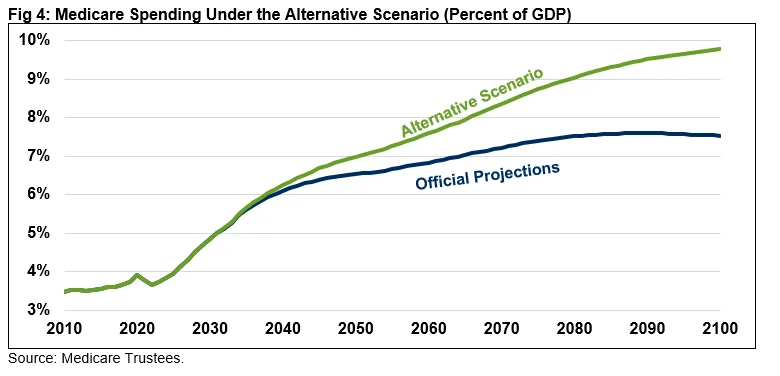
- Medicare’s outlook may be worse than projected. Under the Chief Actuary’s alternative scenario, Medicare spending will rise much faster, to 9.8% of GDP in 2100 compared to projected 7.5% of GDP, and the 75-year HI shortfall would total 1.38% of payroll compared to 0.56% of payroll.
This year’s Trustees’ report reflects what we have long known: the Medicare program is on an unsustainable and costly path. Fortunately, the large amount of waste in the Medicare program provides opportunity to lower costs for the government and beneficiaries alike. Policymakers should act now on common-sense reforms and trust fund solutions to lower the cost of traditional Medicare and Medicare Advantage and to generate revenue or premiums to avoid trust fund insolvency and put Medicare on a sustainable path.
Medicare Hospital Insurance Trust Fund Could be Insolvent by 2033
The Medicare HI trust fund, or Medicare Part A, finances inpatient hospital care. The funding comes mainly from a 2.9% payroll tax on wage income. Currently, the trust fund has about $250 billion in reserves and is projected to run small surpluses this year. Looking forward, the Trustees project the program will quickly draw down its reserves, running out of funds in 2033.
Upon insolvency, payroll taxes would only be able to cover 89% of costs, resulting in an automatic 11% payment cut. That cut would grow to 16% by 2040, likely leading to a large disruption of services for seniors and individuals with disabilities who rely on Medicare.
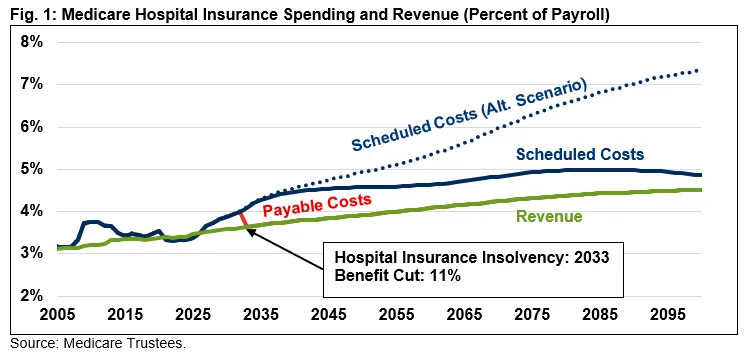
On an annual basis, the Trustees project current modest HI surpluses will turn into deficits of 0.45% of payroll (0.2% of GDP) by 2033 and 0.71% of payroll (0.3% of GDP) by 2043, before shrinking to 0.35% of payroll (0.2% of GDP) by 2100. Over the full 75-year window, the HI trust fund faces a 0.56% of payroll (0.2% of GDP) funding gap. Under the Chief Actuary’s alternative scenario (discussed below), the gap will total 1.38% of payroll (0.6% of GDP).
This gap is driven by rising spending, due to population aging and growing health care costs. HI costs have grown from 2.63% of payroll in 2000, to 3.49% of payroll in 2026 and are set to grow to 4.33% of payroll by 2036 before peaking at 4.99% of payroll in 2085 and slowly declining to 4.86% of payroll in 2100. On the other hand, revenue has grown from 3.11% of payroll in 2000 to 3.49% of payroll in 2026 and is projected to grow to 4.51% of payroll in 2100.
Restoring solvency would require the equivalent of increasing the HI payroll tax rate by 19% (0.56 points) or reducing hospital spending by 12%. Under the Chief Actuary’s alternative scenario, restoring solvency would require raising the HI payroll tax by half (1.4 points) or reducing spending by a quarter.
Medicare Costs are High and Rising
The total gross cost of Medicare – Parts A, B, and D – has grown significantly over the past quarter century, rising from 2.2% of GDP in 2000 to 4.1% of GDP in 2026. The Trustees project continued growth in all parts of the program, growing to 6.5% of GDP in 2050 and to 7.5% of GDP in 2100.
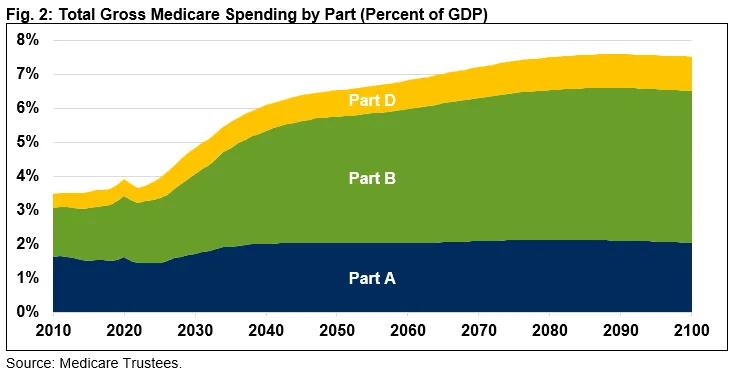
Medicare Part B costs are projected to grow from 2.0% of GDP in 2026 to 3.7% of GDP in 2050 and 4.5% of GDP in 2100. Medicare Part A costs are projected to rise somewhat more slowly, from 1.5% of GDP in 2026 to about 2.0% of GDP in 2050 and beyond. Medicare Part D prescription drug costs are projected to rise from 0.7% of GDP in 2026 to 1.0% of GDP in 2100.
A significant source of spending growth in the Medicare program is Medicare Advantage (MA). MA is the privately managed, government funded alternative to traditional Medicare. MA now covers 51% of Medicare beneficiaries, set to grow to 56% in 2035. As we have discussed previously, the MA program is significantly overpaid as compared to Traditional Medicare, in part through a mechanism known as upcoding. Total spending on the MA program is set to grow from 1.8% of GDP in 2026 to 2.8% of GDP in 2035.
There are plenty of options for lawmakers to utilize to reduce high and rising Medicare spending, many of which come from our Health Savers Initiative. Some options include adopting site-neutral payments in Medicare, reducing MA overpayments, improving the MA quality bonus program, reforming cost-sharing rules, reducing excessive hospital payments, and lowering the cost of prescription drugs both for Parts B and D. Lawmakers could also generate more revenue to fund Medicare, including by broadening the payroll tax base to account for what employers pay in compensation for health care and other fringe benefits.
Medicare’s Outlook has Deteriorated Since Last Year
The financial outlook of the Medicare program has significantly worsened since last year’s report, as the projected HI trust fund shortfall has grown by 33% and gross Medicare costs by up to 13%.
While the projected HI insolvency date of 2033 is the same year as last year’s projection, the 75-year shortfall is now 0.56% of payroll, up from 0.42%, and deficits now persist through 2100.
The largest contributors to the expanded shortfall include revenue loss from lower taxation of Social Security benefits resulting from OBBBA, reductions in the estimated number of workers due to lower immigration and fertility, and higher expected Medicare Advantage costs, as well as higher projected spending on hospitals, skilled nursing facilities, and certain other providers under Traditional Medicare.
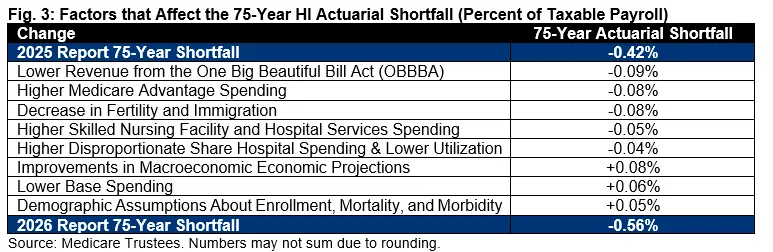
Partially offsetting these effects, the Trustees have observed and integrated into their projections lower near-term Medicare spending and also project stronger economic productivity along with cost-reducing changes to assumed enrollment, mortality, and morbidity.
For many of the same reasons that the HI trust fund outlook has worsened, the Trustees also project overall Medicare costs to grow faster as a share of GDP over the next 75 years. While they still expect gross Medicare spending to total about 4.3% of GDP in 2027, the Trustees now project it to grow to above 7.5% of GDP by 2099 instead of 6.7% of GDP – a 13% increase.
The largest upward cost revision is in Medicare Part D, the prescription drug program. The Trustees now project Part D costs to exceed 1.0% of GDP by 2099, a 58% increase from last year, due largely to increases in expected use of GLP-1 weight loss drugs and expensive specialty drugs along with lower expected rebates, a higher cost of benefit redesign, and other cost trends.
Meanwhile, spending on Medicare Part A is now projected to total 2.0% of GDP in 2099, a 9% increase from previous projections of 1.9% of GDP. And despite some near-term reductions due to pricing reforms around skin substitutes, the Trustees now project Part B costs to rise to 4.5% of GDP in 2099, a 7% increase from their previous 4.2% of GDP projection.
Medicare’s Overall Outlook is Significantly Worse Under Alternative Scenario
The Medicare Trustees’ official projections are based on currently scheduled payment rates. However, it is unclear whether these rates will remain in effect over the next few decades as the cost of providing care may continue to rise faster than payment rates and policymakers have already been enacting regular increases to physician payment rates.
Each year the Medicare Actuary provides an alternative scenario that assumes provider payments eventually begin to grow at a rate more consistent with underlying medical costs. In this alternative scenario, gross Medicare costs grow from 4.1% of GDP today to 7.0% of GDP in 2050 and continue to grow to 9.8% of GDP in 2100, compared to 7.5% of GDP under current law.
Specifically, Part A costs would grow to 3.1% of GDP by 2100 under the alternative scenario, as compared to 2.0% in the official projections. Part B would grow to 5.7% of GDP in 2100 under this alternative scenario, whereas official projections show Part B growing to 4.5% of GDP in 2100. Part D costs do not differ between the official projections and the alternative scenario.
Due to the higher spending on Part A, the HI funding gap would be almost 2.5 times larger than under official projections – 1.38% of payroll (0.6% of GDP) as opposed to 0.56% of payroll (0.2% of GDP). Whereas, under the official projections, HI spending and revenue would face a 0.35% of payroll deficit in 2100, the program would face a 2.8% of payroll deficit in that year under the alternative scenario.
Conclusion
The Medicare Trustees project that the HI trust fund will be insolvent in just seven years. Upon insolvency, payments under the law would be cut by 11% – less than a year after seniors face a 22% Social Security cut – jeopardizing access to care. Over 75 years, the trust fund faces a large 0.56% of payroll shortfall.
The long-term outlook for Medicare as a whole is similarly dire, with gross costs projected to nearly double from 4.1% of GDP this year to 7.5% of GDP by 2100. Under the Chief Actuary’s alternative scenario, the outlook is far worse, with HI facing a 1.38% of payroll shortfall and total Medicare costs rising to 9.8% of GDP.
Medicare’s outlook is also significantly worse than last year, with the HI shortfall up 33% and overall costs projected to be 13% higher by 2099 than projected last year.
With the national debt now the size of the economy and interest costs continuing to rise, this news could not come at a worse time.
Policymakers should work quickly to make changes to reduce the projected cost of Medicare and ensure it is adequately funded. Thoughtful solutions can help reduce spending for the federal government and for beneficiaries in the program.
Fortunately, policymakers have plenty of options available to slow Medicare spending growth through lowering the overall cost of the program, reducing wasteful spending, removing inefficiencies, and improving incentives for providers and beneficiaries alike.
Lawmakers should adopt changes sooner rather than later to get overall health spending under control and ensure adequate revenue so that the Medicare program can continue to serve its beneficiaries over the long run without interruption.