New Approaches to Social Security Benefit Taxation
Social Security’s retirement fund is on course to go insolvent in just six years; a few months later, Medicare’s Hospital Insurance (HI) trust fund is projected to be exhausted. Upon insolvency, beneficiaries will face an abrupt 22% cut in retirement benefits and access to health care will come under threat. Prompt action is needed.
Social Security and Medicare HI are both financed primarily through payroll taxes. Since 1984, the partial income taxation of Social Security benefits has provided additional revenue to fund both programs. Depending on one’s household income, up to 85% of a person’s Social Security benefits may be subject to the income tax, with taxation of the first 50% of those benefits going to fund Social Security and up to 35% to Medicare. These taxes generated $99 billion in 2025 – 5% of dedicated revenue. By 2100, they are projected to generate 10% of dedicated revenue.
The decision to partially subject benefits to income taxation was meant to improve “tax neutrality” between types of income while also serving as a form of Social Security partial means test. However, the current design is in some ways flawed, and some have called for reducing or repealing taxation of benefits.1 Through 2028, seniors are also eligible for a special deduction meant to mitigate benefit taxation.2
Unfortunately, even partial repeal of benefit taxation would prove costly to Social Security’s and Medicare’s already beleaguered trust funds. Full repeal would worsen Social Security’s 75-year solvency gap by one-fifth and would double Medicare’s gap. Meanwhile, reforming or expanding taxation of benefits could achieve many of the goals of repeal and do so while improving trust fund solvency.
In this Trust Fund Solutions Initiative white paper, we offer several options to change taxation of Social Security benefits. These options would:
- Streamline Taxation of Benefits
- Expand Taxation of Benefits
- Support Progressive Benefit Taxation
- Replace Taxation of Benefits
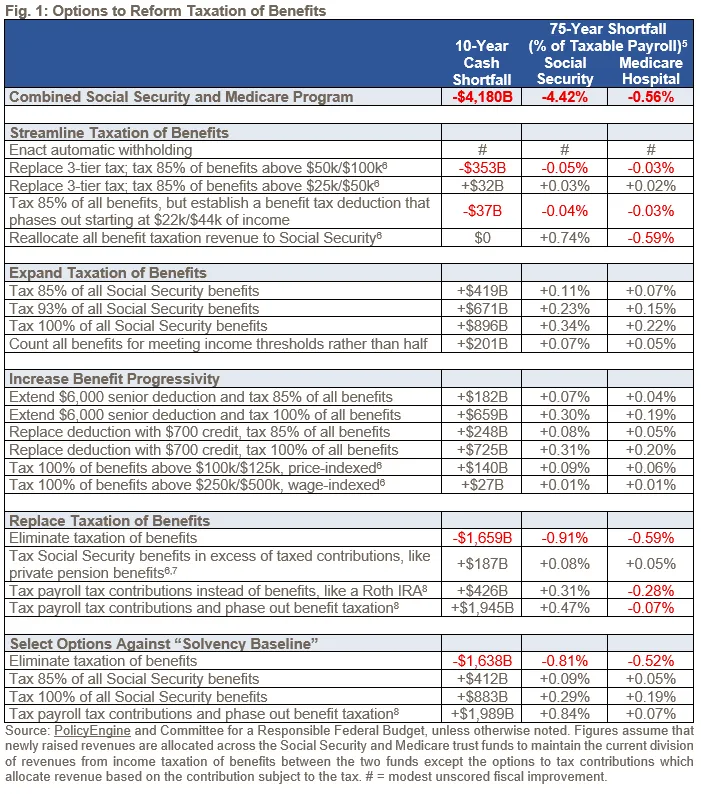
Based on existing estimates and new estimates modeled by Max Ghenis of PolicyEngine (see their Interactive Dashboard),3,4 the most aggressive of these options would generate up to $2 trillion over a decade while closing 10% to 20% of Social Security’s 75-year funding gap and up to 13% of Medicare’s. The next largest option would close 8% of Social Security’s solvency gap and 39% of Medicare’s. Many of these options would also improve neutrality, efficiency, and equity.
Summary Table
Over 75 years, Social Security faces a 4.4% of taxable payroll gap, while HI faces a 0.6% of payroll gap. Below, we show the impact of each option assuming revenue is allocated proportionally to current law. Appendix V shows the share of each shortfall closed, including under alternative allocations. The PolicyEngine Interactive Dashboard shows year-by-year details.
Benefit Taxation Is an Important Though Flawed Source of Trust Fund Revenue
Prior to 1984, Social Security benefits were fully exempt from the federal income tax (see Appendix I for the history of benefit taxation). This exemption treated Social Security income more favorably than earned income or other forms of retirement income.9
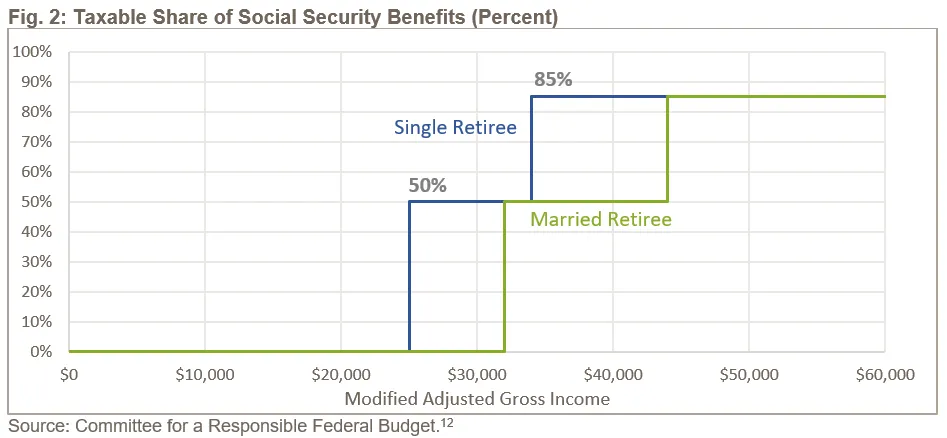
As a result of the Social Security Amendments of 1983 and the 1993 Omnibus Budget Reconciliation Act, benefits are taxed with a three-tier system. Up to $25,000 ($32,000 for couples) of income, benefits are untaxed; above that, 50% of Social Security benefits are taxable up to $34,000 ($44,000 for couples) in income; above that, 85% are taxed. Half of Social Security benefits count toward calculating those income thresholds.10 Revenue from the taxation of the first 50% of Social Security benefits is deposited into the Social Security trust funds, while the incremental revenues from the last 35% go to HI.11 Medicare benefits remain completely untaxed.
Less than half of seniors currently pay any income taxes on benefits, and of those who do, many pay little in overall taxes.13 This is in part due to the thresholds for taxation, but also the progressive structure of the income tax. Most seniors enjoy an effective “zero rate” on their first $24,150 ($47,500 for couples) of income (only counting half of Social Security income) due to the $16,100 ($32,200) ordinary standard deduction, the $2,050 ($3,300) additional standard deduction for those over 65, and a further $6,000 ($12,000) deduction for most seniors available through 2028 under the One Big Beautiful Bill Act (OBBBA).14 The next $50,400 ($100,800) is taxed at 10% or 12% – meaning most Social Security income that is taxed faces an effective rate of 5% to 10.2%.
In part because benefit taxation thresholds are frozen, taxation of benefits has been generating increasing amounts of revenue over time, playing a larger role in Social Security’s and Medicare’s finances. Revenue from benefit taxation has grown from 0.08% of GDP in 1985 to 0.32% in 2025 and is projected to reach 0.66% by 2100. As a share of trust fund revenue, benefit taxation has grown from 1% in 1985 to 5% today and is projected to double to 10% by 2100.15
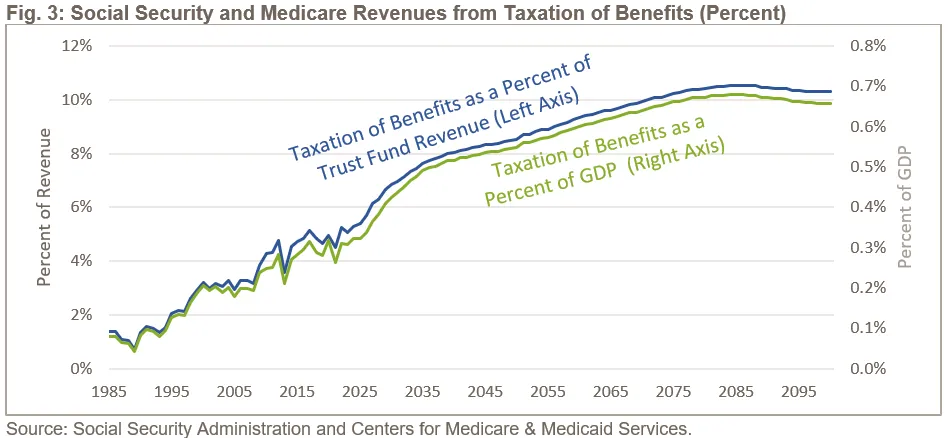
This revenue is vital to Social Security and Medicare. If benefit taxation were repealed, Social Security’s theoretically combined trust funds would be insolvent two years earlier and its 75-year shortfall would grow from 4.4% to 5.3% of payroll; Medicare HI’s insolvency date would advance four years and its long-term gap would double from 0.6% to 1.2% of payroll (see Appendix II).
Taxation of benefits was recommended by the 1979 Social Security Advisory Council as a way to improve tax neutrality: 85% was believed to be the approximate share of Social Security income that has not already been subject to tax for high-income earners.16 At the time of the 1983 reforms, bipartisan support for taxation of benefits was also rooted in the ability of Democrats to describe the policy as expanding progressive taxation and the ability of Republicans to describe the policy as a partial “means test” of benefits for seniors with high current earnings.
However, the current benefit taxation regime is not without its flaws. The phase-in of taxation produces far higher effective marginal tax rates than implied by the income tax schedule alone.17 For example, once the phase-in for taxing 85% of benefits begins, each $1 of additional income from work faces an effective marginal tax rate 85% higher than the statutory rate – over 40% (52% including payroll taxes) for someone at the 22% bracket. These high marginal tax rates are particularly harmful because the older workers who can collect Social Security are flexible in how they realize income and especially sensitive to incentives around the decision to work and retire.18
The formula for determining taxable benefits is also complicated and confusing: two sets of income thresholds are used to determine taxable benefits; the definition of income used is not consistent with other income definitions; and the partial inclusion of benefits themselves or determining whether benefits should count as income is in some ways circular.19 This complexity increases the difficulty of estimating tax liabilities, leading to mistakes and surprise tax bills, tax avoidance and evasion, higher compliance costs,20 and a variety of economic distortions.21 The three-tier partial taxation system also falls far short of achieving true tax neutrality.22
Options to Streamline Taxation of Benefits
Social Security’s three-tier benefit taxation is complex, confusing, difficult to navigate, and in some ways arbitrary. Some options to simplify and streamline benefit taxation include:
- Impose automatic withholding. The complexity of benefit taxation makes it difficult for seniors to predict how much they will owe at tax time – a phenomenon likely worsened by recent (false) claims that taxation of benefits has been eliminated.23 In many cases, this can leave seniors with ‘surprise’ tax bills; in others, seniors who owe taxes won’t file at all. Although beneficiaries can request the withholding of income taxes from their Social Security benefits, such withholding is neither required (as it is with wage income) nor automatic.24 Policymakers could make withholding automatic with an opt-out or even make it mandatory. Not only would this reduce surprise tax bills, but it would likely marginally improve Social Security’s and Medicare’s finances by reducing unpaid taxes.25
- Establish a single taxation threshold. Most of the complications and distortions associated with taxation of benefits come from the four different income thresholds ($25,000, $32,000, $34,000, $44,000) that phase in how much of Social Security benefits are taxed, in part based on half the value of those benefits themselves. The thresholds also create a ‘marriage penalty.’ The 2015 version of the Social Security 2100 Act proposed to simplify this by setting a single threshold of $50,000 for singles and $100,000 per couple, above which 85% of benefits would be taxed. Although this would reduce revenue, similar thresholds at around $25,000 and $50,000 would likely be close to solvency neutral.
- Rationalize the taxation formula. Rather than a three-tiered system that taxes different shares of Social Security benefits as income, a more streamlined option would include most or all benefits as income and then establish a deduction to address distributional concerns. As an example, the 2005 National Tax Panel proposed counting 85% of all Social Security benefits as income while establishing a deduction equal to the value of those benefits, with the deduction starting for income above $22,000 ($44,000 per couple).26
- Reallocate revenue from taxation of benefits. Under current law, taxation of the first 50% of Social Security benefits goes to the trust fund from which they are paid (taxation of disability benefits goes to the disability trust fund) and taxation of the remaining 35% of benefits goes to Medicare’s HI trust fund. These allocations are arbitrary and could be adjusted. In the 1990s, several plans proposed to reallocate Medicare’s share of benefit taxation back to Social Security.27 More recently, a proposal by Primus, Watson, and Smalligan would also transfer all past taxation of benefits revenue from Medicare to Social Security. While these proposals would meaningfully strengthen Social Security solvency, they would, absent other changes, hurt Medicare as much as they help Social Security – doubling Medicare’s shortfall and advancing insolvency four years if done prospectively or immediately putting Medicare $500 billion in debt if enacted retrospectively. Reallocation should thus only be done in the context of a plan to strengthen both trust funds.
Options to Expand Taxation of Benefits
Although taxation of Social Security benefits is intended to create a more neutral tax system – treating Social Security benefits and taxes like other types of income and taxing all income exactly once – the current system falls far short of this goal. The three-tier tax system also creates additional distortions by partially taxing benefits based on income, which effectively creates a second layer of taxation that boosts marginal rates. As a result of the taxation thresholds, some middle-class seniors face an effective marginal tax rate above 50%.28 Interestingly, expanding taxation of Social Security benefits can help address some of these harmful incentives while improving neutrality and equity and raising new revenues. Some options include:
- Tax 85% of all Social Security benefits. Principles of efficient taxation suggest income should be taxed exactly once, meaning any benefits not taxed at the point of contribution (via payroll taxes) should be counted as income.29 The decision to tax 85% of benefits for seniors making above $34,000 ($44,000 per couple) was based on the desire to move toward neutrality and tax benefits progressively, given the finding that typical high-earning beneficiaries already paid tax on 15% of their benefits through the post-tax employee share of payroll taxes. However, the income tax schedule is already quite progressive, and partial exemptions from benefit taxation actually weaken efficient and neutral taxation. These income thresholds also produce very high effective marginal tax rates around the phase-in – in some cases over 50% – at ages when workers are most sensitive to incentives around work, retirement, income realization, and benefit claiming.30 Research finds the thresholds discourage work and encourage tax avoidance.31 Taxing 85% of all benefits would improve tax neutrality and remove spikes in effective marginal rates while maintaining progressive taxation and improving solvency.
- Tax 90%+ of all Social Security benefits. Although the Social Security Administration estimated that 85% of the benefits of higher income seniors had never been taxed, the same estimate found that an average of 93% of benefits had never been taxed among all seniors. Taxing 93% of all benefits would thus maximize tax neutrality, on average, ensuring that on average all income is taxed once and only once. A smaller share of benefits could be taxed to reduce the number of individual beneficiaries facing slightly excessive taxation, or a larger share could be taxed to the extent benefit taxation also serves as a “means test.”32
- Expand income definition for taxing Social Security benefits. The share of Social Security benefits subject to taxation depends on retirees’ Modified Adjusted Gross Income (MAGI), which equals the sum of taxable non-Social Security income, tax-exempt interest, and 50% of Social Security benefits. Because the thresholds are meant to reflect ability to pay – and to avoid circular calculations of income – the MAGI definition would be improved if it included all Social Security benefits. This change would hasten the phase-in of benefit taxation. A more aggressive approach could count Social Security as income for other purposes.33 In addition to boosting Social Security and Medicare revenue, these options could generate savings elsewhere due to other provisions that depend on MAGI.34
Options to Increase Benefit Taxation Progressivity
The current income thresholds for benefit taxation provide a poorly designed and inefficient way to make Social Security benefit taxation more progressive than the tax code as a whole. The $6,000 per senior bonus deduction from OBBBA provides some relief, but it is to some degree redundant with existing rules, expires in 2029, and would be costly to continue without offsets. Progressivity can be achieved more efficiently while generating more overall revenue for Social Security and Medicare. Some options include:
- Permanently extend the bonus senior deduction while expanding taxation of benefits. OBBBA enacted a temporary bonus senior income tax deduction equal to $6,000 per person age 65 or older, phased out at higher income levels, that is set to expire in 2029. While this policy did not eliminate taxation of Social Security benefits, it lowered tax burdens on Social Security beneficiaries. It is also projected to cost the federal government, including the trust funds, $23 billion per year. Extending the deduction on its own would significantly worsen deficits and trust fund solvency. However, combining an extension of the deduction with an expansion of taxation of benefits – for example, by subjecting 85% or 100% of all benefits to taxation – would improve trust fund solvency while maintaining the tax break for many middle-income seniors.
- Replace the bonus senior deduction with a tax credit while expanding taxation of benefits. Although the temporary $6,000 bonus senior deduction from OBBBA phases out starting at $75,000 of income ($150,000 for couples), it delivers larger benefits to higher earners up to (and somewhat beyond) that phase out, since deductions are worth more at higher income brackets. For example, the deduction is worth $600 for someone paying in the 10% bracket and $1,320 for someone paying at the 22% bracket. The current senior deduction also applies against non-Social Security income, counter to its stated purpose. One option to address these concerns would be to replace the deduction with a $700 non-refundable tax credit against taxes owed on benefits. In combination with expanding taxation of benefits to remove income thresholds, this option could ensure revenue is generated in a more targeted way.
- Increase taxation of benefits at a higher income threshold. Taxation of benefits could be used as a tool to slightly means test Social Security benefits among higher income retirees, going beyond neutral taxation, to improve solvency and increase progressivity. For example, the Bipartisan Policy Center’s 2016 Commission on Retirement Security and Personal Savings proposed raising the share of benefits that are taxed to 100% for beneficiaries with incomes above $250,000 ($500,000 for couples). More recently, Primus, Watson, and Smalligan proposed taxing 100% of benefits for beneficiaries with over $100,000 in income ($125,000 for couples).35 These options have the benefit of raising new revenues from higher incomes retirees, increasing the Social Security system’s overall progressivity.
Options to Replace Taxation of Benefits
To address concerns related to taxation of benefits, some have proposed scaling back or repealing the current benefit taxation structure. Fully repealing taxation of benefits without a replacement would reduce revenue funding Social Security and Medicare trust funds by $1.7 trillion over ten years and substantially worsen the financial outlook of both programs. We estimate this change would expand Social Security’s 75-year shortfall by 20% and advance the insolvency of the theoretically combined Social Security trust funds by two years from 2034 to 2032. Full repeal of benefit taxation would more than double the Medicare HI shortfall and advance its insolvency by four years from 2033 to 2029. See Appendix II for details.
As a matter fiscal prudence and tax efficiency and fairness, and to protect Social Security and Medicare from deeper cuts, any proposal to repeal the current partial taxation of benefits should be accompanied by a plan to replace the lost funds. The most efficient option would be to replace the current structure with one that taxes all income exactly once. Some options include:
- Tax benefits like a private pension. The 1983 Greenspan Commission considered an option to make benefits tax free until cumulative benefits reach cumulative post-tax contributions and count all subsequent benefits as income. An alternative design proposed by Warshawsky in 2008 would be to effectively annuitize post-tax payroll contributions based on life expectancy and establish an annual deduction or exclusion above which benefits are taxed. These options would ensure all income is taxed exactly once and improve Social Security’s and Medicare’s solvency.
- Tax contributions instead of benefits, like a Roth account. An alternative option would end taxation of benefits and instead treat all payroll tax contributions as income. Specifically, the 7.65% employer payroll tax contributions to finance Social Security and Medicare could be counted as income for tax purposes, with revenue dedicated to their respective trust funds.36 This option would tax Social Security and Medicare more like a Roth IRA or Roth 401(k) and would do so along consumption tax principles by being neutral with respect to when income to or from Social Security benefits is consumed.37 To avoid paying a windfall to current beneficiaries who pay neither the contribution nor benefit tax, benefit taxation could be phased out gradually. This approach would generate meaningful solvency improvements in the first few decades, when additional resources are vital for averting near-term insolvency. Those improvements would be significantly larger and more sustained if enacted in combination with other reforms to bring Social Security’s and Medicare’s costs and revenues in line. Appendix III describes this proposal in more detail.
Taxation of Benefits Reforms Can Improve Solvency
Thoughtful reforms to improve or repeal and replace taxation of benefits could help some to improve Social Security and Medicare HI solvency, as illustrated in our summary table.
For Social Security – assuming revenue is allocated in the same proportion as current law – taxing 85% of all benefits would close 2% of the 75-year shortfall, taxing 93% would close 5%, and taxing all benefits would close 8%. Meanwhile, taxing Social Security benefits in excess of post-tax contributions, like a private pension, would close 2% of the shortfall.
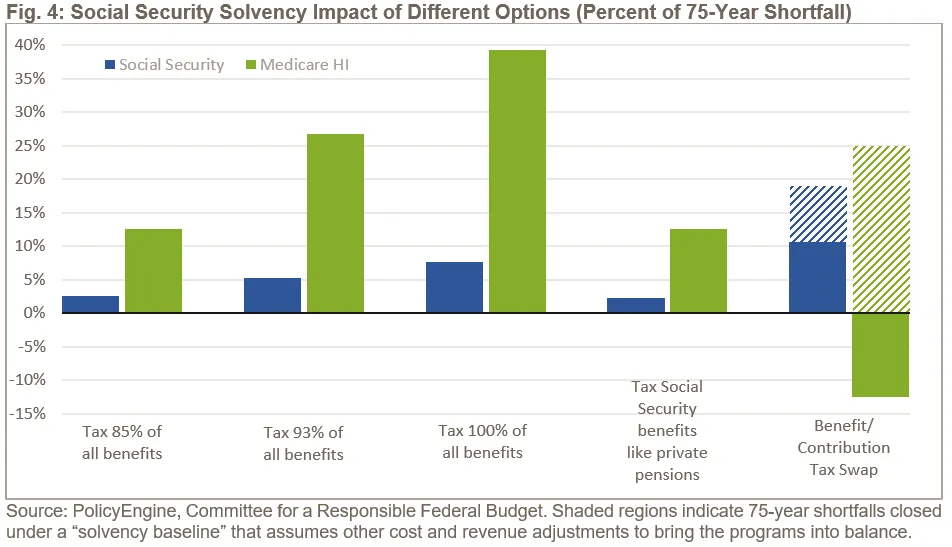
For Medicare, these reforms would close an even larger share of its solvency gap, largely because of Medicare HI’s smaller long-term imbalance. Taxing 85% to 100% of all benefits, for example, would close one-eighth to two-fifths of the HI shortfall. Taxing Social Security benefits in excess of post-tax contributions, like an ordinary pension, would close one-tenth of the shortfall.
Taxing contributions instead of benefits, like a Roth-style account, could also substantially improve solvency, particularly if existing benefit taxation is phased out gradually. If enacted alone, this policy would close one-tenth of Social Security’s gap while worsening Medicare’s shortfall. If enacted on top of other solvency measures, it could close one-fifth of Social Security’s gap and 13% of Medicare’s. Savings would be frontloaded; over ten years, it would close two-fifths of Social Security’s solvency gap and 90% of Medicare’s gap (see Appendix III).
Although reforms to taxation of benefits would be modest relative to some other reforms, they could be an important element of a larger solvency package (see Appendix IV).
Benefits Taxation Reforms Can Improve Efficiency, Simplicity, and Growth
Reforms to benefit taxation can have a number of important benefits beyond improving solvency.
Changes could improve fairness, efficiency, and neutrality by better adhering to the important tax principle that all income (or consumption) be taxed exactly once. They could also improve simplicity, saving beneficiaries time and money on compliance while reducing tax evasion and avoidance by shrinking incentives for seniors to inefficiently time asset sales and withdrawals.
Reforms could also encourage work and investment by reducing the very high effective marginal tax rates created by the income thresholds for benefit taxation. Because taxable benefits are contingent on income, every dollar of earnings in the benefit taxation region leads to an additional 50 or 85 cents of benefits being taxed, boosting marginal income tax rates to 150% or 185% of their statutory levels. Including payroll taxes, this lifts the effective federal marginal tax rate to above 50% for some seniors or above 60% in several states and localities including all taxes.
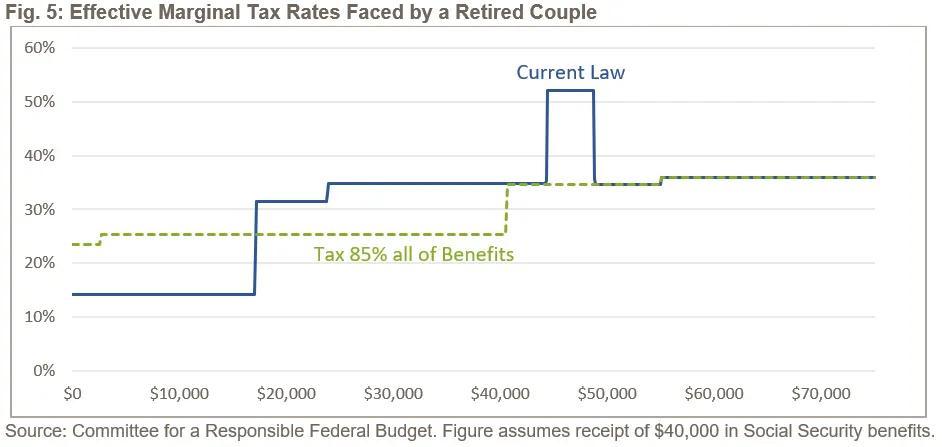
Those old enough to collect Social Security have the most discretion over whether and how much to work, and so such high effective rates can be a strong work disincentive,38 despite the many benefits of continued work in old age.39 Estimates from Tax Foundation and Jones and Li (2018) suggest that simply expanding taxation of benefits to cover 85% of all income would improve labor force participation and output, despite higher taxes, thus strengthening economic growth.40
These and other studies suggest that replacing benefit taxation with taxation of employer payroll contributions would also boost work and investment by shifting taxes onto individuals whose work choices are less sensitive to tax rates and by moving toward consumption tax treatment that makes the tax code neutral with respect to when benefits are paid for and received.41,42 Benefit taxation reforms would also improve economic growth by encouraging more savings and investment as workers prepare for changes in after-tax benefits and by reducing unified deficits and debt relative to baseline projections, which should reduce crowd out of private investment.
Conclusion
With Social Security and Medicare approaching insolvency, trust fund solutions are urgently needed to restore solvency and protect these programs for workers and retirees alike.
Although the current approach of partial income taxation of Social Security benefits has some design flaws that worsen efficiency and complexity, reducing or repealing taxation of benefits would undermine Social Security’s and Medicare’s finances. Ending benefit taxation would cost over $1.7 trillion over the next decade, advance the insolvency of the Social Security and Medicare trust funds, and substantially widen their solvency gaps.
Policymakers should reform rather than end Social Security benefit taxation and do so in a way that strengthens Social Security and Medicare solvency.
Thoughtful reforms could improve simplicity, neutrality, efficiency, predictability, and in some cases progressivity and could do so in a way that supports healthy and productive aging, reduces tax evasion and avoidance, and promotes economic growth.
The options outlined in this paper focus on streamlining and simplifying taxation of benefits, expanding taxation of benefits, preserving progressive benefit taxation, or replacing the current model of taxation of benefits with an alternative tax regime.
Most of the options would also improve the solvency of both Social Security and Medicare, with some providing modest boosts and others more significant improvements. In combination with other reforms (see Appendix IV), these changes could help restore solvency to Social Security and Medicare over the next 75 years and beyond.
The Committee for a Responsible Federal Budget does not endorse any particular solution to restore solvency to Social Security and Medicare. The options presented in this paper should be added to the library of potential options lawmakers consider when crafting a broader reform package. The insolvency of the Social Security and Medicare trust funds are approaching, and trust fund solutions are urgently needed.
Appendix I – History of Taxation of Benefits
Until 1984, Social Security benefits were exempt from the federal income tax. While they were not explicitly excluded from taxation by law, a series of rulings by the Bureau of Internal Revenue in 1938 and 1941 determined benefit payments were non-taxable gifts based on earlier Supreme Court rulings that Social Security was a policy to advance the “general welfare.”43
The favorable tax treatment of Social Security benefits was gradually followed by considerations of reform. The 1979 Advisory Council on Social Security, for example, wrote that benefits should be taxed more like private pensions, where benefits exceeding workers’ cumulative nominal contributions would be subject to income tax. Due to suspected administrative challenges, however, the Council argued “rough justice” would be done by taxing 50% of benefits.44
In 1981, when Social Security’s retirement fund was nearing insolvency, President Reagan and Congressional leaders appointed the National Commission on Social Security Reform, informally known as the Greenspan Commission, to devise a set of solvency solutions.45 In the agreement that emerged from its work, the Greenspan Commission recommended taxing a portion of Social Security benefits like the 1979 Council. Subsequently, Congress subjected up to 50% of Social Security benefits to taxation for individuals with $25,000 ($32,000 for couples) in income and earmarked those revenues to the Social Security trust funds.
In the following decade, President Clinton, acting on internal research from the Social Security Administration that found the highest earners contributed 15% of lifetime benefits in post-tax lifetime nominal payroll taxes, proposed expanding taxation of Social Security benefits from 50% to 85% of payments in his Fiscal Year 1994 budget proposal. In the 1993 Omnibus Budget Reconciliation Act that subsequently became law, up to 85% of benefits were made taxable for beneficiaries with incomes above $34,000 ($44,000 for couples), with the incremental revenues from the reform allocated to the Medicare Hospital Insurance (HI) trust fund.46
Since 1993, the rules governing benefit taxation have remained largely constant: up to 50% of Social Security benefits are taxable for beneficiaries with $25,000 ($32,000 for couples) in income and up to 85% are taxable for those with $34,000 ($44,000 for couples) in income. These thresholds are not adjusted for inflation or wage growth, remaining fixed in nominal terms from year to year.47 Likewise, the allocation of revenues to the Social Security and Medicare trust funds continues as originally prescribed in the 1994 law.48
While the rules governing benefit taxation have not changed since 1993, other policy changes have been made that indirectly affect it. Several increases in the overall standard deduction over the years, along with an additional senior standard deduction, have reduced the number of seniors subject to income tax. A temporary bonus senior deduction from the 2025 One Big Beautifull Bill Act grants an additional $6,000 deduction ($12,000 for couples) to those age 65 and up, phased out above $75,000 ($150,000 for couples) of income. This deduction modestly reduces revenue from benefit taxation and more significantly reduces total taxes paid by seniors.
Appendix II – Repealing Taxation of Benefits Would Threaten Solvency
Rather than working to fix the flaws in the current taxation of benefits design, some policymakers have called for reducing income taxation of benefits by increasing the income thresholds above which they apply or by repealing taxation of benefits entirely. This would be a costly mistake that would substantially worsen the financial challenges facing both Social Security and Medicare. Repeal would advance the insolvency of Social Security’s retirement fund by over a year to 2031, or by two years to 2032 if theoretically combined with Social Security’s disability fund. The Medicare HI trust fund, meanwhile, would be exhausted four years earlier in 2029.
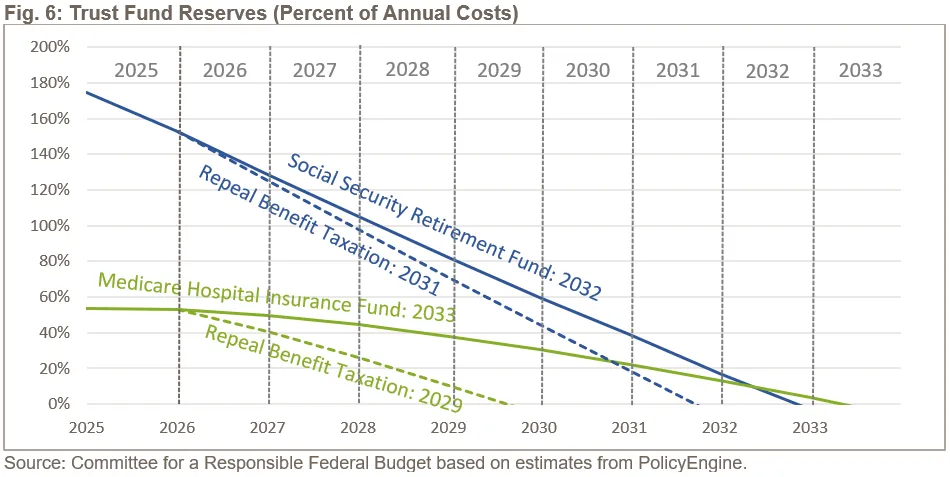
Fully repealing taxation of benefits would reduce total ten-year revenues by $1.7 trillion, according to PolicyEngine, with the Social Security trust funds losing $1 trillion in non-interest income and the Medicare HI fund losing $0.7 trillion. Over 75 years, Social Security’s actuarial deficit would increase by one-fifth, from 4.42% of taxable payroll to 5.33%, while Medicare HI’s would more than double from 0.56% of payroll to 1.15%. By 2035, it would expand Social Security’s required insolvency benefit cut by five percentage points and Medicare’s by ten points.
Repealing taxation of benefits would also amplify Social Security’s unequal tax treatment, worsening tax neutrality and efficiency. And although repealing taxation of benefits would reduce distortions by lowering marginal tax rates for seniors, the higher debt to replace it would likely have larger negative economic effects, and alternative sources of taxation could introduce new distortions. One estimate from the Penn Wharton Budget Model finds that full repeal would reduce output by 0.5% after a decade and 2.1% after three decades.49
Shrinking taxation of benefits could also have significant fiscal and solvency costs and could worsen many of the distortions in the current program by increasing the number of people subject to very high effective marginal rates during the phase in period.50
Appendix III – Taxing Payroll Tax Contributions Instead of Benefits
An efficient income tax code taxes all income exactly once. Because Social Security and Medicare benefits are financed in part by worker payroll tax contributions, and because those contributions are not deducted from income for tax purposes, a portion of benefits are essentially taxed on the front end. However, employer payroll tax contributions do not count as taxable income and are essentially pre-tax.51 Additionally, benefits paid out by Social Security and Medicare significantly exceed the nominal payments put in. To ensure all income is taxed exactly once, a neutral tax code would tax all Social Security and Medicare benefits in excess of taxed contributions.52
An alternative approach to taxing untaxed benefits would be to tax contributions and end taxation of benefits. Whereas expanding taxation of benefits would treat Social Security similar to a private pension, this approach would match treatment of Roth-style retirement accounts and effectively reflect a consumption tax approach.53 We modeled an option to count employer Social Security and Medicare payroll tax contributions as income for income tax purposes, dedicating the revenue to the respective trust funds.54 To limit windfalls to current and newer beneficiaries who pay little or nothing in contribution taxes, benefit taxation would be phased out over 37 years.55
This approach would improve solvency by increasing upfront revenue collection through 2060.56 Enacted on its own, the proposal would raise enough revenue to close two-fifths of Social Security’s ten-year gap and 90% of Medicare’s. Although the policy would reduce long-run revenue – by about 0.1% of GDP by 2100 – it would generate enough upfront revenue to close one-tenth of Social Security’s 75-year funding gap and reduce long-term deficits including interest.
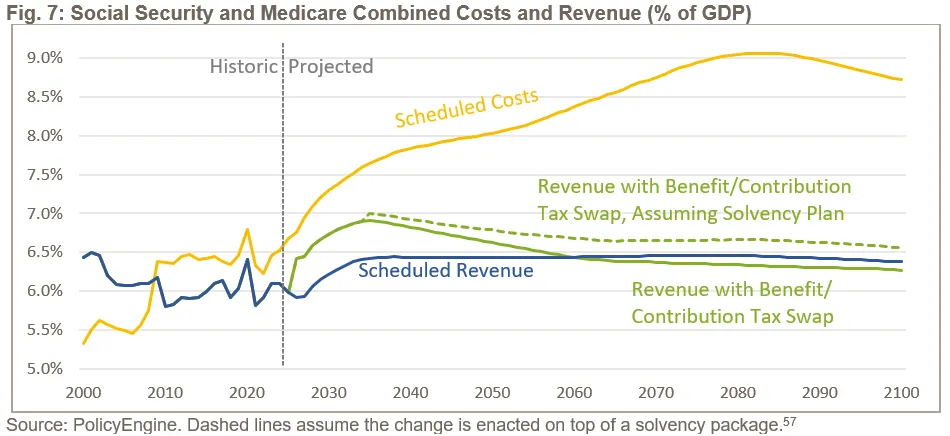
The benefits would be greater and more sustained in the context of a broader solvency plan, since lower benefits reduce the cost of repealing benefit taxation and higher payroll taxes increase revenue from taxing contributions. In this case, the approach would close one-fifth of Social Security’s 75-year gap and one-eighth of Medicare’s while still boosting net revenue through 2100.
Appendix IV – Combining Benefit Taxation Reform with Other Options
Although no reforms to Social Security benefit taxation would be enough to restore Social Security or Medicare solvency on their own, they could be part of a broader solvency package.
Most of the options in this paper would provide ongoing revenue to help fund Social Security and/or Medicare – revenue that could be allocated to the fund most in need (see Appendix V).
We previously released trust fund solutions to replace the employer payroll tax with an Employer Compensation Tax on all compensation and to enact former Congressman Tim Penny’s idea to enact a Flat-Rate Cost-of-Living Adjustment (COLA). Relative to the 2026 Trustees’ baseline, aggressive versions of these changes would close 90% of Social Security’s solvency gap and delay insolvency to around 2090. Also applying income taxes to 93% of all benefits and dedicating all the new revenue to Social Security would be enough to extend solvency for 75 years and beyond.58
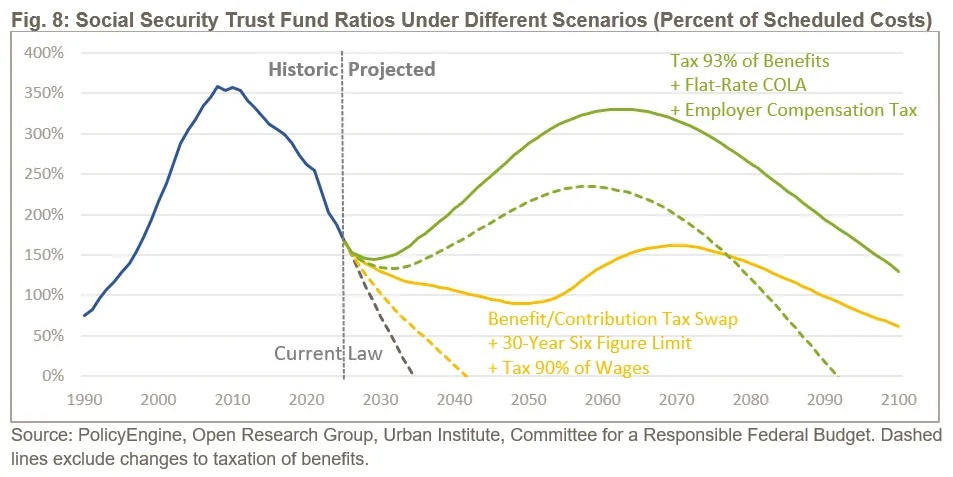
Replacing benefit taxation with taxation of contributions would generate more front-loaded revenue, helping to buy time for other options to be phased in more gradually. Whereas increasing the payroll tax cap to cover 90% of earnings and enacting a 30-Year Six Figure Limit, which caps benefits at $100,000 per couple, would only delay insolvency a few years to 2041, for example, also taxing employer payroll tax contributions and phasing out benefit taxation would be enough to maintain solvency through 2100 and beyond.
These options could also help with Medicare solvency. Taxing 93% of benefits while dedicating all of the revenue to Medicare would be enough to achieve HI 75-year solvency along with policies to slow cost growth by 0.25% per year for 20 years. Dedicating only a proportional share of this revenue to Medicare would achieve solvency if combined with changes to slow cost growth by 0.6% per year for 20 years. Future Trust Fund Solutions papers will put forward ideas.
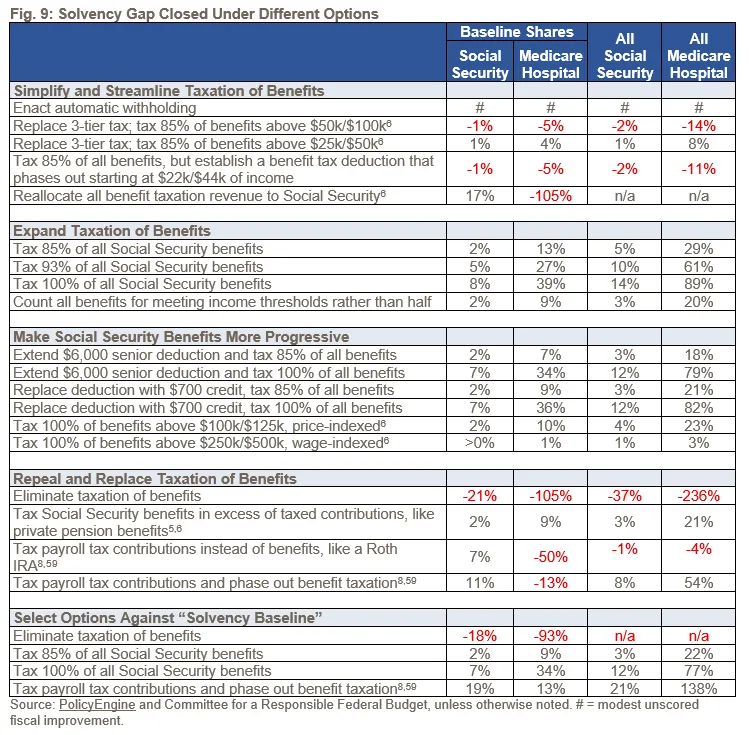
Appendix V – Alt. Summary Table: Shortfall Closed with Different Allocations
The share of the Social Security and Medicare solvency gaps closed by the policies described in this paper depend in part on how the new revenue is allocated across the different trust funds. Our summary table generally maintains “baseline shares” – keeping the revenue proportions the same as under current law – except in the case of taxing contributions. Alternatively, all new revenue could be dedicated to either Social Security or to Medicare, based on their needs. The below table shows what share of gaps would be closed under these allocations. See the PolicyEngine Interactive Dashboard for year-by-year details.
Endnotes
1 “Donald Trump’s Suggestion to End Taxation of Social Security Benefits.” Committee for a Responsible Federal Budget. Jul. 2024; Senior Citizens Tax Elimination Act, H.R. 1040, 119th Congress. (2025); and You Earned It, You Keep It Act, S.2716, 119th Congress (2025).
2 The July 2025 One Big Beautiful Bill Act (OBBBA), in addition to permanently extending reduced income tax rates, made households eligible for a temporary bonus senior deduction equal to $6,000 per adult age 65 or older, phased out above certain income levels. Last year, we estimated that OBBBA’s enactment on the whole would reduce total taxation of benefits by $30 billion per year and advance the insolvency of the Social Security and Medicare trust funds by approximately six months – though this was mostly due to extension of lower tax rates. In this year’s Social Security and Medicare Trustees’ Reports, OBBBA was projected to increase Social Security’s 75-year shortfall by 0.16% of taxable payroll and Medicare Hospital Insurance’s by 0.09%.
3 Social Security Administration. “Provisions Affecting Taxation of Benefits.” Social Security Administration. 2026.
4 The simulations were run by Max Ghenis of PolicyEngine using PolicyEngine’s microsimulation model. Simulations assume a 2026 start date and were aligned with the assumptions of the 2026 Social Security Trustees’ Report. We are enormously grateful to Max Ghenis and the PolicyEngine team for modeling these options and patiently dealing with our many questions. For more information about how PolicyEngine modeled these options, visit PolicyEngine’s Online Dashboard.
5 Social Security and Medicare Hospital Insurance use different definitions of taxable payroll: Social Security’s taxable payroll covers all wages and self-employment earnings below the taxable maximum ($184,500 in 2026) whereas Medicare’s covers all wages and earnings above and below Social Security’s taxable maximum. In 2026, the Social Security Trustees project Medicare’s taxable payroll to be roughly 25% larger than Social Security’s.
6 Committee for a Responsible Federal Budget based on Social Security Administration.
7 This option would tax Social Security benefits like private pensions by taxing all benefits in excess of an established basis – in this case, the cumulative sum of lifetime after-tax payroll tax contributions divided by the unisex life expectancy at benefit eligibility, with those amounts only being deductible for the original years of life expectancy. This option would initially only apply to retirees with incomes above $25,000 in income ($32,000 for couples), with those income thresholds gradually phasing out over 20 years. Importantly, policymakers could enact this option in alternative ways. For example, a similar option, scored by the Congressional Budget Office (CBO), would immediately treat Social Security benefits like private pensions for tax purposes but without an income phase-in. Over ten years, CBO found this option would raise federal revenues by $410 billion.
8 This option allocates revenues according to the trust funds to which the employer contributions are dedicated. The revenue from taxing the first 6.2% of employer contributions is allocated to the Social Security trust funds and the remaining 1.45% is allocated to the Medicare HI fund. Revenue losses from repealing taxation of benefits are attributed to the trust funds to which the taxes on benefits would have been allocated.
9 Ordinary income, like wages, bonuses, rent, and taxable interest, is progressively taxed according to the income tax schedule. Because traditional private pensions are paid for, in part, by ordinary income that has already been subject to tax, the tax code provides for the taxation of pensions of amounts above some “basis” that reflects post-tax contributions. Other forms of retirement income are often taxed on a preferential basis relative to income (though not necessarily consumption). Traditional retirement accounts such as 401(k)s and Individual Retirement Accounts (IRAs) generally allow for tax-free contributions but taxed withdrawals, while Roth-style accounts allow for post-tax contributions with tax-free withdrawals. Most other long-term investments are made post-tax, with returns on investment above basis taxed at a preferential capital gains rate upon withdrawal. With the exception of Health Savings Accounts (HSAs), no source of retirement income is tax-free on both the front and back end, as most of Social Security was prior to 1984.
10 For purposes of determining the share of Social Security benefits subject to income tax, the Internal Revenue Service (IRS) uses a form of Modified Adjusted Gross Income, which equals the sum of a household’s adjusted gross income, tax-exempt interest, foreign income and several other exclusions, and half of its Social Security benefits. For more information, see IRS Publication 915.
11 Whittaker, Julie M. “Social Security: Calculation and History of Taxing Benefits." Congressional Research Service, RL32552. October 2016.
12 Modified Adjusted Gross Income equals the sum of taxable income, tax-exempt interest, foreign income and several other exclusions, and one half of Social Security benefits.
13 Dahl, Molly, “Testimony on Social Security’s Finances” Congressional Budget Office, Publication 62271. March 2026.
14 Because taxation of Social Security benefits is contingent on beneficiaries’ Modified Adjusted Gross Income (MAGI), other tax policies that reduce households’ MAGI amounts allow some retired beneficiaries to reduce or avoid benefit taxation altogether. For example, distributions from Roth Individual Retirement Accounts (IRAs) and Qualified Charitable Distributions from traditional IRAs are not included in MAGI and as a result do not count toward the thresholds that determine benefit taxation.
15 These projections assume the income tax code is adjusted to offset “real bracket creep” where taxpayers get pushed into higher brackets. Specifically, the 2026 Social Security Trustees’ Report assumes that income tax brackets rise with average wages after 2035, rather than with the Chained Consumer Price Index for All Urban Consumers as specified under current law (see Section V.C.7 of the 2026 Social Security Trustees’ Report for more information). Under DYNASIM4, ID1013 projections (which does not assume income tax brackets change from current law) we received from Karen Smith at the Urban Institute, revenue from taxation of benefits will be 37% higher at the end of the century compared to projections from the Social Security Trustees. This could imply taxation of benefit revenue nearly tripling rather than doubling as a share of total revenue over the next 75 years.
16 According to a 1993 unpublished memo from the Social Security Administration’s then Office of the Actuary, the projected ratio of post-tax Social Security payroll contributions to expected benefits for workers starting their careers in 1993 would be 7%, implying 93% of benefits should be taxed to capture all Social Security income. However, the category of workers with the highest estimated ratio – high-income male workers – was 15%, which suggested taxing of 85% of benefits when targeting taxation of benefits on high-income retirees.
17 Viard, Alan D. and Sita N. Slavov. “The Wrong Way to Make Social Security More Progressive.” Tax Notes Federal, American Enterprise Institute. September 2019.
18 Blundell, Richard, Eric French, and Gemma Tetlow. 2016. "Retirement Incentives and Labor Supply." In Handbook of the Economics of Population Aging, vol. 1B, edited by John Piggott and Alan Woodland, 457–566; Alpert, Abby and David Powell. “Tax Elasticity of Labor Earnings for Older Individuals.” Michigan Retirement and Disability Research Center, University of Michigan. Working Paper No. 2012-272. Sep. 2012; and French, Eric. “The Effects of Health, Wealth, and Wages on Labour Supply and Retirement Behaviour.” Review of Economic Studies 72 (2): 395-427. Apr. 2005.
19 The dependence of one definition of income on another definition of income can confuse taxpayers trying to determine their taxable incomes and hence their tax liabilities, increasing the risks of mistakes and the time it takes to complete tax filings. It can also produce horizontal and vertical inequities across retirees depending on the source of their income. For example, a couple receiving around the maximum Social Security benefit of $100,000 would only have 11% of their combined benefits included in their taxable income and face $0 in income tax liability. On the other hand, a couple with the same $100,000 in income but $40,000 in combined benefits and $60,000 in earnings would see the maximum 85% of benefits included in taxable income and owe $5,000 in income taxes.
20 A 2025 Tax Foundation analysis estimated, based on Internal Revenue Service data, that hours spent complying with the federal tax code cost the economy $536 billion in 2024, or 1.8% of Gross Domestic Product.
21 Feldman, Naomi E., Peter Katuščák, and Laura Kawano. “Taxpayer Confusion: Evidence from the Child Tax Credit." American Economic Review 106(3):807-835. March 2016. Abeler, Johannes and Simon Jäger. “Complex Tax Incentives.” American Economic Journal: Economic Policy 7(3):1-28. August 2015.
22 For retirees who have a higher share of benefits taxed than is justified based on the ratio of their post-tax payroll contributions to expected benefits alone, a higher share of benefits is taxed than would be justified according to principles of efficient taxation. The reverse is true for retirees with a lower share of taxable benefits.
23 At a July 2025 rally, President Trump said the One Big Beautiful Bill Act (OBBBA) delivered “no tax on Social Security.” Similar claims have persisted into 2026 despite the rules regarding taxation of Social Security benefits not having been modified directly.
24 Social Security Administration. “The House Passes H.R. 4039 Social Security Miscellaneous Amendments Act of 1996.” Social Security Legislative Bulletin No. 104-33. September 1996.
25 This option would mainly improve Social Security and Medicare finances by improving tax compliance and generating tax revenue from those seniors who do not file their taxes. It would likely further improve federal finances by generating more revenue collection earlier in the year, from which the government would generate some interest savings. These savings would not automatically accrue to the Social Security and Medicare trust funds but could if accompanying reforms increased the frequency with which transfers are made from the Treasury to the trust funds.
26 The 2005 tax panel also proposed indexing these thresholds to inflation. We do not consider or estimate that approach in this paper.
27 Report of the 1994-1996 Advisory Council on Social Security, Social Security Administration. January 1997.
28 Because taxation of Social Security benefits is contingent on other income, including earnings, the current system can sharply increase effective marginal tax rates at the phase-in region of income. For seniors with incomes above the $34,000 (44,000 for couples) income threshold for taxing 85% of benefits, every dollar of earnings increases taxable income by $1.85, meaning that their effective marginal income tax rate lies 85% above their statutory rate. For someone in the 22% income tax bracket, this would mean facing an effective marginal income tax rate of 40.7%. After factoring in payroll taxes, their effective marginal tax rates on earnings would exceed 50%.
29 Auerbach, Alan J. and James R. Hines Jr. “Taxation and Economic Efficiency.” National Bureau of Economic Research Working Paper No. 8181. March 2001.
30 Workers at these ages are also well suited to adjust their reported income through asset withdrawal and realization in response to tax policy.
31 Jones, John Bailey and Yue Li. “The Effects of Collecting Income Taxes on Social Security Benefits.” Journal of Public Economics 159:129-145. Mar. 2018; Reichenstein, William, and William Meyer. 2018. “Understanding the Tax Torpedo and Its Implications for Various Retirees.” Journal of Financial Planning 31 (7): 38–45; and Geisler, Greg, and David Hulse. 2016. “The Taxation of Social Security Benefits and Planning Implications.” Journal of Financial Planning 29 (5): 52–63. May 2016.
32 Even if 100% of benefits were taxed, taxation of benefits would be highly progressive, generating little to no tax burden on lower-income seniors at or below the first tax bracket while applying the highest tax rates only to couples with over $750,000 of annual taxable income. For more information on taxation of benefits as a progressive approach to targeting Social Security benefits, see Goodman, Sarena and Jeffrey Liebman. “The Taxation of Social Security Benefits as an Approach to Means Testing.” National Bureau of Economic Research Retirement Research Center Paper No. NB 08-02. Sep. 2008.
33 For example, an option considered by the 1983 Greenspan Commission would treat Social Security benefits as income for determining retirees’ marginal income tax rates while still excluding benefits themselves from taxation. See Option No. J-5 in Appendix K to the Report of the 1983 Greenspan Commission on Social Security Reform for more information.
34 In addition to Social Security benefit taxation, several other tax expenditure programs and taxes depend on Modified Adjusted Gross Income (MAGI), including the Child Tax Credit, health insurance premium tax credits, several education-related tax credits and deductions, the net investment income tax, and contribution limits to traditional and Roth retirement accounts. By broadening MAGI’s definition, tax expenditures will phase out faster and other taxes rise, increasing total federal revenues.
35 A similar option modeled by the Tax Foundation would tax 100% of Social Security for retirees with over $125,000 in income ($250,000 for couples). Based on their estimates, this option would reduce primary deficits by $100 billion over ten years and reduce debt as a share of GDP by 1 percentage point after 30 years.
36 The majority of revenues raised from taxing employer contributions would be dedicated to the Social Security trust funds because 6.2 percentage points of the combined 7.45 percentage point employer-side payroll tax is currently dedicated to the Social Security trust funds versus the 1.45 percentage points dedicated to Medicare HI. As a result, pairing taxation of employer payroll contributions with a phase-out of benefit taxation would cause net revenues to increase in every year within the 2026-2100 period for the Social Security trust funds while only increasing net revenues into Medicare HI for about 20 years. Importantly, this reform would raise Medicare HI’s revenues at a time when they are most needed to avoid trust fund insolvency and would provide lawmakers with additional time to phase in other reforms to bring the programs into financial balance.
37 An alternative to treating Social Security benefits like Roth accounts is to instead treat them like traditional retirement accounts whereby 100% of benefits are taxed while employees’ currently post-tax payroll contributions become income tax deductible. Assuming this approach is taken for Social Security’s payroll tax and benefits, while Medicare’s HI tax continues to be counted as income on the front end, PolicyEngine estimates this option would worsen combined solvency by about 0.2% of GDP over 75 years (by comparison, full repeal of taxation of benefits would worsen solvency by about 0.55% of GDP).
38 Blundell, Richard, Eric French, and Gemma Tetlow. 2016. "Retirement Incentives and Labor Supply." In Handbook of the Economics of Population Aging, vol. 1B, edited by John Piggott and Alan Woodland, 457–566; Alpert, Abby and David Powell. “Tax Elasticity of Labor Earnings for Older Individuals.” Michigan Retirement and Disability Research Center, University of Michigan. Working Paper No. 2012-272. Sep. 2012; and French, Eric. “The Effects of Health, Wealth, and Wages on Labour Supply and Retirement Behaviour.” Review of Economic Studies 72 (2): 395-427. Apr. 2005.
39 Butrica, Barbara, Karen E. Smith, and C. Eugene Steuerle. 2006. “Working for a Good Retirement.” Urban Institute Discussion Paper 06-03. https://www.urban.org/research/publication/working-good-retirement; Kuhn, Michael and Klaus Prettner. 2022. “Rising Longevity, Increasing the Retirement Age, and the Consequences for Knowledge-based Long-run Growth.” Economica 90 (357): 39-64. https://onlinelibrary.wiley.com/doi/full/10.1111/ecca.12445; Bronshtein, Gila et al. 2018. “The Power of Working Longer.” National Bureau of Economic Research Working Paper 24226. https://www.nber.org/papers/w24226; Patacchini, Eleonora and Gary V. Engelhardt. 2016. “Work, Retirement, and Social Networks at Older Ages.” Center for Retirement Research at Boston College Working Paper 2016-15. https://crr.bc.edu/wp-content/uploads/2016/11/wp_2016-15.pdf; Sewdas, Ranu et al. 2020. “Association Between Retirement and Mortality: Working Longer, Living Longer? A Systematic Review and Meta-Analysis.” Journal of Epidemiology and Community Health 74 (5): 473-480. https://pmc.ncbi.nlm.nih.gov/articles/PMC7307664/; Li, Jiannan, Bocong Yuan, and Junbang Lan. 2021. “The Influence of Late Retirement on Health Outcomes Among Older Adults in the Policy Context of Delayed Retirement Initiative: An Empirical Attempt of Clarifying Identification Bias.” Archives of Public Health 79 (59). https://pmc.ncbi.nlm.nih.gov/articles/PMC8077823/; Banks, James et al. 2025. “The Impact of Work on Cognition and Physical Disability: Evidence from English Women.” Labour Economics 94. https://www.sciencedirect.com/science/article/pii/S0927537125000545.
40 Eliminating the current income thresholds and taxing 85% of all benefits would reduce effective marginal tax rates in some cases by as much 17 percentage points. According to past estimates from the Tax Foundation, this change alone would increase employment by the equivalent of 12,000 full-time workers.
41 Jones (2018) simulated a policy reform that replaced benefit taxation with a budget-neutral increase in the payroll tax rate and found that it would increase aggregate labor supply through an increase in labor force participation among older workers, who tend to have higher labor supply elasticities than younger workers. While a payroll tax increase is not equivalent to an income tax increase (as would occur for many workers if employer payroll tax contributions were made income taxable), for many individuals their effects are qualitatively similar. If benefit taxation were repealed in a deficit-financed way, Felix Reichling of the Penn Wharton Budget Model estimated that it would cause Gross Domestic Product (GDP) to fall 0.5% over ten years and by 2% over 30 years due to the combination of reduced incentives to work and save and the increase in debt and deficits.
42 Carrol, Robert and Alan D. Viard. “Why Tax Consumption?" in Progressive Consumption Tax: The X Tax Revisited. 2012.
43 U.S. Congress, Senate Committee on Finance. “Tax Free Status of Social Security Benefits.” Report to accompany S. Res. 87, S.Rept. 97-135. June 15, 1981.
44 Social Security Administration. “Social security financing and benefits.” Report of the 1979 Advisory Council, pp. 64-65. 1981.
45 “Report of the National Commission on Social Security Reform." National Commission on Social Security Reform. Jan. 1983.
46 Whittaker, Julie M. “Social Security: Calculation and History of Taxing Benefits.” Congressional Research Service, RL32552. October 2016.
47 Due to the general growth in incomes and prices, effectively these thresholds lead to taxation of higher shares of Social Security benefits over time. As a result, the Congressional Budget Office projected in 2015 that income taxes paid on Social Security benefits would rise from 6.5% of benefits in 2014 to 8% in 2024 and then to 9% in 2039. Importantly, these projections were made before the passage of the 2017 Tax Cut and Jobs Act and the 2025 One Big Beautiful Bill Act, which reduced tax liabilities by reducing income tax rates and, in the latter, creating a temporary bonus senior deduction.
48 Revenues from the first 50% of income taxation of Social Security Old-Age and Survivors Insurance (OASI) benefits are credited toward the OASI trust fund while those from the taxation of Social Security disability (SSDI) benefits are credited to the SSDI trust fund. In 2024, over 95% of revenues from taxation of the first 50% of Social Security benefits were credited to Social Security’s retirement fund. Revenues raised from the income taxation of the incremental 35% of Social Security benefits are credited entirely to Medicare’s Hospital Insurance trust fund.
49 Reichling, Felix. “Eliminating Income Taxes on Social Security Benefits.” Penn Wharton Budget Model. Feb. 2025.
50 For example, raising the current income thresholds into one set that phases in taxation of 85% of benefits at $50,000 ($100,000 for couples) would cost $355 billion over ten years, worsen Social Security’s 75-year deficit by 0.05% of taxable payroll, and grow Medicare HI’s shortfall by 0.03% of payroll. While this option would reduce effective marginal tax rates for older workers, it would also increase them for those with incomes that would fall within the phase-in range.
51 Employer payroll tax contributions and one half of Self-Employed Contributions Act payroll tax contributions are deductible as business expenses.
52 Importantly, this issue remains even if one views individual benefits as completely disconnected from individual taxes because the money collected in payroll taxes is used to fund Social Security benefits and thus should be appropriately taxable either when paid in or paid out.
53 A similar idea was first proposed in Emily M. Sunley, Jr. “Employee Benefits and Transfer Payments” in Comprehensive Income Taxation (1977). Sunley proposed that workers pay income taxes on all employee and employer payroll tax contributions. Retirees would be taxed on Social Security benefits in excess of the amortized value of all past tax payments. Another approach proposed by Sylvester J. Schieber and John B. Shoven in their Personal Security Accounts 2000 plan, which was borne out of their work on the 1994-96 Advisory Council on Social Security, would have taxed 50% of final benefits to match the tax treatment of contributions.
54 Importantly, this same approach could be used for unemployment benefits, which are currently taxed when received and financed by an employer-side payroll tax, for workers compensation, and/or for voluntary income-replacement insurance such as disability insurance. In 2018, CBO estimated applying this approach to employer-paid unemployment taxes and workers’ compensation and premium taxes would increase revenues by about 0.1% of GDP in the first decade if this income was also subject to payroll taxation. As with the option we’ve outlined, the net gain would decline over time – though less so, since some of the taxed contributions are not subject to taxes upon withdrawal either.
55 This option would make all employer payroll contributions income taxable beginning in 2026, with the new revenues being credited to the Social Security and Medicare HI trust funds according to the fund to which the contributions are made. Beginning in 2029, once the $6,000 per senior deduction has expired, this option would gradually phase out the taxable share of Social Security benefits, beginning first with the 50% allocated to the Social Security trust funds and then the 35% allocated to Medicare HI. The amount subject to the tax would fall by 2.5% per year, zeroing out the amount paid to the Social Security trust funds by 2048 and the amount paid to the Medicare funds by 2062.
Even with this phase in, many seniors would benefit from tax reductions on their benefits without making commensurate tax payments on their contributions. A fully fair transition would phase out benefit taxation only for new beneficiaries according to the share of their careers spent paying tax on employer payroll contributions. An alternative to both of these approaches would allow workers to decide whether to pay income tax on their and their employers’ payroll contributions or on their benefits received in retirement.
56 Although the front-loaded savings are in part driven by the gradual phase-out of benefit taxation, they are more so driven by the shift from taxing benefits to taxing contributions. Assuming immediate repeal of taxation of benefits, the option would still generate net revenue through 2055 and would be almost exactly solvency neutral across the trust funds over 75 years.
57 Dashed lines reflect changes in revenues compared to a baseline in which both the Social Security and Medicare HI trust funds are made solvent through a generic solvency package beginning in 2035. Specifically, in each year in the 2035-2100 period, the gap between both Social Security’s and Medicare HI’s costs and revenues is closed half through proportional benefit reductions and half through payroll tax rate increases.
58 Absent changes to benefit taxation, changes to Social Security’s scheduled benefits and revenues may aggravate or prolong existing problems with the current system. For example, because taxation of benefits is in part contingent on Social Security benefits, reforms that slow the growth in benefits could push some seniors into the phase-in region of benefit taxation, confronting them with high marginal tax rates on their earnings. Likewise, increases in the payroll tax rate or base could amplify Social Security’s unequal treatment in the tax code by exacerbating the under- or over-taxation of benefits for some retirees. As discussed above, benefit taxation reforms would mitigate these problems and thus strengthen the benefits to other program reforms.
59 For allocations dedicated entirely to one trust fund, this option would credit the net change in revenues that would occur entirely to the trust fund in question while holding the other trust fund harmless.