National Health Expenditures Continue to Rise
The Centers for Medicare & Medicaid Services (CMS) recently released the latest National Health Expenditures (NHEs) projections, estimating health care cost growth both by category of care and amongst Medicare, Medicaid, and private health insurance through 2034. CMS estimates:
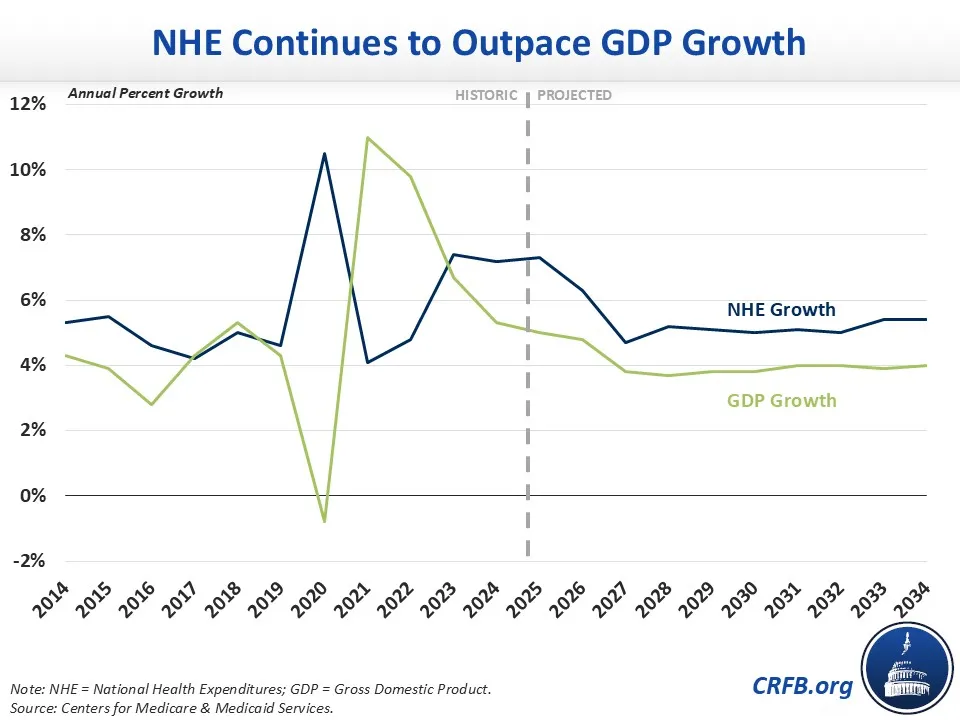
- Health care spending totaled $5.7 trillion in 2025, will grow to $6.0 trillion in 2026, and $9.0 trillion in 2034; as a share of the economy, NHEs would rise from 18.4% of Gross Domestic Product (GDP) in 2025 to 18.7% in 2026 and 20.6% in 2034.
- Near-term increases will be driven by increased utilization and prescription drug spending, while health care price inflation will rise faster than economy-wide inflation through the rest of the decade.
- Insurance coverage will drop somewhat over the course of the decade – from 91.7% of the population in 2025 to 90.5% in 2034 – largely due to decreases in employer-sponsored insurance (ESI) coverage and direct coverage like through the Affordable Care Act (ACA) exchanges.
- Of the largest sources of health coverage – private health insurance, Medicare, and Medicaid – Medicare will grow the fastest over the decade at 7.7% due to both higher enrollment and faster per-person spending growth, while Medicaid and private insurance will grow at 5% each.
NHEs continue to grow faster than both inflation and the economy, growing 7.3% from 2024 to 2025 and projected to grow an average of 5.4% annually from 2025 to 2034. CMS attributes much of the near-term growth in NHEs to estimated increases in utilization and prescription drug spending rather than growth in health care prices. Whereas the NHE price index grew 2.6% in 2025 – similar to the economy-wide Personal Consumption Expenditures price index at 2.6% and Consumer Price Index at 2.6% – real, inflation-adjusted health care spending grew 4.5%. CMS estimates this trend to reverse over the decade, with health care prices growing somewhat faster than economy-wide inflation. Over the decade, spending on home health care, personal care, and prescription drugs will rise fastest among health costs.
In terms of health care coverage, CMS expects that the insured rate will drop somewhat over the coming years largely due to reductions in Medicaid and ACA exchange enrollment – the two largest factors influencing this change in the near term being the Medicaid provisions in the One Big Beautiful Bill Act (OBBBA) and the expiration of the enhanced ACA subsidies. By 2034, CMS expects Medicaid enrollment to totally recover while ESI enrollment will decline, Medicare coverage continues to grow with the aging population, and the uninsured hold steady. However, overall coverage rates will still hold at around 90% over the decade.
CMS projects that Medicare will experience the highest spending growth from 2025 to 2034 amongst the three major payers (Medicare, Medicaid, and ESI). In 2025, Medicare spending growth was relatively stable as slowing enrollment and higher per-enrollee spending offset one another. By 2026, Medicare spending growth will accelerate from 7.7% in 2025 to 9.2% in 2026 largely due to increases in utilization of Medicare Part A or hospital-based services and an increase in Part D spending related to provisions in the Inflation Reduction Act limiting premium increases for beneficiaries. From 2029 through 2034, Medicare spending and enrollment will grow the fastest on average of the major spenders, at 7.3% and 1.3% per year, respectively. This is largely related to the younger baby boomers aging into the program and the oldest baby boomers reaching the age at which they typically consume more care. In 2034, CMS projects that 22% of the population will be covered by Medicare, and it will constitute 26% of NHEs.
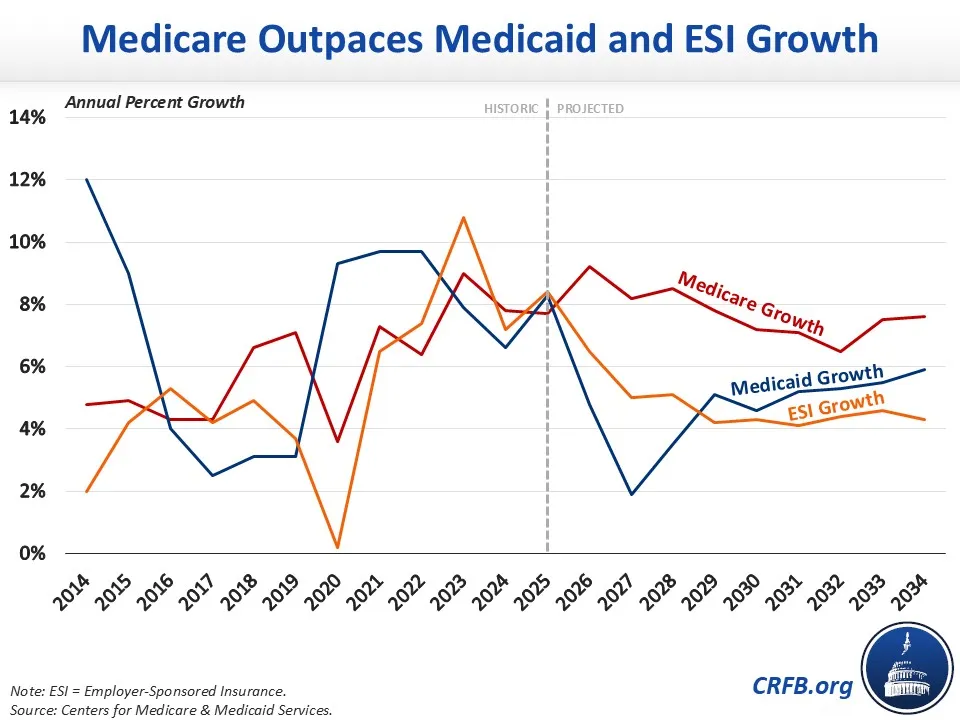
In the private health insurance sector, spending grew more slowly at 8.2% in 2025 compared to 8.8% in 2024 as enrollment growth declined; however, per-enrollee spending growth increased from 5.2% in 2024 to 6.8% in 2025 and is expected to grow further to 8.2% in 2026. From 2029 to 2034, private health insurance spending growth is projected to average 4.4% – a slowdown largely due to older, more expensive enrollees aging into Medicare. In 2034, they project that 60% of the population will be covered by private health insurance but will comprise just 30% of national health spending.
As these latest projections show, health care continues to be a huge driver of federal spending growth. Policymakers should work to reduce cost growth through commonsense reforms like site-neutral payments, Medicare physician payment reform, and reducing Medicare Advantage overpayments. This would help both consumers with health care affordability and help put our nation’s fiscal situation on a more sustainable path.