Part D Costs on the Rise Due to IRA's Benefit Redesign
The Inflation Reduction Act’s (IRA’s) Medicare Part D drug benefit redesign will cost much more than originally estimated, according to the Congressional Budget Office (CBO), explaining much, but not all, of CBO’s recent $650 billion upward revision to its Medicare Part D cost projections through 2035.
In this piece, we show that:
- The IRA benefit redesign is driving up the cost of Medicare Part D. Over the IRA’s 2022-2031 budget window, CBO projects Medicare Part D will cost $400 billion more than its immediate post-IRA estimate and $150 billion more than before the enactment of the IRA. The higher-than-expected cost of the IRA’s Part D redesign is the main contributor to the cost increase, which has also been boosted by higher inflation, the introduction and expanded use of newer drugs like GLP-1s, and other factors.
- Design and implementation choices made the IRA redesign more susceptible to cost overruns. Although policies can always cost more or less than originally expected, the IRA’s particular cost-sharing rules made it more susceptible to cost overruns, and the IRA’s premium growth cap meant that any increase in Part D costs would be mostly added to deficits rather than shared with beneficiaries. The Biden Administration’s “Premium Stabilization Demonstration Project” and choices over what to count as out-of-pocket costs have driven up costs further.
- Thoughtful fixes can lower drug costs and restore budgetary savings. This could include some combination of relaxing the premium growth cap, increasing and better measuring the out-of-pocket maximum, stabilizing the insurance market, strengthening drug negotiations, expanding the inflation rebate, and pursuing reforms to lower overall prescription drug costs.
Although CBO has not re-estimated the IRA or its component parts, the information they have provided suggests the law’s Part D redesign will cost $200 to $300 billion through 2031,1 as opposed to the original $30 billion. This would more than erase the savings from the law’s drug negotiation and inflation rebate provisions,2 though the IRA may still modestly reduce drug prices once accounting for other provisions. The below table reflects our best understanding and what we might expect from a re-estimate.
Comparing IRA Cost Score to Potential Re-Estimate
(positive numbers indicate savings)
| Original Score (2022-2031) | Current Estimate (2022-2031)* | |
|---|---|---|
| Drug Negotiations | $96 billion | $100 to $200 billion |
| Inflation Rebates | $63 billion | |
| Part D Redesign | -$30 billion | -$200 to -$300 billion |
| Subtotal, Drug Pricing Reforms | $129 billion | net cost |
| Repeal of “Drug Rebate Rule” | $122 billion | Unknown |
| Other drug changes | -$10 billion | |
| All IRA Drug Policies | $241 billion | likely net savings |
| Change in Part D spending from 2022 pre-IRA baseline’ | $249 billion | -$153 billion |
| Change in Part D spending from post-IRA 2023 baseline | n/a | -$402 billion |
Source: CRFB estimates based on CBO data.
*CRFB rough interpretation of CBO general discussion.
‘This differs from the savings estimate in part because not all savings accrue to Medicare Part D and in part because of other changes between baselines.
Policymakers should pursue reforms to fix the IRA’s drug provisions so that they reduce costs and deficits as originally intended.
IRA’s Part D Redesign is Driving Up Part D Costs
In its most recent baseline, CBO revised the projected federal cost of the Medicare Part D drug program up by $650 billion through 2035 and has pointed to the IRA’s Part D benefit redesign as a main (but not exclusive) driver of this cost increase. Between 2022 and 2031, CBO projects Part D costs will be $400 billion higher than projected after the passage of the IRA and $150 billion higher than before the IRA was enacted.
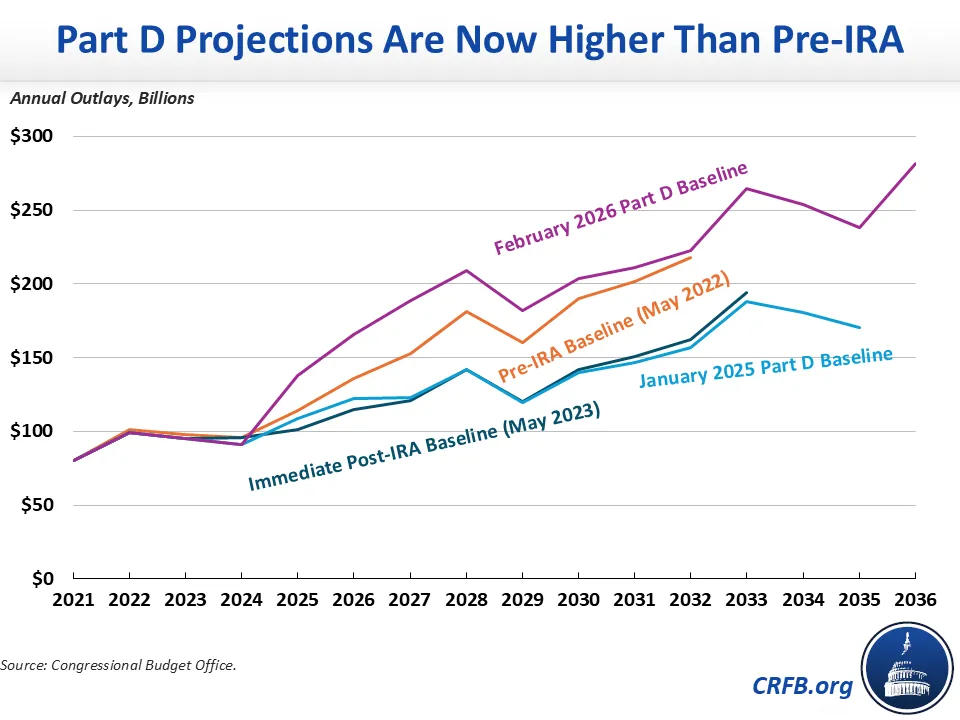
Although CBO originally scored the benefit redesign to add $30 billion to deficits through 2031, CBO’s latest figures suggest it might add $200 to $300 billion to deficits over the same period. This would be larger than the roughly $160 billion of savings originally projected from drug price negotiations and the inflation rebate, though it may still be smaller than the savings from all drug provisions in the IRA, including the long-term moratorium on the 2020 rebate rule.
In addition to the increased cost of the redesign, a number of other factors can help explain higher projected Part D spending. These include higher-than-expected overall inflation, the introduction and expanded use of new drugs such as GLP-1 anti-obesity drugs, a market-wide acceleration in medicine use, higher premium bids in anticipation of pharmaceutical tariffs, and somewhat reduced expectations from drug price negotiations in light of data from the first round of negotiations and new negotiation restrictions from the One Big Beautiful Bill Act (OBBBA).
Design and Implementation Choices Made the Redesign More Susceptible to Cost Overruns
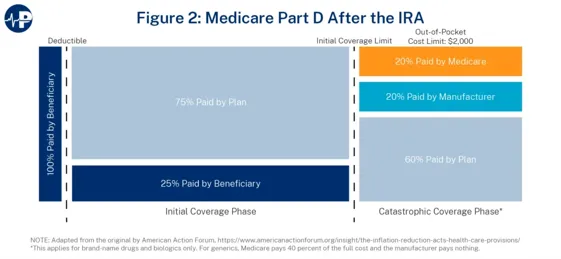
Conceptually, the IRA’s Part D redesign was perhaps one of the most consensus-driven elements of the bill (see an explanation of the redesign here). By shifting payment structures so insurance plans and drug manufacturers pay a larger share of catastrophic (as opposed to ordinary) costs and rationalizing the overall formula, most experts believed a redesign would improve incentives to drive down drug costs and generate enough savings to pay for a cap on out-of-pocket costs to reduce cost sharing.
Redesign proposals were recommended by MedPAC, called for by President Trump, and included in Democratic proposals, Republican proposals, and bipartisan legislation before being enacted under the IRA. All of these plans were scored as relatively close to budget neutral – leading to anywhere between $50 billion of ten years savings and $30 billion in costs.
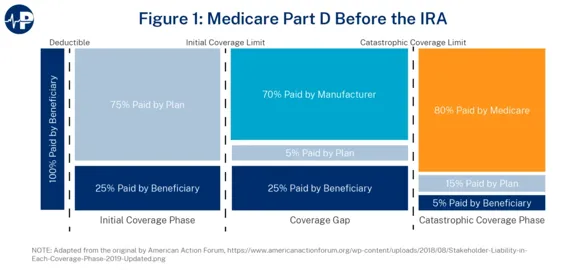
Source: Paragon Health Institute.
The surge in recent plan bids suggests estimates from CBO and other estimators were wrong, however. And though it is not clear exactly why, early evidence suggests that beneficiaries might have been more sensitive to cost sharing prior to the IRA than previously believed, meaning that Medicare Part D’s pre-IRA coinsurance was doing more to encourage beneficiaries to seek lower-cost drugs and discourage overutilization than previously believed. The IRA’s redesign may have also pushed up bids by increasing uncertainty for insurers and reducing competition.
Any time a public policy involves a combination of large levers to produce costs and savings, as any Part D redesign would, there is a higher risk of estimating error.3 But two key choices for the IRA’s redesign made it particularly vulnerable to uncertainty over the magnitude of the net outcome, while two important administrative actions further boosted its costs.
Most significantly, the IRA included a cap on premium growth that shifts nearly all of the cost of higher-than-expected drug spending onto the government. Prior to the IRA, premiums had been set at 25.5% of total costs so that any increase in drug spending would be shared roughly 3-to-1 between the government and beneficiaries. By capping premium growth to 6% through 2029, however, the IRA ensures additional spending – whether driven by the benefit redesign, GLP-1s, or other factors – will be paid for almost dollar-for-dollar with new subsidies. MedPAC estimates this cap has cut beneficiaries’ share of costs by half to 13% in 2026, costing the federal government roughly $20 billion this year alone – about half of the increase in Part D spending projections.4
The IRA’s specific cost-sharing design has also likely driven up costs much more than expected in light of new evidence suggesting higher beneficiary sensitivity to cost sharing. With a $615 maximum deductible, 25% coinsurance rate, and $2,100 out of pocket cap for 2026, the current formula only imposes cost sharing on $6,550 per year worth of drugs – which is significantly less than under most other redesign proposals.5 This significantly reduces the incentive of many beneficiaries to seek lower-cost drugs in addition to leading to overutilization.
The Biden Administration’s implementation of benefit redesign took these problems from bad to worse. First, their decision to allow plans that have low cost sharing to count that benefit towards the out-of-pocket cap drove up federal costs by pushing more beneficiaries above the out-of-pocket maximum and inducing more drug spending. And the “Premium Stabilization Demonstration Project” further boosted federal spending by temporarily increasing premium subsidies further and reducing the incentive for plans to compete for enrollees through lower bids.
Thoughtful Fixes Can Lower Costs and Restore Budgetary Savings
There are several options available to help stem the growth of Part D costs and fix the flawed redesign of the benefit. Doing so in a fiscally responsible way would also ensure the IRA’s prescription drug provisions reduce deficits as intended.
Below are some options to achieve this goal, many of which could be enacted in combination with one another.
- Restore Part D premiums to 25.5% of costs. The current Administration is rightly ending the “Premium Stabilization Demonstration,” but lawmakers should go further by gradually restoring Part D premiums to or at least toward their historic 25.5% of cost levels. This could be achieved while also avoiding the “premium cliff” expected in 2030 by boosting the 6% cap (for example to 10%) on premium growth and continuing to grow premiums at that rate until they reach 25.5% of costs. This change should be made in combination with other reforms to lower costs and slow the growth in the ultimate premiums.
- Require Only True Out-of-Pocket Costs be Counted Toward the “True Out-of-Pocket” (TrOOP) Costs Cap. Congress or the Administration should rethink the practice of counting plan subsidies as out-of-pocket costs, which leads to higher prescription drug spending, pushes more beneficiaries above the out-of-pocket maximum where cost sharing disappears altogether, and reduces plan competition, leading to higher bids.
- Stabilize the Insurance Market. To help reduce plan bids, Congress, the Administration, and/or the Center for Medicare & Medicaid Innovation could make or experiment with changes to encourage more plans to re-enter the Part D market and reduce the risk the plans take on. This could include by allowing more plan flexibility, improving risk adjustments, somewhat reducing plans’ share of catastrophic costs through more reinsurance, or other changes.6
- Increase the Out-of-Pocket Maximum. Especially in light of new evidence over how much lower cost sharing is driving up costs, policymakers should consider increasing the current $2,100 out-of-pocket maximum, which is significantly lower than the $2,500 to $4,000 maximum that would have been in place by 2026 had policymakers enacted any of the prior redesign proposals.7 Policymakers could consider a lower coinsurance rate (for example 5% or 10%) between the current and new out-of-pocket maximum, which would both minimize the financial impact on most beneficiaries and do more to discourage overutilization and promote the use of lower-cost drugs for those with very high prescription drug usage.
- Improve and Expand Drug Negotiations. The Administration should prioritize getting lower prices in drug negotiations. Congress could further strengthen negotiations by requiring more drugs to be negotiated each year, accelerating the timeline after which drug prices can be negotiated, and/or reducing the maximum fair prices for negotiations; West Health and Verdant Research have recently updated their tool to help policymakers calculate potential savings from changes to negotiations. They could also consider applying negotiated prices to heavily-subsidized health spending in the Federal Employee Health Benefits (FEHB) programs and Affordable Care Act market exchanges.
- Strengthen Medicare Inflation Rebates. Policymakers could strengthen Medicare’s inflation rebates by extending them to commercial markets as originally proposed under the IRA and by reindexing the rebate cap to measure inflation with the more accurate chained consumer price index (C-CPI).
- Pursue Additional Reforms to Reduce Drug Spending. Beyond adjusting the IRA, there is more policymakers could do to lower prescription drug costs in Medicare B and D, including a variety of changes to encourage the advancement of generic drugs, adjustments to Low-Income Subsidy (LIS) copayments to better encourage the purchase of generic drugs, changes to the way Medicare pays doctors for physician-administered drugs, drug reimportation from Canada, or even reforms to the 340B drug discount program.
***
Health care costs are the largest category of federal spending, and containing their growth is important to fixing our unsustainable fiscal situation. With Medicare Part D costs much higher than anticipated in part due to the IRA’s Part D redesign, policymakers should work to fix the Part D benefit and drive down prescription drug and other health care costs for the federal government and the public at large.
1 CBO estimates that $550 billion of the $700 billion they estimate in higher Part D costs through 2035 is from higher plan bids, and that the Part D redesign is the “leading driver” of those bids. We find Part D costs increased by $650 billion through 2035. We assume “leading drivers” suggests between 50% and 80% of the cost of the higher bid, which would be between 42% and 68% of the total cost increase. Applying that percentage to the $402 billion revision through 2031 would suggest an upward cost revision of between $170 billion and $272 billion. Added to the $30 billion original cost estimate, this brings the total cost to between $200 and $300 billion.
2 CBO now believes that drug negotiations will lead to a smaller reduction in prices but against higher spending, and it is not clear to us whether they believe negotiations will save more or less than projected under the IRA. CBO says they project smaller rebate collections than previously but that rebates could grow larger in light of higher Part D spending. CBO is not able to re-estimate the indirect effects of rebates.
3 As an illustrative example, if a $10 billion policy was the combination of $500 billion in costs and $490 billion in saving, cost estimates would need only be off by 2% for the net impact to either double to $20 billion or disappear altogether.
4 The 6% limit on Part D premium growth will expire after 2029, at which point premiums will be rebased at a new level and set so that beneficiaries pay at least 20% of total expected plan costs – still lower than prior to the IRA but a large increase in premiums in 2030 and beyond. The Medicare Trustees estimate that this will result in the base beneficiary premium increasing from $46.44 in 2029 to $68.93 in 2030 – a 48% increase. After that point, the government will again share in the burden of faster-than-expected cost growth with beneficiaries but at a ratio of 4-to-1 instead of 3-to-1.
5 For example, if Congress had enacted the Wyden-Grassley Prescription Drug Pricing Reduction Act of 2020, which would have set the out-of-pocket cap at $3,100 in 2023 indexed for Part D cost growth and requiring 20% coinsurance up to the cap, we estimate that in 2026 the cap would be about $3,800 and would have applied to more than $16,000 of prescription drug costs.
6 The IRA increased the share of catastrophic costs paid by plans from 15% to 60% in order to encourage plans to better control costs while reducing government reinsurance from 80% to 40% for generic drugs and 20% for brand-name drugs and eliminating the 5% cost sharing by beneficiaries; drug manufacturers pay the remaining 20%. Although it would be a mistake to fully reverse this policy, policymakers could consider dialing back the plan share some – for example, by reducing the plans’ share from 60% to 50% – and finance the difference through higher government reinsurance or perhaps in part through higher manufacturer rebates and/or cost sharing.
7 In general, Democratic proposals set their out-of-pocket maximum at $2,000 in the first year while Republican and bipartisan proposals set it to $3,100. Because all of these plans would have started prior to 2025, all would be higher than $2,100 by this year – some substantially so.