CBO Projects High Federal Health Program Costs
Federal health programs will cost over $26 trillion through 2036, under the Congressional Budget Office (CBO) baseline, making health care the largest category of federal spending. In this piece, we show:
- Health care is the largest area of federal spending, and projected to grow in size from less than $2 trillion today to over $3 trillion by 2036.
- Medicare spending is projected to nearly double over the next decade, while the cost of Medicaid and the Children’s Health Insurance Program (CHIP) will grow a projected 36% and ACA subsidies by 33%.
- Projected health spending is largely unchanged since last baseline, with significant savings from the One Big Beautiful Bill Act (OBBBA) and regulations countered by economic and technical revisions.
- Medicare’s Hospital Insurance trust fund will be depleted by 2040, 12 years sooner than previously projected, thanks in part to revenue loss from OBBBA.
Federal Health Care Spending is High and Rising
Federal health care spending costs more than any other area of the budget. Total net federal spending on Medicare, Medicaid, ACA subsidies, and CHIP is greater than spending on Social Security, defense, or interest on the debt, and will remain so over the next decade.
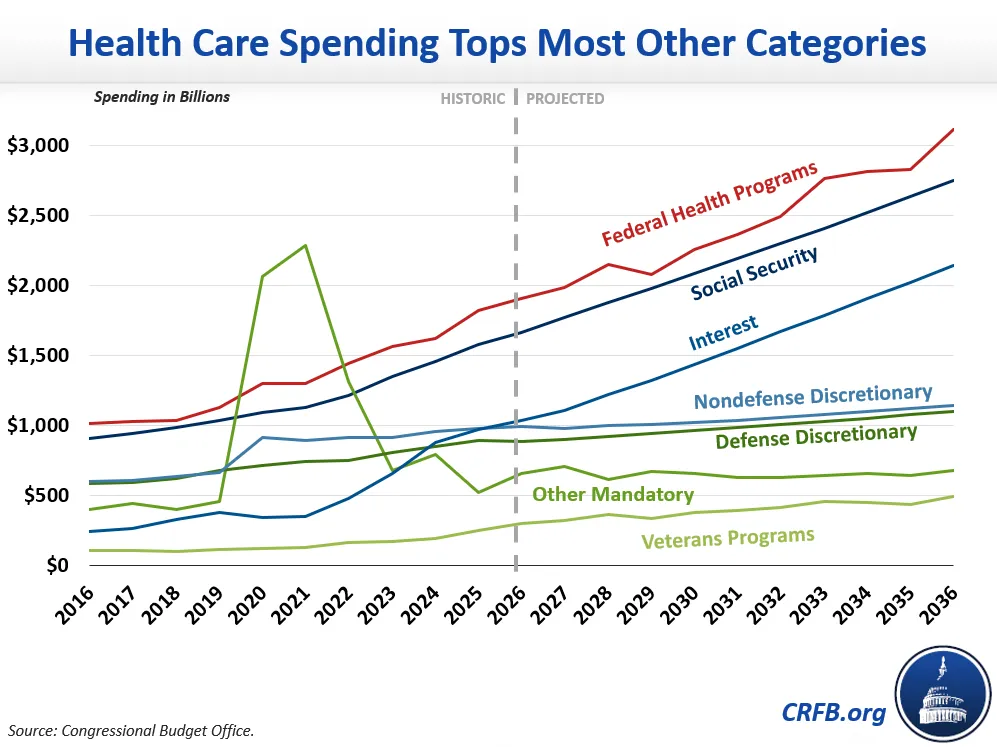
Government spending on federal health programs has grown 80% over the past decade, from $1.0 trillion in 2016 to $1.8 trillion in 2025. Projected spending is expected to grow 63% by 2036 to $3.1 trillion. As a share of the economy, costs have grown from 5.4% of Gross Domestic Product (GDP) in 2016 to 6.0% in 2025 and are projected to reach 6.7% of GDP by 2036.
Medicare Spending Will Grow the Quickest
Most federal health care spending – $988 billion in 2025 – goes to the Medicare program. CBO projects Medicare costs to roughly double to almost $2.0 trillion by 2036, due largely to the aging population and an increase in per beneficiary health care costs.
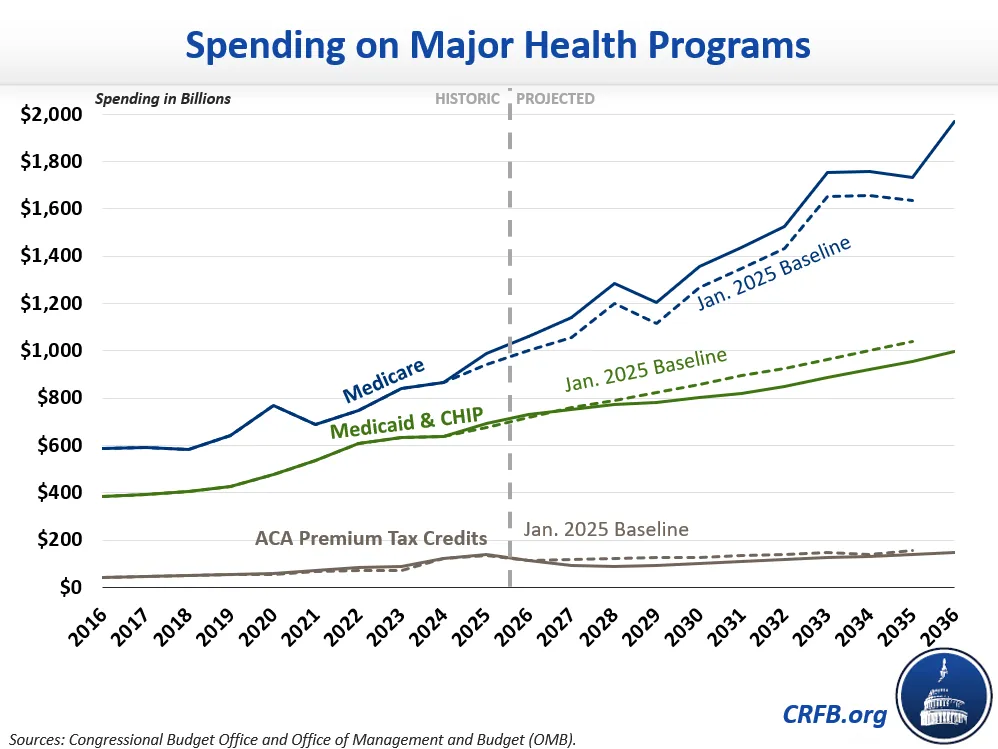
The Medicaid program (in combination with CHIP) cost the federal government $691 billion in 2025 and is projected to grow 36% to $996 billion by 2036. Medicaid costs are projected to grow at a slower rate than Medicare largely due to $1.2 trillion in ten-year savings from the One Big Beautiful Bill Act (OBBBA), but will nonetheless continue to grow by 3.6% per year – and by 4.7% per year on a per beneficiary basis.
Finally, Affordable Care Act (ACA) exchange subsidies and related spending, which cost $140 billion in 2025, is projected to shrink to $112 billion in 2026 – due mainly to the expiration of enhanced subsidies, but also certain OBBBA changes, and some regulatory cost-control measures – before growing to $150 billion in 2036. Costs in 2036 will grow 7% from 2025 and 33% from 2026. This relatively modest growth from 2026 is driven by $130 billion of savings from OBBBA and $40 billion of savings from regulatory changes.
Federal Health Care Spending Projections Have Not Changed Much
Federal health care spending is projected to cost $23.6 trillion between 2026 and 2035, which is almost identical to the $23.5 trillion projected in CBO’s January 2025 baseline. Various policy changes have reduced projected health care spending by about $1.6 trillion, while various technical and economic revisions have increased costs by a similar amount.
OBBBA reduced Medicaid spending by $1.2 trillion through 2035 through a variety of reforms to limit provider taxes and state directed payments, restrict eligibility, improve program integrity, and require community engagement activities (“work requirements”), among other changes. Other health measures in OBBBA saved over $100 billion, mainly due to eligibility and program integrity-related provisions in the ACA marketplaces.
Administrative rules have saved nearly $300 billion more, mainly due to a final rule that reduces the reimbursement rate for skin substitutes, a wound care product that has been subject to abusive pricing practices and experienced skyrocketing costs from $256 million in 2019 to over $10 billion in 2024.
Comparing the January 2025 and February 2026 CBO Baselines
| 2025-2035 | |
|---|---|
| January 2025 Baseline Federal Health Spending | $23.5 trillion |
| One Big Beautiful Bill Act Medicaid Savings | -$1.2 trillion |
| One Big Beautiful Bill Act Medicare, ACA, and Other Changes | -$0.1 trillion |
| Administration rules on Skin Substitutes and ACA Marketplace | -$0.3 trillion |
| Higher Medicare Part D Spending from Technical Revisions | +$0.6 trillion |
| Higher Medicare FFS Spending from Technical Revisions | +$0.5 trillion |
| Higher Medicaid Spending from Technical Revisions | +$0.7 trillion |
| Other Economic and Technical Changes | -$0.1 trillion |
| February 2026 Baseline Federal Health Spending | $23.6 trillion |
Source: Congressional Budget Office. Note: Numbers may not sum due to rounding.
These important policy changes, unfortunately, are only large enough to counter underlying cost increases that CBO projected using new data and other technical improvements. Overall, economic and technical changes increased expected health care costs by $1.7 trillion.
A number of technical changes increased projected outlays since the last baseline. CBO projected that outlays for Medicare Part D will increase by $0.6 trillion due to an increase in annual per enrollee costs for Part D, which caused insurers to increase the bids for Part D premiums. Similarly, CBO increased projected outlays for Medicare by $0.5 trillion over the decade due to higher-than-expected fee-for-service spending and enrollment. A Medicaid revision increased projected outlays by $0.7 trillion due to a decrease in the average health status of enrollees and thus higher costs per enrollee, despite lower enrollment.
The Medicare Hospital Insurance (HI) Trust Fund Will be Insolvent By 2040
The Medicare’s Hospital Insurance (HI) trust fund will run out of reserves by 2040, according to a new blog post from CBO – which matches our prior estimates. This insolvency date is 12 years sooner than the 2052 date estimated a year ago. The advanced insolvency is driven largely by reduced revenue from taxation of Social Security benefits, largely as a result of the One Big Beautiful Bill Act (OBBBA). CBO also projects higher costs for the Medicare program and a lower amount of wages that are subject to the payroll tax.
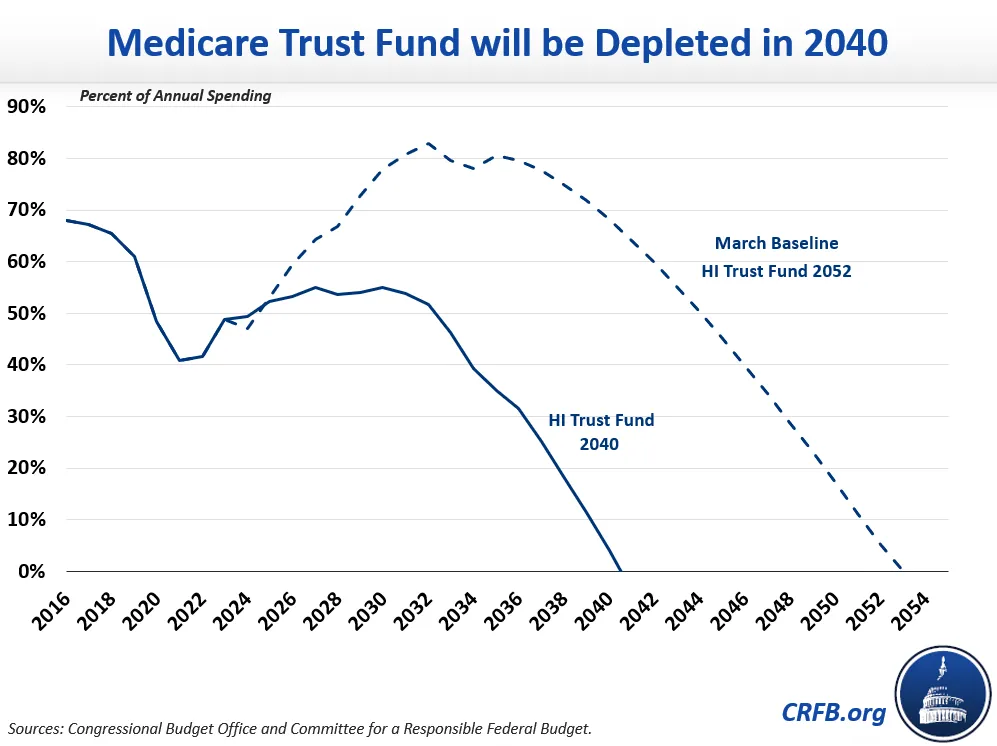
Between 2027 and 2036, CBO projects the HI trust fund will experience a $193 billion cash deficit, including $52 billion in 2036 alone. Over 25 years, CBO projects the HI trust fund will face an actuarial shortfall of 0.30% of payroll, or 0.13% of GDP. This is more than twice as high as CBO’s 2025 estimate of 0.13% of payroll (0.06% of GDP), with the increase largely due to OBBBA.
Upon insolvency, CBO projects Medicare payments will need to be cut by 8% to match revenues, with that cut rising to 10% by 2056.
While CBO’s 2040 insolvency projection is itself a reason for concern, the Medicare Trustees are even more pessimistic – we estimate an insolvency date of 2032 under their projections, and a payment cut of 12%.
* * * * *
The latest CBO baseline highlights health care costs’ contributions to rising federal outlays. In total, growing health care spending through 2036 can explain 30% of all spending growth and 63% of all spending growth as a percentage of GDP. As costs grow for the federal government so too will costs for states and for beneficiaries.
Thankfully, there are plenty of options for lawmakers to address this growth, including further restricting Medicaid financing schemes, adopting site-neutral payments, reducing Medicare Advantage overpayments, lowering prescription drug costs, and funding cost-sharing reductions, among other changes.
Lawmakers should take action sooner rather than later to slow the growth of health care spending, reduce deficits, and restore trust fund solvency.