What’s in the Senate FY 2026 Budget Resolution?
The Senate adopted its Fiscal Year (FY) 2026 budget resolution last night, kicking off the reconciliation process. Unfortunately, the budget is about a year too late and includes no plan to address the growing national debt – nor much of any budgetary plan at all. Instead, this budget resolution is designed almost exclusively to facilitate reconciliation legislation that would fund the Immigration and Customs Enforcement (ICE) agency and Border Security Operations (BSO), in place of ordinary appropriations.
In summary, the FY 2026 budget resolution would:
- Allow the House and Senate to write reconciliation legislation that adds up to $140 billion to primary deficits through FY 2035, with up to $70 billion allowed each for the Judiciary and Homeland Security Committees.
- Call for $1.2 trillion of additional defense spending over a decade, growing defense budget authority by more than $250 billion (27%) between 2026 and 2027.
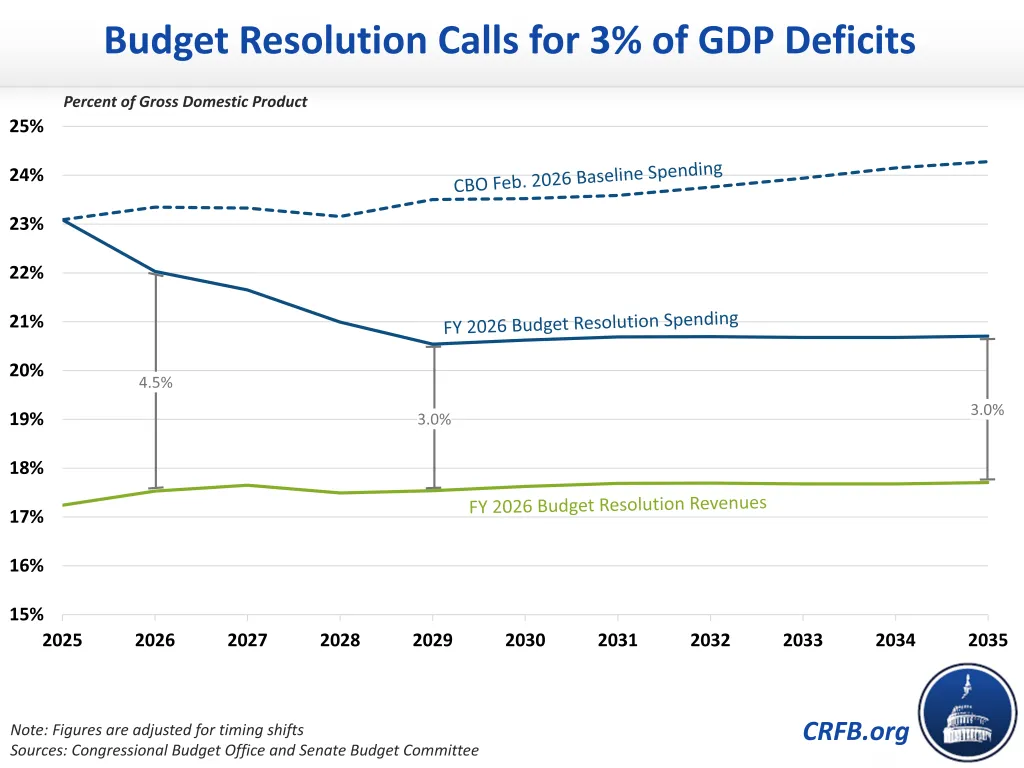
- Put the projected deficit on a path toward 3% of Gross Domestic Product (GDP) by FY 2029 and beyond, relying more than entirely on $9.7 trillion of completely unspecified savings through FY 2035 to achieve this target.
- Waive various budget enforcement tools, including Senate Pay-As-You-Go (PAYGO) rules and budgetary points of order against increasing deficits.
Importantly, press reports and member comments indicate that the intention is for reconciliation to provide $70 billion of total ICE and BSO funding to cover 3.5 years of costs that would otherwise be funded through ordinary appropriations.
Although this $70 billion would be intended to replace rather than add to ordinary funding, it could nonetheless lead to higher deficits. It also sets a new precedent for funding regular (as opposed to supplemental) appropriations via the reconciliation process, which in itself would put certain immigration funding on autopilot for several years and could open the gate for putting a larger portion of the budget on autopilot.
Reconciliation Instructions in the FY 2026 Budget Resolution
Although policymakers have enacted 11 of 12 appropriations bills for FY 2026, the government remains in a partial shutdown due to the lapse in funding for the Department of Homeland Security. To overcome disagreements over immigration policy, the Senate passed a funding bill in March that stripped out ICE and BSO funding.
Policymakers intend to use the reconciliation process – which requires 50 as opposed to 60 votes in the Senate – to fill that gap and fund ICE and BSO outside of the normal appropriations process for the next 3.5 years.
The Senate-adopted FY 2026 budget resolution instructs the House and Senate Judiciary and Homeland Security committees to write legislation that can add up to $70 billion to ten-year deficits each for a total of $140 billion in allowable increases. The reported intention is to hold total funding to $70 billion while giving the committees maximum flexibility to deal with overlapping jurisdictions. However, there is no codified $70 billion limitation and therefore reconciliation would borrowing above $70 billion – and up to $140 billion.
Reconciliation Instructions in the FY 2026 Budget Resolution
| Senate | House | |
|---|---|---|
| Judiciary Committee | $70 billion | $70 billion |
| Homeland Security Committee | $70 billion | $70 billion |
| Total Amount of Deficit Increase Allowed | $140 billion | $140 billion |
Source: Senate Budget Committee.
There is also nothing in the reconciliation instructions to require the money to be appropriated over a 3.5 year period and nothing in the budget resolution to help ensure the mandatory funding replaces rather than adds to discretionary funding levels.
Budgetary Totals in the FY 2026 Budget Resolution
The FY 2026 budget resolution includes spending, revenue, and deficit totals for the current fiscal year and the next decade. Encouragingly, these totals would put the debt on a sustainable path and reduce deficits to the 3% of GDP target endorsed by the board of the Committee for a Responsible Federal Budget and many others. Unfortunately, they do not appear to reflect any specific policies or any particular fiscal plan – they appear to be largely meaningless numbers that are neither grounded in intent nor reality.
The budget assumes revenue levels consistent with what the Congressional Budget Office (CBO) projected in its February 2026 baseline – despite the fact that $1.9 trillion of tariffs have since been ruled illegal and ended and that the baseline assumes the expiration of new tax cuts on tips, overtime, seniors, factory investment, and state and local tax deductibility, among others.
On the spending side, the budget resolution would increase defense outlays (for the 050 National Defense budget function) by $1.2 trillion over the next decade relative to CBO’s February 2026 baseline. More significantly, the budget assumes $9.7 trillion of ten-year deficit reduction from “allowances” – which is a budgetary term for unspecified savings. The budget resolution does not put forward any specific policies or policy examples to explain how it would achieve these savings, nor does it show what area of the budget the savings would come from. Without this detail, there is little reason to take these savings seriously.
With interest savings, the budget would reduce deficits by $10.7 trillion over a decade relative to CBO’s February 2026 baseline – though again, more than the entirety of this savings come from phony or unspecified savings.
Claimed Deficit Reduction in FY 2026 Budget Resolution Compared to CBO February 2026 Baseline
| Ten-Year Totals (FY 2026-2035) | |
|---|---|
| Defense Spending Increases | -$1.2 trillion |
| Unspecified Spending Reductions (“Allowances”) | $9.7 trillion |
| Baseline Differences | $0.6 trillion |
| Interest Savings | $1.6 trillion |
| Total Claimed Deficit Reduction Relative to CBO Baseline | $10.7 trillion |
Source: Congressional Budget Office and Senate Budget Committee. Figures may not sum due to rounding.
Based on these figures, the budget reports a 4.5% of GDP ($1.4 trillion) deficit for FY 2026, which is more than $400 billion lower than CBO’s baseline, falling by 0.5% of GDP annually until the deficit reaches 3.0% of GDP in 2029 and beyond. Between 2026 and 2035, the budget assumes revenue will rise from 17.5% of GDP to 17.7% of GDP, spending will fall from 22.0% of GDP to 20.3% of GDP, and debt will fall from 99.3% of GDP to 94.3% of GDP.
The Budget Waives Budget Enforcement
Tucked within more technical sections of the budget resolution are provisions exempting an eventual reconciliation bill from PAYGO and other budget enforcement in the Senate. Specifically, it allows the Budget Chair to waive the reconciliation legislation from Senate PAYGO rules, and it explicitly exempts the reconciliation legislation from two points of order against increasing short- and long-term deficits. The Byrd Rule, which prevents reconciliation from adding to out-year deficits or include non-budgetary changes, would remain in place.
The Budget Sets a Troubling New Precedent
In addition to failing to set meaningful budgetary totals for this year and the next decade, the budget transforms the use of reconciliation in some potentially troubling ways.
Historically, reconciliation was intended to be used to enact deficit reduction by facilitating enactment of policies to increase revenue or reduce spending – and such deficit reduction is needed more now more than ever. Instead, this budget resolution would use reconciliation to fund ordinary discretionary functions that would normally be enacted through the appropriations process. This would be a significant departure from the normal budget process.
To be sure, this is not the first time Congress has used reconciliation to provide mandatory funding for normally-discretionary activities – it did so in the American Rescue Plan Act, the Inflation Reduction Act, and the One Big Beautiful Bill Act. But these bills provided funding on top of ordinary appropriations; Congress has never used reconciliation to replace discretionary funding with mandatory funding.
Although theoretically, replacing discretionary funding with mandatory funding would not add to deficits, it could significantly undermine the regular order budget process and comes with many fiscal risks. Appropriations are intended to be handled annually through the regular discretionary budget process, which allows Congress to scrutinize and set funding levels in the context of an overall discretionary budget based on needs and priorities with timely input from the agencies, the Office of Management and Budget, and Appropriations Committees. Circumventing that process via reconciliation reduces the amount of oversight, transparency, and accountability in federal budgeting.
Roughly three-quarters of the budget is already on autopilot – meaning it is not subject to the annual appropriations process – with 61% of spending going towards mandatory programs and another 14% towards interest on the national debt. Moving ICE and BSO funding to the mandatory side – and funding them for multiple years – increases that share of the budget that lawmakers cannot control annually and may create a new precedent to fund a larger share of the budget via mandatory spending.
Allowing multi-year funding – particularly if all appropriated in one year – could also add to the deficit if lawmakers boost appropriations in light of lower top-line discretionary levels or if the executive branch spends down the funds quickly and returns to request more. For these and other reasons, it is a mistake to exempt reconciliation from PAYGO rules in the Senate.
A Path Forward
Rather than using reconciliation to fund ordinary government functions, lawmakers should fund immigration enforcement through the appropriations process and use reconciliation to reduce debt and begin to put deficits on a path toward 3% of GDP.
If lawmakers do choose to appropriate $70 billion over 3.5 years through reconciliation, they should do at least do the following:
- Set an overall $70 billion (or less) ceiling on total borrowing from the Judiciary and Homeland Security Committees, similar to the House provision in the FY 2025 budget resolution or the Conrad Rule, to prevent policymakers from taking advantage of the Committee flexibility to borrow up to $140 billion.
- Appropriate the $70 billion over four fiscal years, rather than all in the first year, in order to avoid creating a “slush fund” that could be spent down in order to create pressure for even more funding.
- Require reconciliation to offset new spending by removing the Senate PAYGO waiver and providing deficit reduction instructions to any committee that might be called on to provide offsets.
- Codify and adjust the Fiscal Responsibility Act discretionary targets, turning them into binding caps and reducing them to account for the new mandatory appropriations.
***
The proposed FY 2026 budget resolution sets the stage for an eventual reconciliation bill to fund ICE and BSO. While it is good that lawmakers decided on a narrow scope for the bill as opposed to a broader one that would allow for “Christmas tree” legislation that funds unrelated priorities, it would be better if it required lawmakers to reduce deficits on net, as the reconciliation process was originally intended to do. Ultimately, the net deficit effect of this budget resolution and its reconciliation legislation will depend greatly on how Congress chooses to write the bill this year and appropriate spending in future years.
Appendix: CBO February 2026 Baseline vs. FY 2026 Budget Resolution Metrics
| Fiscal Year | 2026 | 2027 | 2028 | 2029 | 2030 | 2031 | 2032 | 2033 | 2034 | 2035 | ’26-35 |
| SPENDING | |||||||||||
| CBO (Feb. 2026) | 23.3% | 23.3% | 23.5% | 23.2% | 23.5% | 23.6% | 23.8% | 24.3% | 24.2% | 23.9% | 23.7% |
| Budget Resolution | 22.0% | 21.7% | 21.3% | 20.2% | 20.6% | 20.7% | 20.7% | 21.1% | 20.7% | 20.3% | 20.9% |
| REVENUE | |||||||||||
| CBO (Feb. 2026) | 17.5% | 17.7% | 17.5% | 17.6% | 17.6% | 17.7% | 17.7% | 17.7% | 17.7% | 17.7% | 17.6% |
| Budget Resolution | 17.5% | 17.6% | 17.5% | 17.5% | 17.6% | 17.7% | 17.7% | 17.7% | 17.7% | 17.7% | 17.6% |
| DEFICITS (adjusted for timing shifts) | |||||||||||
| CBO (Feb. 2026) | 5.8% | 5.7% | 5.6% | 6.0% | 5.9% | 5.9% | 6.1% | 6.3% | 6.5% | 6.6% | 6.0% |
| Budget Resolution | 4.5% | 4.0% | 3.5% | 3.0% | 3.0% | 3.0% | 3.0% | 3.0% | 3.0% | 3.0% | 3.0% |
| DEBT | |||||||||||
| CBO (Feb. 2026) | 100.6% | 102.1% | 104.1% | 105.8% | 107.7% | 109.6% | 111.5% | 114.0% | 116.2% | 118.0% | N/A |
| Budget Resolution | 99.3% | 99.2% | 99.2% | 98.1% | 97.4% | 96.7% | 96.1% | 95.9% | 95.3% | 94.3% | N/A |
Source: Congressional Budget Office (CBO) and Senate Budget Committee.