IMF Warns of Risks from Rising Debt
The International Monetary Fund (IMF) recently released its semiannual Fiscal Monitor report, warning that risks to the global fiscal outlook have worsened. With many nations now facing increased spending pressures, rising interest costs, and changes in sovereign debt markets, global public debt is on the rise and could cause economic instability.
In the latest projections, the IMF shows that gross global debt will reach 100% of global Gross Domestic Product (GDP) by 2029 – one year earlier than previously estimated – and debt in the U.S. will rise even more rapidly. Interest payments are nearly 3% of global GDP, up from 2% in just four years.
Among the many topics the IMF explores in this Fiscal Monitor, it takes a harder look at how the U.S. and other economies have changed sovereign debt market dynamics over the past few years, identifying three areas of concern:
- Shifting ownership of U.S. Treasuries
- Declining convenience yield of U.S. Treasuries
- Issuance of short-term debt
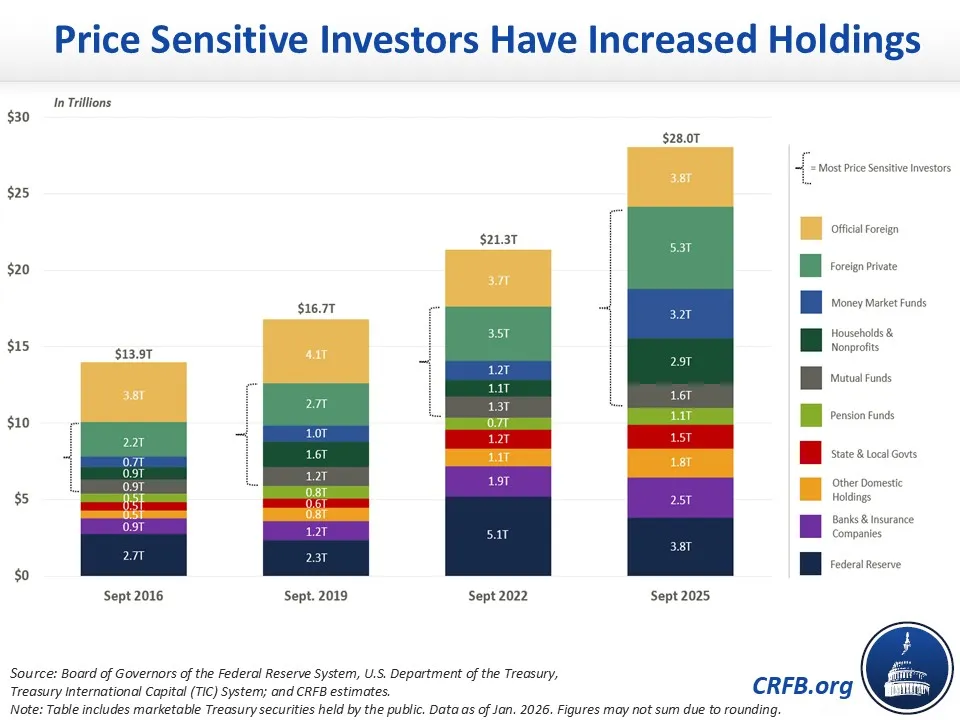
As the IMF notes, there has been a movement in U.S. debt ownership away from typical financial institutions like banks to more price-sensitive investors like hedge funds. The higher price sensitivity means that even small movements in Treasury yields could cause significant turmoil in Treasury markets as some investors may be forced to sell their positions to prevent large losses.
Additionally, as U.S. debt is rising, investors are less willing to accept lower returns on Treasuries – “the safety premium…decreases.” Given that Treasuries tend to be the basis for “risk-free” investments around the world, the decline in the safety premium raises interest rates globally.
Finally, there has been some movement away from medium- or long-term dated debt to short-term issuance; we’ve seen this in the U.S., where 33% of debt will roll over in the next year. This has caused debt service costs to skyrocket, with net interest doubling between 2022 and 2025 and on course to double again by 2034. As the IMF notes, “the resulting rise in interest outlays can in turn constrain a country’s fiscal space, potentially forcing procyclical spending cuts or tax increases that amplify the contractionary effect of rising interest rates.” This elevates rollover risk and contributes to an overall riskier sovereign debt situation both domestically and abroad.
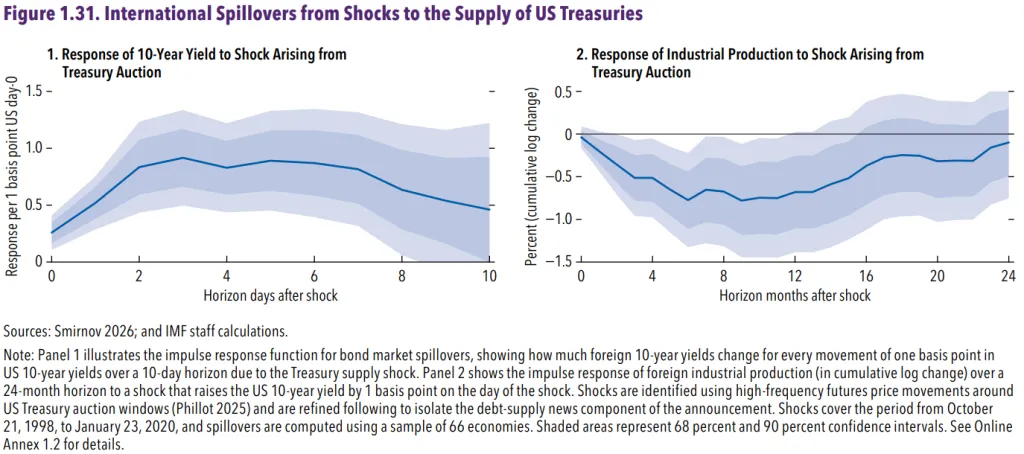
Because U.S. debt underlies much of the global system, changes in Treasury yields raise borrowing costs around the world. The IMF estimates that for every 1 basis point increase in Treasury yields after a “Treasury debt supply shock,” where the supply of Treasuries is higher than anticipated, rates around the world rise by 0.8-0.9 basis points and slow global growth.
To prevent rising global debt, rising global interest costs, or a future fiscal crisis, the IMF recommends forward-looking plans to preserve stability and reduce market risk. In the U.S. specifically, the IMF calls for realistic fiscal targets and consolidation measures address revenue and spending, including trust funds like Social Security and Medicare. The IMF stresses that “the window for an orderly adjustment is narrowing”, making near-term policy choices critical for long-term stability.