Saving MEDICARE Act Would Dramatically Reduce MA Overpayments
Representative Lloyd Doggett (D-TX) and 44 cosponsors recently introduced the Saving Medicare Enrollees from Deceptive Insurers and Creating Ample Resources for Everyone (Saving MEDICARE Act), which would significantly change the way that Medicare Advantage (MA) plans are paid. MA plans currently cost significantly more than traditional Medicare plans, with projected excess costs of $1.3 trillion over the next decade. The bill would address a major source of federal waste, fraud, errors, and abuse while improving affordability in the process.
The Saving MEDICARE Act would reduce, if not fully eliminate, excessive MA costs by addressing a number of issues that we and others have highlighted, including upcoding, favorable selection, the Quality Bonus Program, and improper payments. The plan would substantially and perhaps indefinitely delay Medicare insolvency while significantly lowering health care costs and reducing deficits.
The Congressional Budget Office (CBO) has not released an estimate of the Save MEDICARE Act, but one analysis from Brown University published along with the bill release estimates that the bill would reduce Medicare spending by $2.5 trillion from 2028 to 2037. Although we cannot verify this analysis, we believe the bill would save at least $1 trillion over the next decade based on extensive literature from the Medicare Payment Advisory Commission (MedPAC) and others. The bill would also reduce beneficiary premiums both for those enrolled in MA and in traditional Medicare.
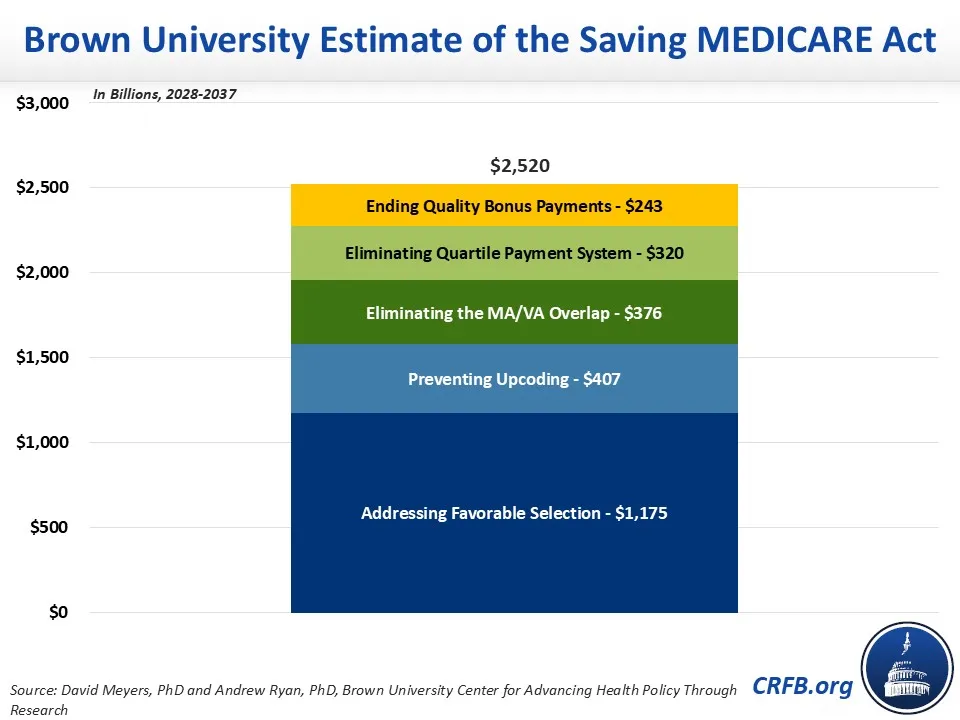
To achieve these savings, the plan would:
- Reduce upcoding, a practice in which plans assign diagnoses to enrollees to make them appear sicker than they are. The Saving MEDICARE Act would exclude patient diagnoses that are gathered from chart reviews and health risk assessments – processes that plans often use to increase coding intensity without necessarily improving care.
- Address favorable selection, which benefits plans by enrolling members in MA with the same risk scores but who use fewer services than traditional Medicare. The legislation would address favorable selection by eliminating the system that pays more to plans that enter markets with fewer plans and by adjusting the benchmark downward.
- Eliminate the MA Quality Bonus Program, a flawed program that fails to distinguish quality from regular performance.
- Improve the timeliness of Risk Adjustment Data Validation (RADV) audits to recover overpayments when plans fail to support beneficiaries’ risk scores with medical documentation.
- Allow the Veterans Health Administration to bill MA plans for care provided to beneficiaries enrolled in MA, which is currently prohibited and leading to duplicative payments in MA, by incorporating the GUARD VA Benefits Act.
Taken together, the Saving MEDICARE Act puts forward a comprehensive plan to address the underlying causes of excessive MA costs that have been driving up the cost of Medicare. It goes much further than other serious efforts such as the No UPCODE Act, which would help address rampant upcoding, and likely saves more than the thoughtful Reform the Medicare Advantage Program Act as well.
If used for deficit reduction rather than as an offset, the Saving MEDICARE Act would substantially reduce deficits, lower health care costs for seniors, extend solvency of the Medicare Part A trust fund, and address a serious source of waste and abuse in the government.