Higher Ed Tax Breaks Could Help Fill Pell Shortfall
The Pell Grants program is out of reserves and faces a $100 to $185 billion shortfall over the next decade. As lawmakers work to limit the cost of the Pell program, they may also consider boosting funding into the program on a one-time or ongoing basis. Recently, the House Appropriations Subcommittee for Labor, Health and Human Services, and Education proposed covering some of the shortfall by ending the in-school interest subsidy. Reforms to higher education tax breaks – which cost over $30 billion per year – offer another possible way to offset the costs.
Higher Education Tax Breaks are Costly
The federal government will issue about $33 billion in tax breaks designed to assist students in paying for college tuition and related expenses next year. Over a third of these tax breaks take the form of two tuition-subsidizing tax credits – the American Opportunity Tax Credit (AOTC) and the Lifetime Learning Credit (LLC) – while remaining tax breaks include deductions, exemptions, and exclusions related to tuition, student loan interest and cancellation, and college savings.
In total, these tax breaks are roughly as large as the entire Pell Grants program, and are about three times as large as the current Pell shortfall.
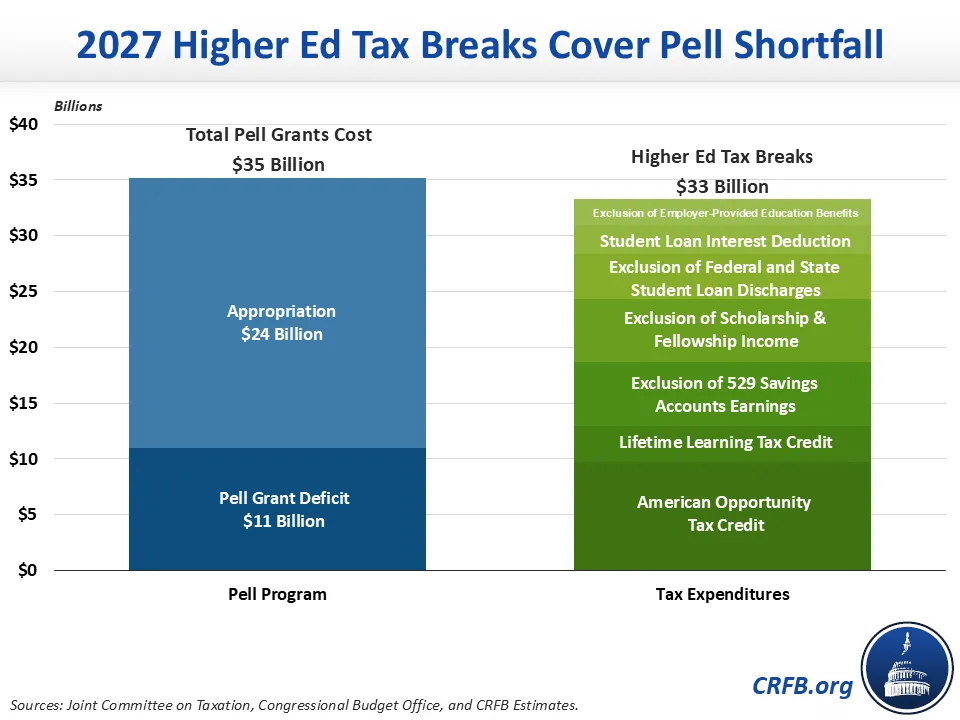
This $33 billion is on top of the tens of billions of dollars in tax breaks and arguable tax breaks that go directly to universities in the form of tax-deductible charitable donations, bond subsidies, and nonprofit status – including for income from sports teams, university-run hospitals, or research contracts. Nor does it count certain tax preferences for parents of children that are extended to those in college (including the Earned Income Tax Credit).
Higher education tax breaks are effectively a form of spending or “tax expenditure.” In the most obvious case, the American Opportunity Tax Credit (AOTC) sends students cash to fund tuition and other expenses, similar to Pell Grants, with the major difference being that it is run by the Internal Revenue Service (IRS) and not the Department of Education.
Compared to Pell Grants, however, these tax breaks are generally less targeted and less progressive. For example, a Congressional Budget Office (CBO) study looking at 2016 higher education subsidies found that 43% of higher education tax breaks went to households in the top two quintiles, compared to only 20% of total higher education spending and 10% of Pell Grants in particular. Nearly 60% of higher education deductions and exclusions went to the top quintile; and the benefits from 529 Savings Accounts were especially lopsided, with 97% going to the top 20% of households.
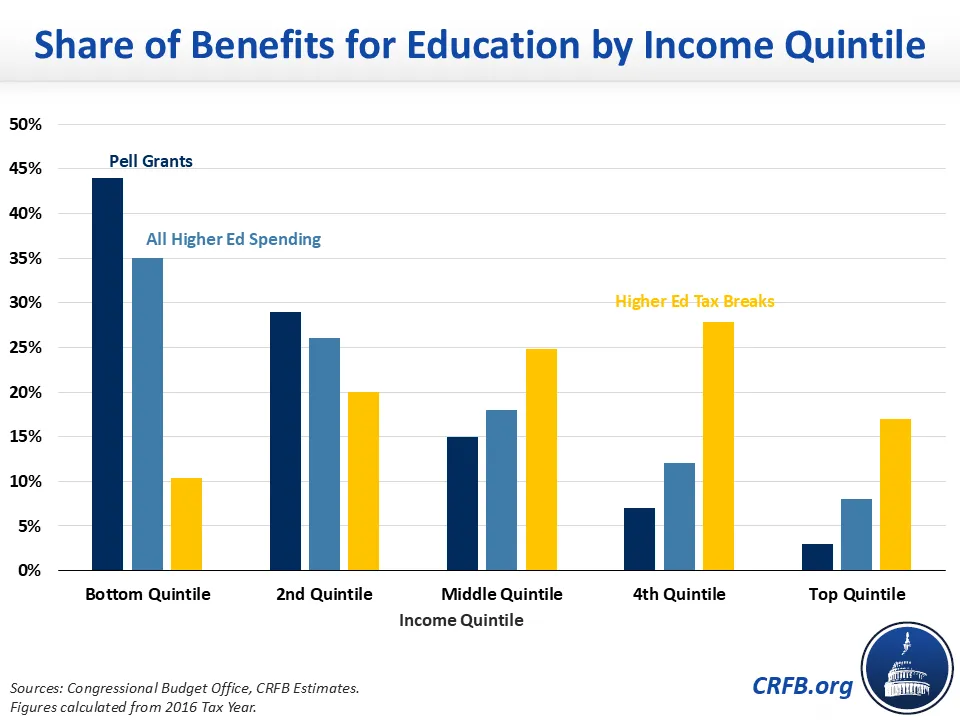
These tax breaks are also often inefficient, with evidence suggesting they do little to increase college enrollment or otherwise improve outcomes. There is also evidence that they drive up the cost of college tuition.
The Pell Grant Program Faces a Large Shortfall
The Pell Grant program provides undergraduates from low- and moderate-income households up to $7,395 per year in grants to fund tuition and other expenses. These grants are funded mainly through annual appropriations, but are set by formula. To reconcile possible differences, the program effectively operates with a reserve to save surplus funding and cover deficits.
These Pell Reserves are now exhausted, and depending on future year growth the Pell program faces a $100 to $150 billion shortfall over the next decade. It would require $16 or $17 billion of savings to fully fund the Pell Grant shortfall through the end of FY 2027 and about $40 billion to fund the shortfall through the end of 2029.
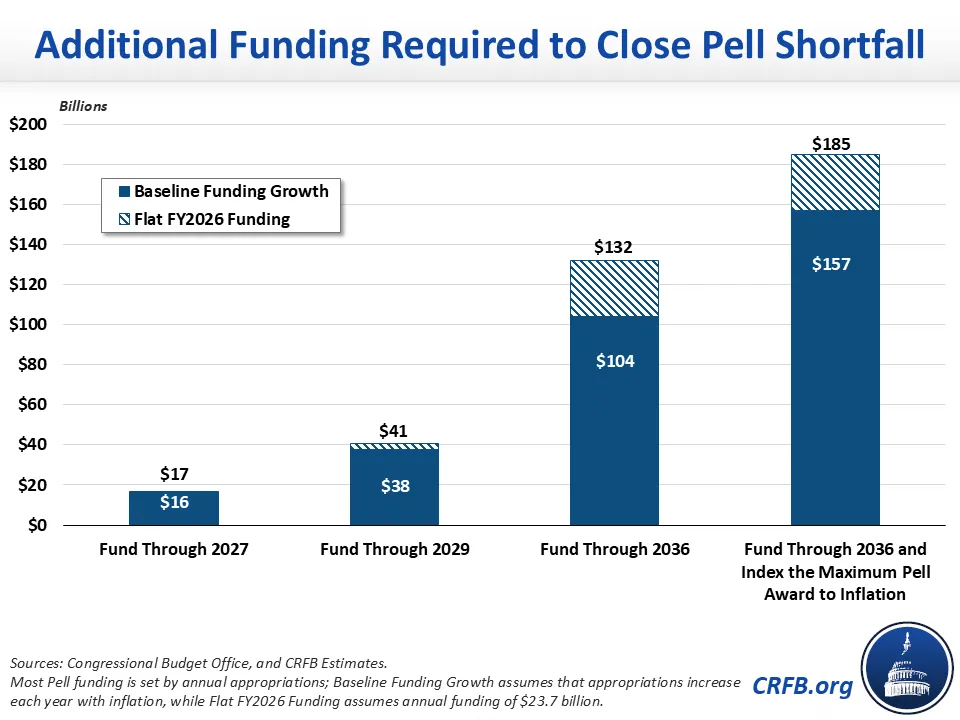
To address the Pell shortfall, policymakers should carefully consider options for lowering the cost of the Pell program itself – which could include tighter income tests, changes to minimum credit requirements, new accountability measures, or aggressive efforts to tackle waste, fraud, errors, and abuse. Policymakers could also look to boost funding into the Pell Grants program, but given the nation’s abysmal fiscal outlook, any new funding must be fully offset.
Tax Break Reforms Can Help Fund Pell
In June, the House Appropriations Subcommittee for Labor, Health and Human Services, and Education approved a proposal that would eliminate subsidized student loans – which do not accrue interest until the student finishes their program of study – at the end of the 2026-27 school year. This proposal is worth considering; indeed, we listed it among a number of possible student loan proposals last summer. But lawmakers should also consider reforms to higher education tax breaks.
In the extreme, we estimate that eliminating all higher education tax breaks could generate $370 billion of savings over a decade – enough to close the Pell shortfall and dedicate $240 billion to deficit reduction. Eliminating only the American Opportunity Tax Credit (AOTC) and Lifetime Learning Credit (LLC) would raise and save $115 billion in revenue through 2036, while eliminating most other deductions, exemptions, and exclusions would generate $255 billion.
Policymakers may also consider more targeted approaches. For example, only repealing the Lifetime Learning Credit – which mostly benefits graduate students – would generate $30 billion. We estimate limiting the AOTC and LLC to undergraduate costs would save a similar amount. So too would consolidating the AOTC and LLC while phasing out benefits between $40,000 and $80,000 ($80,000 and $160,000 for joint-filers) – as proposed in the Tax Reform Act of 2014.
Meanwhile, policymakers could save $65 billion from ending the exclusion for scholarship and fellowship income, $30 billion each from eliminating the deduction for student loan interest and the exemption for employer-provided education assistance and tuition. Ending the tax exemption for student loan forgiveness would save $20 billion.
We estimate that ending tax benefits for new contributions to 529 savings accounts would save about $5 billion over 10 years, but could save much more over the long-run as the accounts are phased-out – the total value of the tax expenditure is over $70 billion through 2036. Policymakers could also reduce the cost of 529s by capping annual contributions similar to the caps in place for Individual Retirement Accounts (IRAs), capping the tax-preferred balance in 529s, or by restricting 529s for higher earners.
Policymakers could also consider broader changes to higher education tax preferences. This could include consolidating them or imposing a broad haircut. For example, our very rough estimate suggests that means-testing all higher education tax breaks with the same limits that currently apply to AOTC – phasing them out between $80,000 and $90,000 of income ($160,000 and $180,000 for married couples) – would raise around $100 billion.
Options to Reform Higher Education and Related Tax Breaks
| Option | FY 2027-2036 Savings |
|---|---|
| Reform Tuition Tax Credits | |
| Eliminate the American Opportunity Tax Credit (AOTC) and Lifetime Learning Credit (LLC) | $115 billion |
| Eliminate the Lifetime Learning Credit (LLC) | $30 billion |
| Eliminate LLC and Phase-Out AOTC After $40,000 Income ($80,000 for Joint-Filers)* | $30 billion |
| Ban Use of AOTC or LLC for Graduate Education | $30 billion |
| Eliminate LLC; Reduce AOTC to maximum credit to $2,000 per year, make AOTC Fully Refundable, begin to phase-out the credit above $50,000 income ($100,000 for joint-filers), and limit use to Undergraduate and Graduate Expenses. | $10 billion |
| Reform Other Higher Education Tax Breaks | |
| Apply AOTC Income Limits to All Higher Ed Tax Breaks | ~$100 billion |
| End Exclusion for Scholarship and Fellowship Income | $65 billion |
| End Exclusion for Scholarship and Fellowship Income for those Making Over $100,000 | $35 billion |
| Eliminate the Deduction for Interest on Student Loans | $30 billion |
| End Exclusion for Employer-Provided Education Assistance | $30 billion |
| End Exclusion for Student Loan Forgiveness | $20 billion |
| End Exclusion for Earnings from New Contributions to 529 Savings Accounts and Similar Programs | ~$5 billion^ |
| Reform College & University Taxation | |
| End Charitable Deductions for All Gifts to Universities | $85 billion |
| Reduce Charitable Deductions for Gifts to Universities to 50% | $40 billion |
| Treat University Net Investment Income as Unrelated Business Income | $40 billion |
| Increase Endowment Excise Tax, w/ 21% Top Rate | $10 billion |
| Eliminate Tax Benefits for Municipal Bonds for Universities | $25 billion |
| Eliminate Tax Benefits for Leveraged Municipal Bonds for Universities | $15 billion |
Sources: Joint Committee for Taxation, Treasury Department, Congressional Budget Office, Bipartisan Policy Center, Scott Hodge, and CRFB Estimates.
*Phase Out Would start Above $40,000 Income ($80,000 for couples)
^While 10-year savings for this policy are low, they would grow substantially over longer budget windows.
There are also a number of options to raise revenue that might look beyond traditional higher education tax breaks. As Scott Hodge of Arnold Ventures has explained, universities benefit from their non-profit status in a large number of ways, despite undertaking many activities that resemble for-profit businesses. These tax-exempt business activities gain a competitive advantage against tax-paying businesses while eroding the corporate tax base. Repealing the charitable deduction for gifts to colleges could generate $85 billion – reducing the deduction or restricting it to specifically charitable causes would save a fraction of that. Meanwhile, ending the tax break for interest on certain bonds for university programs would raise $25 billion; even only eliminating this tax break for leveraged bonds – bonds to cover expenses that could be covered by a university’s investments – would raise $15 billion. Many of these estimates were done by Scott Hodge at Arnold Ventures, and we are thankful for his help.
As another option, taxing university net investment income under the Unrelated Business Income Tax (UBIT) rate – paying the 21% corporate rate – would raise $40 billion. And simply expanding the excise tax on university net investment income from 1.4%, 4% or 8% (based on the size of a university’s endowment and the number of students) to 1.4%, 7%, 14% or 21% – as proposed in earlier versions of the One Big Beautiful Bill Act (OBBBA) – would raise $10 billion in revenue over the next decade.
More narrow proposals could extend UBIT to royalties from NCAA sports, address fraudulent AOTC claims, or rationalize certain charitable contribution rules.
* * *
Unless Congress takes action, the persistent shortfall in the Pell grant program could disrupt awards for low-income students who are currently in university or college. Instead of adding to the unsustainable deficit, policymakers should reform higher education subsidies as a whole – including tax breaks – to avoid adding to the national debt and ensure spending and tax breaks are targeted where they are needed most.