GAO Calls for ‘Urgent and Sustained Action’ on National Debt
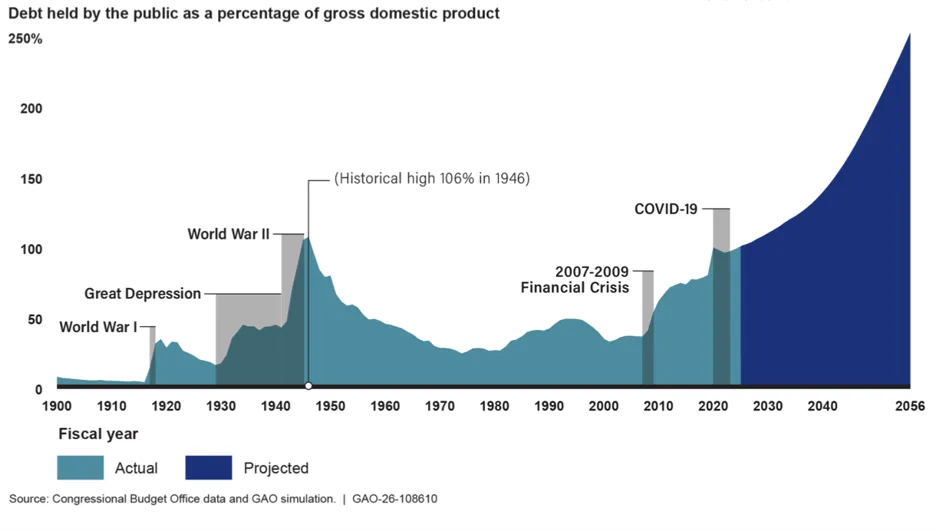
In its new report, “The Nation’s Fiscal Health,” the Government Accountability Office (GAO) projects the national debt will rise to 251 percent of Gross Domestic Product (GDP) by 2056 under a “current policy” baseline, while interest costs will explode to nearly 10% of GDP. As GAO explains, “This unsustainable fiscal outlook poses serious economic, national security, and societal challenges, potentially including lower wage growth, higher prices, and higher interest rates for household and business loans.”
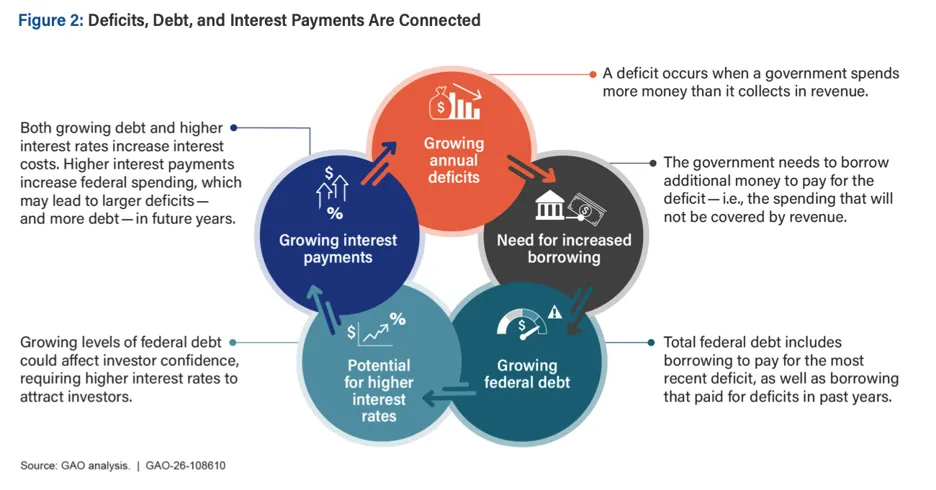
GAO’s report discusses the interplay between very high levels of debt (which recently surpassed the size of the economy), large primary imbalances, and rising interest costs. Without explicitly mentioning the likelihood of a debt spiral, GAO explains how high debt pushes up interest rates and interest costs, which lead to higher deficits and higher debt.
GAO warns that this outlook is unsustainable and would result in: higher interest rates for businesses, households, and governments; slower economic growth due to lower investment in capital and new technologies; and reduced flexibility to respond to unexpected events such as wars or financial crises.
To put the debt on a more sustainable path, GAO recommends:
- Setting a fiscal target, such as reducing deficits to 3% of GDP or stabilizing debt at 100% of GDP,
- Establishing fiscal rules to meet this target and “promote fiscal discipline,”
- Addressing the financial gaps in the Social Security and Medicare trust funds, and
- Reducing deficits by increasing tax compliance, reducing fraud and improper payments, and addressing ‘fragmentation, overlap, and duplication’, including in health care.
To meet a target of stabilizing debt at 100% of GDP by 2056, relative to GAO’s current policy baseline, the agency estimates lawmakers would need to run a 0.2% of GDP annual primary surplus, which could be achieved by increasing revenue by 26%, reducing spending by 21%, or some combination. Delaying action until 2037, the primary surplus would need to be 1.7% of GDP, requiring the equivalent of a 42% tax hike or 31% spending cut.
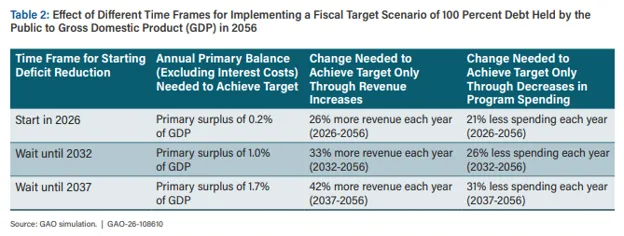
GAO emphasizes urgency, noting that waiting increases the number of policy changes and the costs needed to achieve sustainability. With the Social Security and Medicare trust funds nearing insolvency, a high debt-to-GDP ratio pushing up interest rates, and deficits compounding year after year, Americans are already feeling the effects. Left unaddressed, this trajectory raises the risk of a fiscal crisis and continued delay will harm the well-being of the American people. Putting the government on a sustainable path now, while the changes required are still manageable, would support stronger economic growth and a better future for Americans.