12-Month Rolling Deficit is $1.9 Trillion in July 2026
The federal government borrowed $1.9 trillion over the past 12 months according to new estimates from the Congressional Budget Office (CBO).
Based on data for the first 10 months of the fiscal year (FY), CBO now estimates that the FY 2026 deficit will be $2.1 trillion, compared to $1.9 trillion estimated in its February baseline. The increase is due to tariff revenues being around $250 billion lower than expected as a result of the Supreme Court's decision striking down the Trump Administration's International Emergency Economic Powers Act (IEEPA) tariffs, partly offset by higher than expected individual and payroll tax revenue.
CBO estimates that the July 2026 deficit totaled $431 billion – the difference between $765 billion in spending and $334 billion in revenues – or roughly $140 billion larger than in July 2025. However, timing shifts pushed payments that would have normally been made on August 1st into July. Accounting for those shifts, the July 2026 deficit would have been only $333 billion, or $41 billion larger than July 2025.
CBO estimates total spending in July 2026 was $135 billion above July 2025 levels or $37 billion higher when adjusted for timing shifts. Revenue totaled $334 billion in July – a decrease of $5 billion from last year – driven by a decline in collections of customs duties, mostly due to tariff refunds. Net customs duties were negative in July 2026 due to tariff refunds being issued.
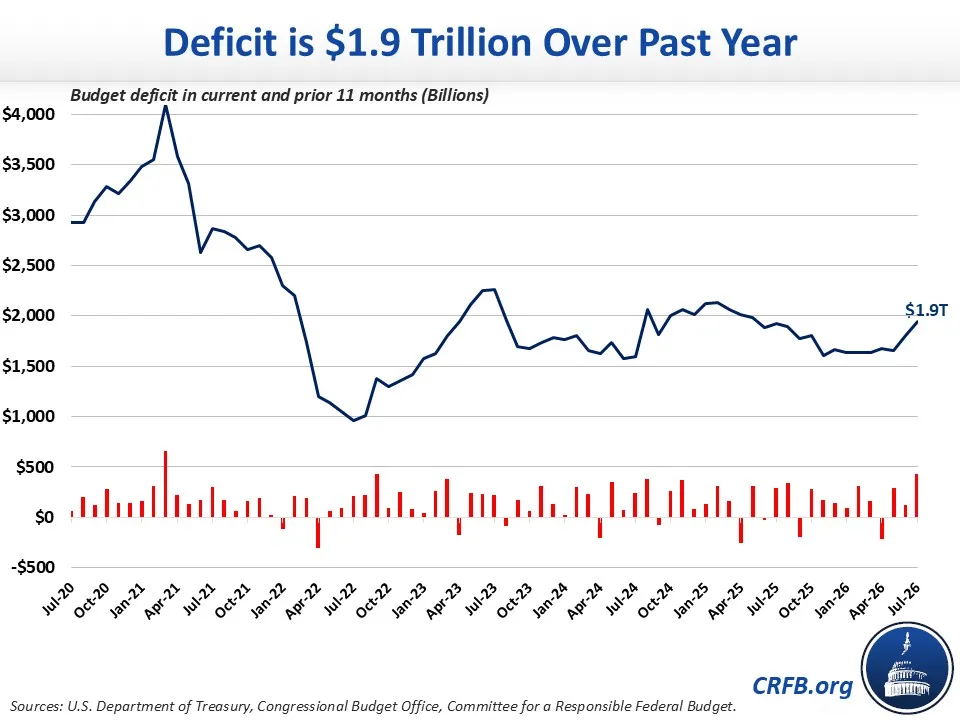
Over the past 12 months, total revenue was $5.4 trillion compared to $5.2 trillion over the same period a year prior. Spending was $7.3 trillion over the past 12 months compared to $7.1 trillion in the same period a year prior. We estimate the $1.9 trillion rolling deficit is about 6.1% of Gross Domestic Product.