A Flat-Rate COLA for Social Security
As part of our Trust Fund Solutions Initiative, which introduces novel ideas to shore up the Social Security, Medicare, and Highway programs, we recently proposed a Social Security COLA Cap – a dollar limit on the size of the cost-of-living adjustment (COLA) received by those with higher benefit levels.
As it turns out, the solution was not nearly as novel as we thought; the Committee for a Responsible Federal Budget’s own co-chair, former Congressman Tim Penny, proposed a similar idea when he was in Congress in 1987. Representative Penny’s “Flat-Rate COLA” would pay all beneficiaries the same COLA, set at the COLA received by a beneficiary at the 20th percentile, effectively combining our COLA cap with a ‘COLA floor’ at the same level.
We asked Karen Smith of the Urban Institute to estimate the impact of a Flat-Rate COLA set at an amount received by the 20th and 30th percentile beneficiary. At the 20th percentile, she found a Flat-Rate COLA enacted in 2027 would close half of Social Security’s 75-year shortfall relative to her baseline; at the 30th percentile it would close two-fifths of Social Security’s long-term gap. For comparison, imposing a COLA Cap at the median COLA would close about one-quarter of Social Security’s long-term imbalance.
Solvency Impacts of Different Reforms
| Solvency Gap Closed | ||
|---|---|---|
| 75-Year | 75th Year | |
| Flat-Rate COLA | ||
| At the 20th Percentile | 50% | 55% |
| At the 30th Percentile | 40% | 45% |
| COLA Cap | ||
| At the 75th Percentile | 10% | 10% |
| At the 50th Percentile | 25% | 30% |
| At the 90th Percentile | 5% | 5% |
| Change COLA Index | ||
| Use Chained CPI Instead of CPI-W* | 15% | 15% |
| Use CPI-E Instead of CPI-W* | -10% | -10% |
| Memo: 20th Percentile Flat-Rate COLA (1988 Start) | 75% | 55% |
| Memo: 20th Percentile Flat-Rate COLA and Employer Compensation Tax | 100% | 110% |
Source: Urban Institute’s DYNASIM4, ID1007 and ID1013 projections. The Flat-Rate COLA was evaluated using assumptions from the 2025 Social Security Trustees’ Report over the 75-year period beginning in 2025 whereas the COLA Cap and Employer Compensation Tax options were scored using assumptions from the 2024 Social Security Trustees’ Report over the 75 years beginning in 2024. The Trustees’ 2026 projections show a larger shortfall – at 4.42% of taxable payroll over 75 years versus 3.82% of payroll in last year’s projections – and so these options would likely close a smaller share of the gap if estimated today by the Chief Actuary. Figures are rounded to the nearest 5%.
*Based on 2025 scores provided by the Social Security Administration’s then-Office of the Chief Actuary, adjusted for the assumptions used in the 2026 Social Security Trustees Report.
Like the COLA cap, the Flat-Rate COLA would be highly progressive. If set at the 20th percentile, the bottom fifth of lifetime earners would see their benefits fall by just 3% in 2065, versus 19% for the top fifth of retirees.1 Set at the 30th percentile instead, the bottom quintile would enjoy a 1% benefit increase, while benefits for the top fifth would fall by 17%.
Both options would increase payable benefits for the lowest-income retirees, including a 13% to 14% increase for the bottom quintile. And both options would reduce old-age poverty below what it would be under scheduled benefits, with poverty estimated to fall 5% (0.3 percentage points) in 2065 under the 20th percentile option and by 10% (0.6 percentage points) under the 30th percentile option.
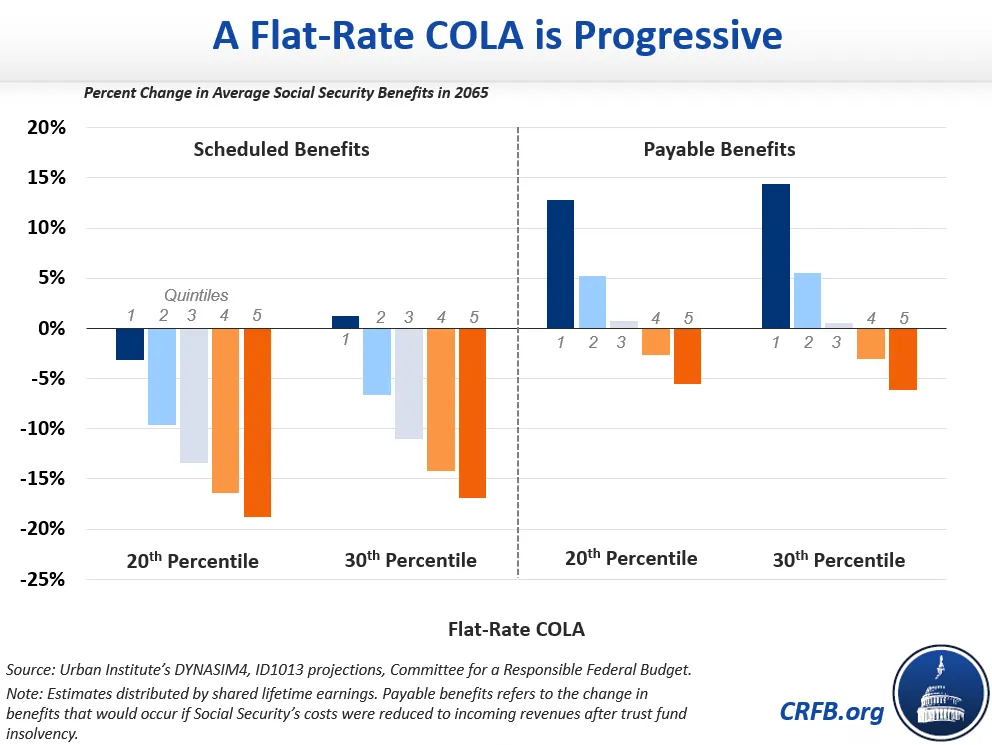
Like our COLA cap, the Flat-Rate COLA would slow the growth in benefits the most for those with the highest lifetime earnings – retirees likely to have the highest wealth and incomes – while continuing to pay those with higher initial benefits more than those with lower benefits over their whole lifetime. Also like the COLA cap, the Flat-Rate COLA would do little to disincentivize work or saving and would still provide inflation protection on some level of benefits.
Unlike our COLA cap, however, the Flat-Rate COLA would increase cost-of-living adjustments for low earners, improving benefit generosity for those most in need. In particular, low-income seniors who live into their 80s and 90s (and beyond) who have outlived any savings or work potential would benefit from real benefit growth over time.
On its own, a Flat-Rate COLA at the 20th percentile would only delay the insolvency of the theoretically combined Social Security trust funds by two years. But in combination with other policies, a Flat-Rate COLA could permanently restore solvency. For example, pairing this Flat-Rate COLA with our Employer Compensation Tax (ECT) that applies the employer half of the payroll tax to all wages and fringe benefits, the theoretically combined Social Security trust funds would remain solvent for 75 years and beyond under Urban’s 2025 baseline. Under the 2026 Trustees projections, which show a significant deterioration in Social Security’s long-term outlook, such a package might fall short of 75-year solvency but would get most of the way there.
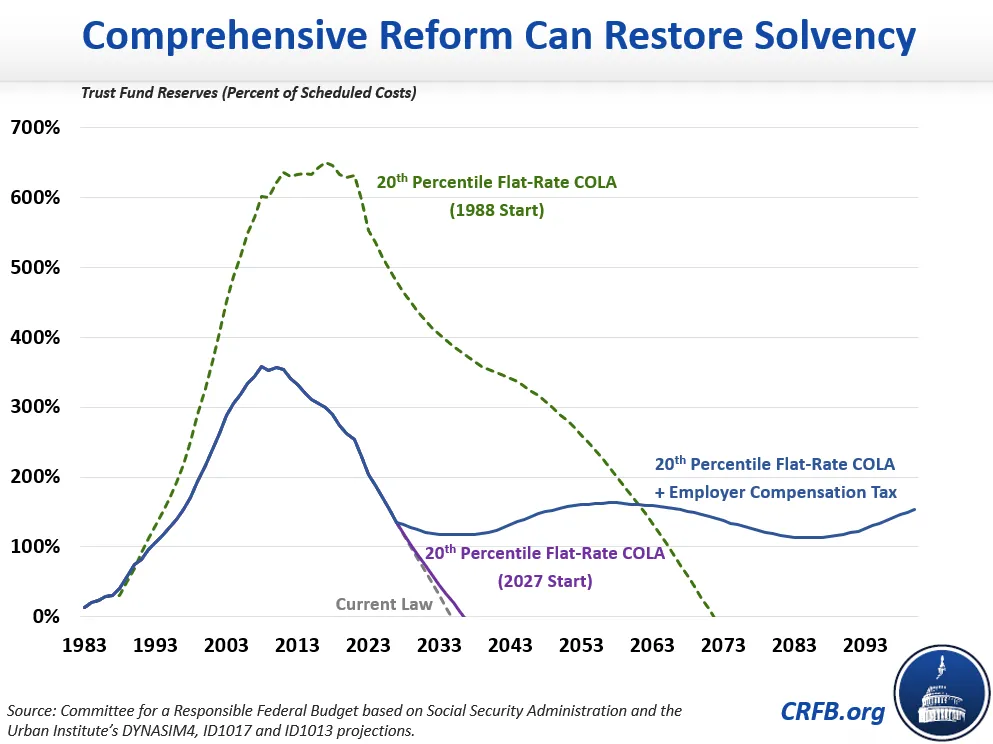
Had lawmakers enacted the Flat-Rate COLA at the 20th percentile in 1987 when Representative Penny proposed it, our rough estimates suggest it would have achieved 75-year solvency at the time, delaying insolvency out to 2071 for the theoretically combined trust funds.
This would have also covered about three-quarters of the solvency gap through 2100, buying substantial time and allowing for incremental reforms such as gradually increasing Social Security’s taxable maximum, raising the normal retirement age, or adjusting the benefit formula to close the remaining gap. Had lawmakers not waited, there would also be fiscal space for meaningful new targeted benefit enhancements.
While policymakers cannot change choices from the past, they still have time to enact timely and thoughtful trust fund solutions to save Social Security and prevent a 22% benefit cut. Many options are on the table, and they can do so in a way that strengthens retirement security, promotes economic growth, and enables healthy and productive aging.
Still, policymakers should have listened to Tim Penny when they had the chance.
1 Because of Social Security’s program rules, which base retired worker benefits on retirees’ own earnings histories, and which offer auxiliary benefits to certain eligible family members, the relationship between Social Security benefits and shared lifetime earnings is not strictly positive, but still highly correlated. As a result, the 20th percentile beneficiary used to determine the Flat-Rate COLA would be similar but not the same as the 20th percentile beneficiary based on lifetime earnings, and the bottom fifth of retirees may still face some reduction in benefits.
Tags
What's Next
-
Image

-
Image

-
Image