GAO: Up to $304 Billion in Tax Fraud Annually
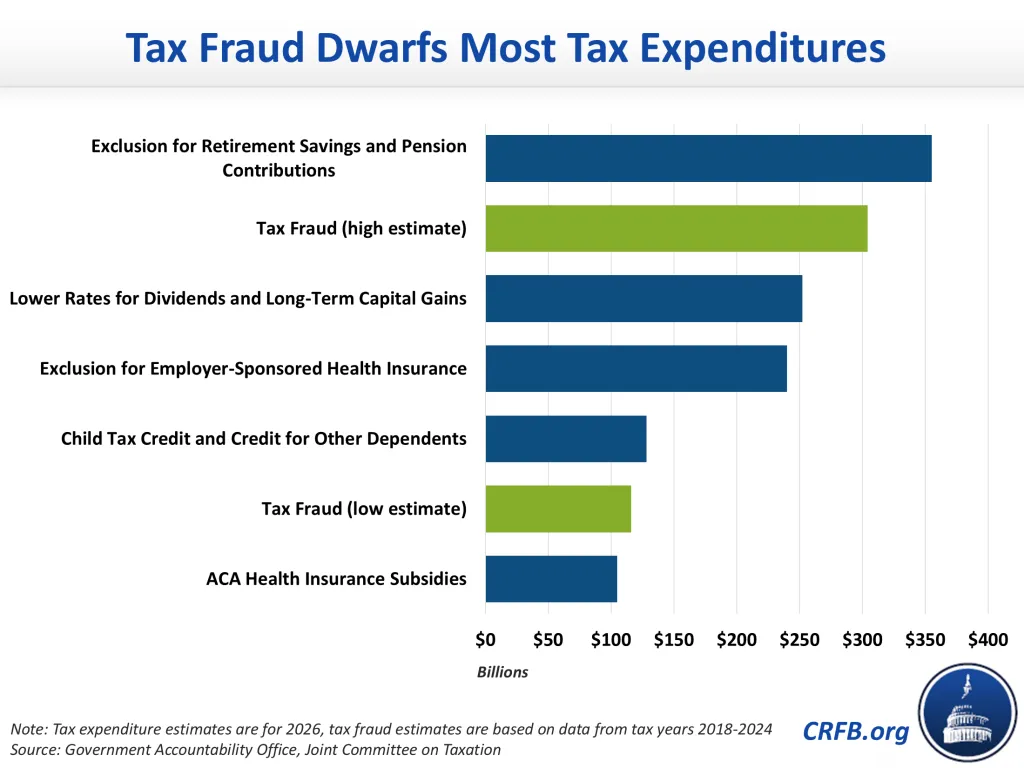
Tax fraud costs the federal government between $116 billion and $304 billion each year, according to a recent analysis by the Government Accountability Office (GAO) using data from 2018 through 2024. Those amounts constitute 2% to 6% of all tax revenue owed to the federal government if applied to tax year 2022, and it goes to show how enforcing the tax code is an important part of reducing waste, fraud, errors, and abuse in the federal budget.
Assuming the higher end of GAO’s estimate, this means annual revenue loss due to tax fraud is larger than all tax expenditures except for the exclusion for retirement savings and pension contributions. Even assuming the lower end of GAO’s estimate, revenue loss due to tax fraud would be larger than all but four tax expenditures.
For its analysis, GAO focused on three areas of tax fraud. The first is adjudicated tax fraud, or cases in which the government has successfully prosecuted a taxpayer for intentionally committing fraud. The second is detected potential fraud, where the government suspects fraud may have been committed but for various reasons does not go so far as to prosecute the taxpayer in question. The third is undetected fraud, most of which occurs in the “shadow economy,” which GAO defines as all legal economic activities that are purposefully hidden from the government.
GAO’s estimate of revenue loss due to tax fraud is similar to but not entirely the same as the Internal Revenue Service’s (IRS) estimates of the “tax gap” – the difference between the amount of tax revenue the federal government is technically owed each year and the amount that it actually collects – which the IRS estimated to be $606 billion in tax year 2022. GAO’s analysis is strictly focused on tax fraud, which by definition must be intentional. The IRS’s estimates of the tax gap, on the other hand, include both intentional noncompliance, or fraud, and unintentional noncompliance, such as errors or misunderstandings. Furthermore, GAO’s analysis includes tax revenue lost due to criminal activity like identity theft, whereas the IRS’s tax gap estimates do not.
GAO’s analysis makes clear that, even at the low-end of the estimate range, tax fraud represents a significant amount of lost revenue for the federal government each year. Increasing funding for the IRS’s enforcement activities has long been known as an effective way to raise revenue without increasing taxes and has received support from presidents of both parties in the past. Policymakers should heed the GAO’s analysis and begin the work needed to reduce fraud and improve the efficiency and effectiveness of the tax code.