CBO Projects Social Security Nearing Insolvency
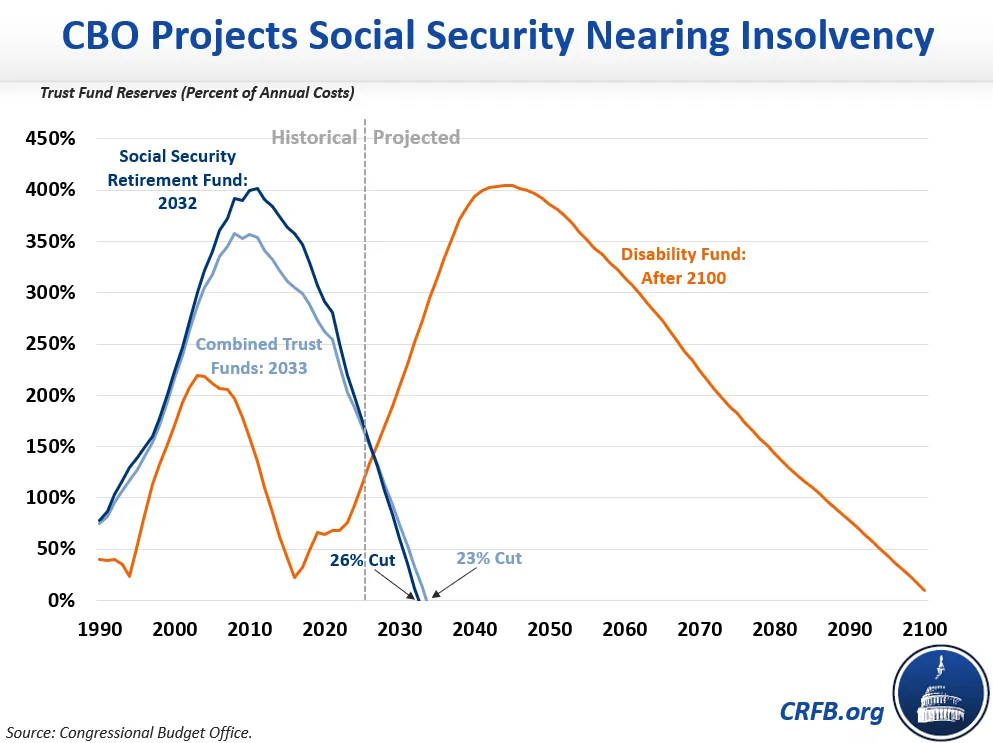
Social Security’s retirement trust fund will be insolvent by mid-2032, according to the latest projections from the Congressional Budget Office (CBO), the same year Social Security’s Trustees are expecting insolvency. Over the next 75 years, CBO projects a shortfall of 1.6% of Gross Domestic Product (GDP), or 4.6% of taxable payroll. Upon insolvency, CBO projects retirees will face a deep 26% benefit cut, rising to 40% by the end of the century.
Assuming policymakers reallocate funds from the financially stronger disability fund, the theoretically combined funds would still run out by 2033 and beneficiaries would still face a 23% cut, growing to 37% by 2100.
The looming insolvency of the Social Security trust funds is driven by a fundamental imbalance between the program’s costs and revenues. Social Security’s costs have grown from 10.7% of taxable payroll in 1990 to 13.5% in 2010 and to 15.0% today. CBO expects these costs to continue growing – to 16.5% of payroll by 2032 and to 21.0% by the end of the century. Meanwhile, revenues are failing to keep up, having grown only from 12.7% of payroll in 1990 to 12.9% today, and growing slowly toward 14% of payroll by some point in the 2100s (due to growing income taxation of benefits).
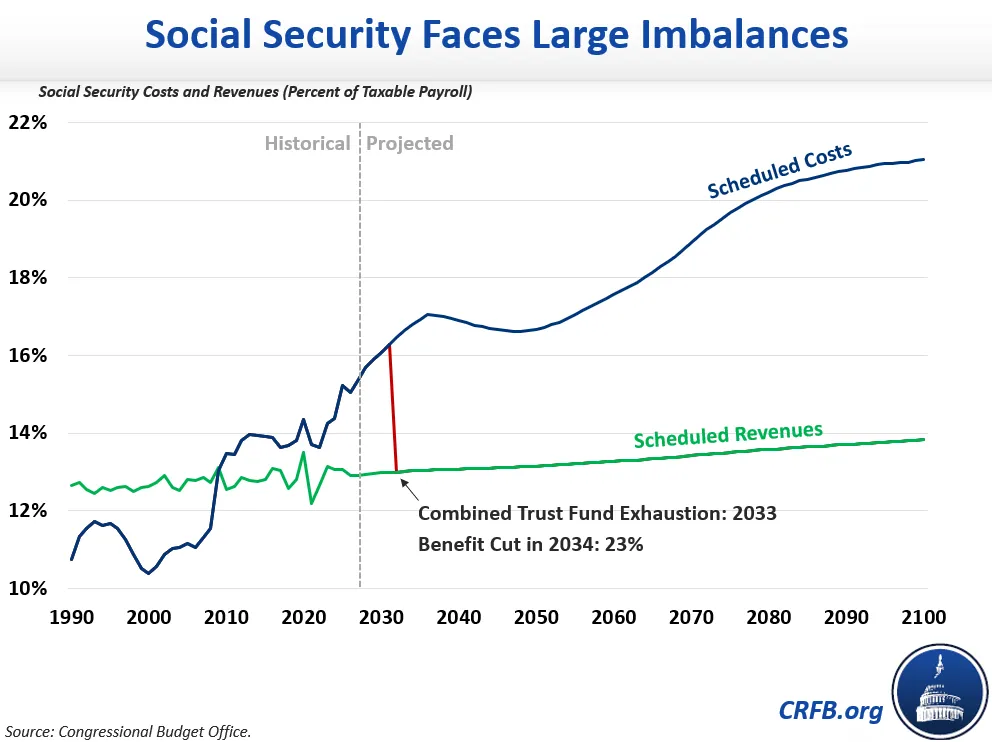
This divergence between Social Security’s costs and revenues is expected to drive growing annual shortfalls through to the end of the century. By 2032, CBO projects Social Security’s revenues will fall short of costs by 3.5% of payroll (1.2% of GDP), up from 2.1% today. By 2100, CBO projects those deficits will double to 7.2% of payroll (2.4% of GDP).
Over the full 75-year period, CBO projects the combined Social Security program will face an actuarial deficit equal to 4.6% of taxable payroll, or nearly 1.6% of GDP.
In other words, Social Security faces a solvency gap equal to one-quarter of projected benefits or one-third of projected revenue. It faces a long-term structural gap equal to more than one-third of projected benefits and one-half of projected revenue.
CBO’s projections are roughly in line with – though worse than – those of the Social Security Trustees, who project Social Security faces a long-term financing gap of 4.4% of taxable payroll (1.5% of GDP) and who also expect Social Security’s retirement fund to run out of reserves in 2032.
Key Comparisons Between the Social Security Trustees' and CBO's Projections
| Social Security Trustees | CBO | |
|---|---|---|
| Insolvency of Social Security's Retirement Fund | 2032 | 2032 |
| Insolvency of the Combined Trust Funds | 2034 | 2033 |
| Retirement Benefit Cut After Insolvency | 22% | 26% |
| Retirement Benefit Cut in 2100 | 38% | 40% |
| Combined Program Long-Term Shortfall | 4.42% of taxable payroll (1.54% of GDP) | 4.57% of taxable payroll (1.56% of GDP) |
| Combined Program Annual Deficit in 2100 | 6.57% of taxable payroll (2.19% of GDP) | 7.22% of taxable payroll (2.44% of GDP) |
Source: Congressional Budget Office, Social Security Administration
Trust fund solutions are urgently needed to save Social Security and to protect retirees from a benefit cut that CBO projects will be as high as 26%. The release of CBO’s 2026 Social Security projections is a timely reminder of the danger facing retirees if policymakers fail to act. The longer it takes to address Social Security’s solvency shortfall, the greater the cost of fixing it will become. Timely action would limit the scale of the adjustments, provide more time to phase in needed reforms, and create additional opportunities to enact targeted benefit enhancements.