PWBM Shows Social Security Solvency Would Improve Fiscal Outlook, Boost Growth
Restoring solvency to the Social Security trust funds could grow the economy and help fix the debt, according to recent estimates of different Social Security solvency packages from Penn Wharton Budget Model (PWBM). PWBM estimates the Social Security solvency packages they analyzed would increase 2060 Gross Domestic Product (GDP) by anywhere from 0.4% to 12.1% and reduce the debt-to-GDP ratio by 14% to 27% in that year.
PWBM modeled the effects of seven solvency packages that combine revenue and benefit changes in a variety of proportions. Among other changes, the packages include policies to raise Social Security’s taxable maximum ("tax max"), increase the 12.4% payroll tax rate, impose a surtax above the tax max, adopt chained CPI for cost-of-living adjustments (COLAs), raise the retirement age, make the benefit formula more progressive, or enact a version of CRFB’s COLA cap so that the highest earners receive the same COLA as those lower down the income spectrum.
PWBM finds that all seven of the packages would increase the size of the economy in 2060 relative to borrowing to pay full benefits – with benefit-heavy packages tending to grow the economy more than revenue-heavy ones. PWBM’s estimates are in line with CRFB’s analysis of a 2019 proposal from CRFB’s Marc Goldwein, Maya MacGuineas, and Chris Towner, which found thoughtful reform could boost Gross National Product by over 8% by 2050.
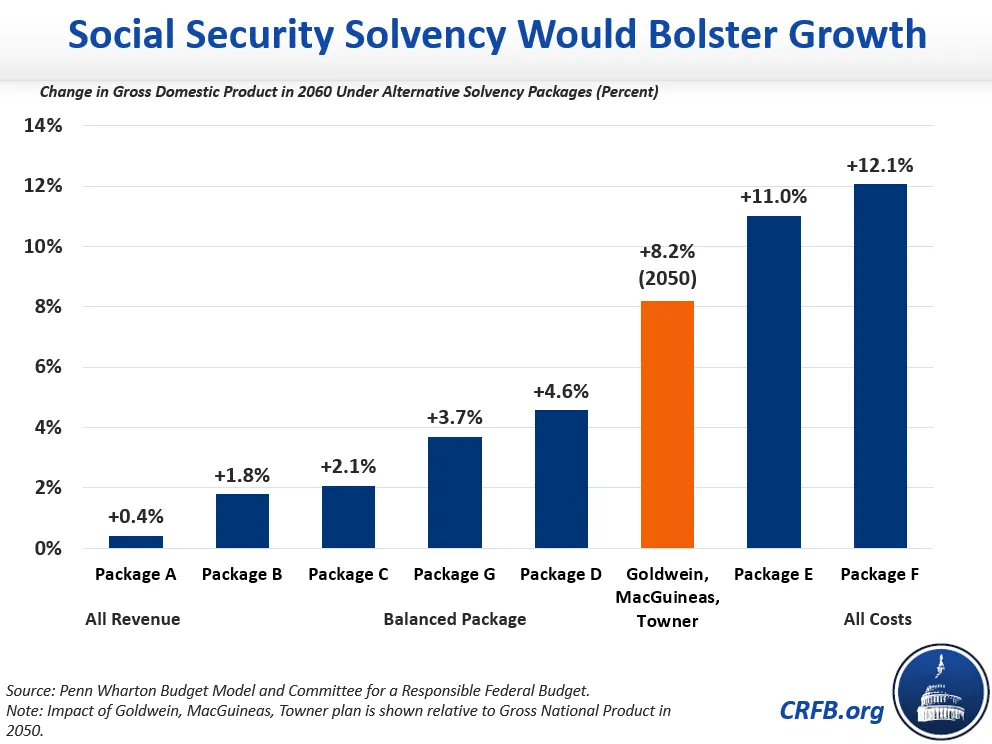
For example, PWBM finds that packages that combine significant revenue and benefit adjustments – such as PWBM’s Package G or D – would increase GDP by 3.7% to 4.6% by 2060, the equivalent of increasing economic growth by 0.1% per year or more.
PWBM’s benefit-heavy runs grow the economy even more, boosting output by up to 12% by 2060 and thereby increasing economic growth by up to 0.3% per year – though these packages would require significant changes in benefits for retirees currently on the program.
Social Security solvency bolsters economic growth through several channels. The current program creates powerful incentives and signals around how much, when, and whether to work, save, and retire. Reforms can thus lead to increased work, delayed retirement, higher labor force participation, and greater private savings.
The stronger growth from the benefit-heavy packages appear to be partially driven by the effects on incentives to work, save, and invest and partially by specific design elements that lead the benefit-heavy options to reduce the federal debt more than the revenue-heavy options. but largely because the benefit-heavy options do more to reduce unfunded obligations and as a result boost private savings and investment.
Solvency-improving reforms will also, by definition, reduce federal borrowing relative to a scenario where full benefits are paid without funding (as under CBO’s baseline). By 2060, PWBM estimates the packages they evaluate would reduce federal debt by between 13% and 19% and – after considering dynamic effects – reduce the debt-to-GDP ratio by 14% to 27%.
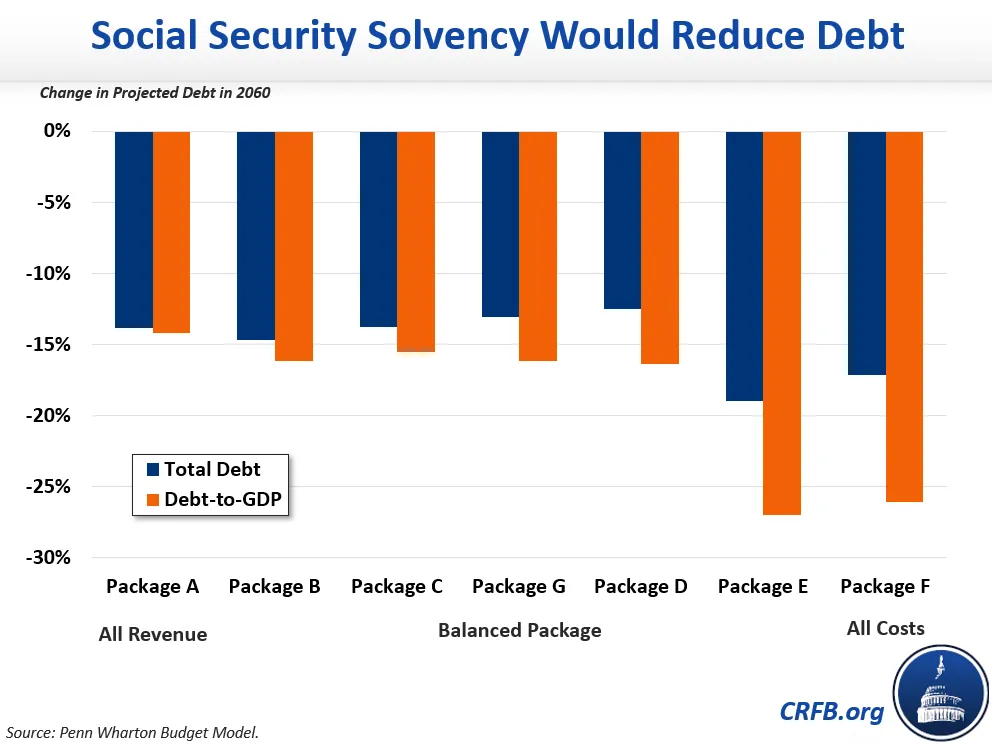
The combination of greater savings and lower national debt would boost private capital by between 2% and 27% under the packages PWBM analyzes while increasing wages by 1% to 11% and boosting hours worked by as much as 2%.
PWBM’s estimates showcase the many benefits of achieving Social Security solvency: federal finances would become more sustainable and, partly as a result, the size of the economy would increase, raising overall living standards. With the insolvency of the Social Security retirement trust fund just six years away, policymakers should act quickly to enact needed reforms and prevent the deep 22% benefit cut facing retirees in 2032. The earlier policymakers act, the smaller the necessary adjustments will have to be, the more time there will be available to phase in reforms, and the greater the number of opportunities they will have to enact targeted benefit enhancements.