CBO Estimates Golden Dome Could Cost More than $1 Trillion
Earlier this year, the Congressional Budget Office (CBO) released an analysis estimating the 20-year cost of a National Missile Defense (NMD) system based on President Trump’s 2025 executive order, titled “The Iron Dome for America,” which outlines the basic capabilities and requirements of such a system. On September 29th, the Senate Armed Services Committee's Subcommittee on Strategic Forces held a hearing featuring testimony from David Mosher, CBO's National Security Division Director, whose testimony was based on the report.
While the Trump Administration has not released further details regarding the architecture or components of the NMD system they’re now calling Golden Dome for America, CBO estimated that an illustrative system designed to meet all of the objectives and requirements laid out in the President’s executive order would cost roughly $1.2 trillion to build, operate, and maintain over a 20-year period.
The system envisioned by CBO would be made up of four distinct, stacked interceptor layers designed to engage different kinds of missiles and other aerial threats at various altitudes, as well as a new satellite constellation for tracking and targeting threats.
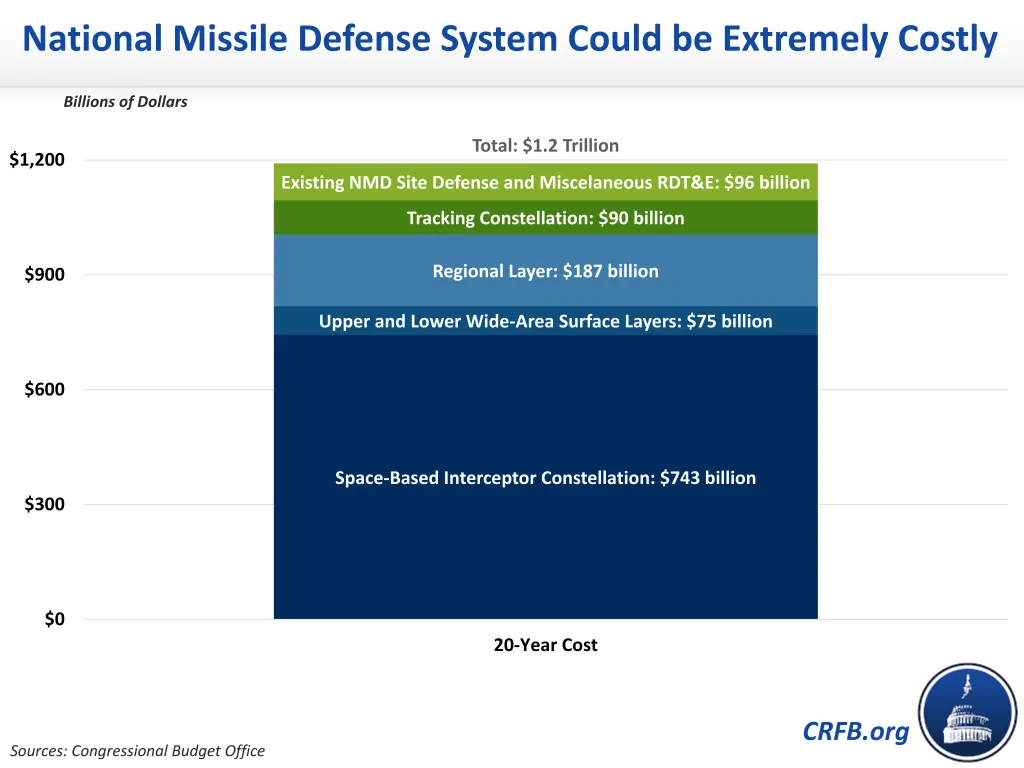
The “top” layer – and easily the most expensive – would be a constellation of approximately 7,800 satellites in Low-Earth Orbit (LEO) armed with two interceptor missiles a piece. CBO estimates this layer would cost $734 billion over 20 years, mainly due to the need to constantly replace satellites that fall out of orbit. CBO estimates the government would have to procure and launch roughly 30,000 interceptor satellites over 20 years in order to maintain a 7,800 satellite constellation.
The next two layers – the upper and lower wide-area surface layers – would consist of a handful of missile sites placed strategically around the United States, some of which already exist. CBO estimates their 20-year cost at $46 billion for the upper-wide area surface layer and $29 billion for the lower-wide area surface layer.
The final layer would be a “regional” layer, composed of dozens of smaller missile sites scattered throughout the country. CBO estimates that 35 of these regional sites would be sufficient to cover the vast majority of the American population at a cost of $187 billion over 20 years.
In addition to the various interceptor layers, President Trump’s executive order calls for a new constellation of tracking satellites capable of simultaneously tracking multiple missiles and other aerial threats anywhere on Earth. The constellation would consist of 135 satellites – 108 in LEO and 27 in medium-Earth orbit – at an estimated cost of roughly $90 billion over 20 years.
CBO’s estimate also includes a budget of $4 billion to establish self-defense systems for existing missile defense sites that would be incorporated into the overall NMD system, as well as a $92 billion budget for general research, development, testing, and evaluation (RDT&E) expenses related to the system.
Importantly, while the NMD system CBO envisions would certainly be more capable than America’s current missile defense systems, it would not be invincible. CBO’s illustrative system is designed to engage up to ten Intercontinental Ballistic Missiles (ICBMs) launched simultaneously from anywhere on Earth, but could easily be overwhelmed by an attack of dozens or hundreds of ICBMs launched by a major nuclear power such as Russia or China.
Also important to note is the significant difference between CBO’s estimate of its illustrative NMD system and the Trump Administration’s own estimates. The Director of the Office of Golden Dome for America has estimated the system will cost $185 billion over the next ten years to develop and deploy, and the President’s FY 2027 budget includes a request for an average of $15 billion per year over the next ten years for the Golden Dome for America Fund. While it is impossible to pinpoint the exact reasons for the discrepancy in these estimates due to the lack of detail from the Trump Administration, the size of the discrepancy seems to indicate the administration is considering a much different system than envisioned by CBO.
Regardless of whether it costs $1.2 trillion or $185 billion, such a system would represent a significant expense that would have to be offset to avoid adding to our large and growing national debt – itself a national security risk. Policymakers should carefully consider whether this new defense system is worth the cost, work to ensure it is produced as efficiently as possible, and offset the costs – preferably twice over – by reprioritizing existing defense dollars or identifying new spending cuts or tax increases.
What's Next
-
Image

-
Image

-
Image