What's in the House FY 2027 Budget Resolution?
The House Budget Committee released a Fiscal Year (FY) 2027 budget resolution today. Unlike a typical budget resolution, which outlines spending and revenue levels for the upcoming year and decade with specific targets, this budget appears to only be intended to facilitate reconciliation legislation to fund defense and other priorities. While the budget includes budgetary totals, it lacks significant detail on where any savings would come from.
In summary, the House’s proposed FY 2027 budget resolution:
- Allows the House to write reconciliation legislation that adds up to $95 billion to primary deficits through FY 2036, which could add about $130 billion to the debt including interest costs.
- Calls for nearly $3.4 trillion in unspecified government-wide savings, $2.6 trillion in savings from unspecified macroeconomic feedback effects, and $1.7 trillion in interest savings.
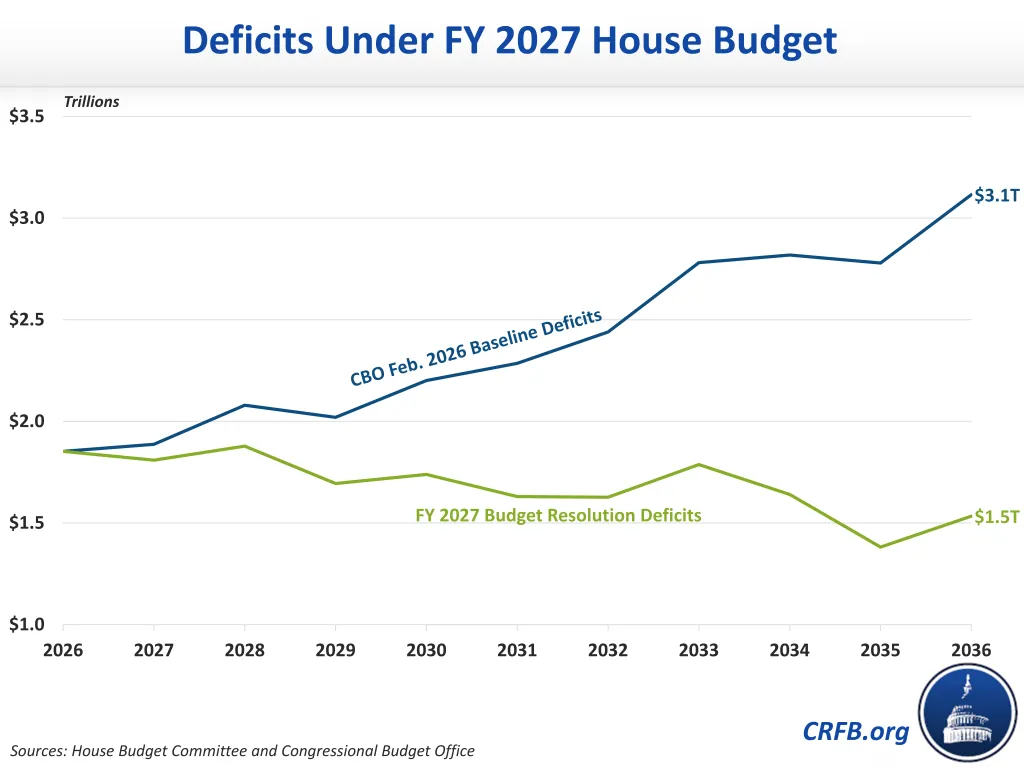
- Reduces deficits from roughly $1.9 trillion in FY 2026 to $1.8 trillion in 2027, $1.7 trillion in 2029 and 2030, and $1.5 trillion by 2036.
- Makes no concrete progress on enacting deficit-reducing policies.
While we have argued that another round of reconciliation should achieve significant net deficit reduction – as the reconciliation process was intended to do – this budget lays the groundwork for a reconciliation bill that would do the exact opposite and increase deficits, just like the reconciliation bills from July 2025 (the One Big Beautiful Bill Act) and June 2026 (the Secure America Act) did.
Reconciliation Instructions in the House’s FY 2027 Budget Resolution
The House’s proposed FY 2027 budget resolution includes reconciliation instructions to four House committees, allowing for up to $95 billion in primary (non-interest) deficit increases over the coming decade. Without offsets, we estimate legislation borrowing up to this total would add roughly $130 billion to debt including interest.
Reconciliation Instructions in the House FY 2027 Budget Resolution
| Primary Deficit Increase (FY 2027-2036) | |
|---|---|
| Armed Services Committee | $60 billion |
| Permanent Select Committee on Intelligence | $13 billion |
| Agriculture Committee | $12 billion |
| House Administration Committee | $10 billion |
| Primary Deficit Increase | $95 billion |
| Potential Interest | $35 billion |
| Total Debt Increase | $130 billion |
Sources: House FY 2027 budget resolution and CRFB estimates.
While the budget resolution itself does not include details regarding exactly what this funding would go toward, the $60 billion instruction for the Armed Services Committee is slightly less than the amount of military funding included in the White House’s supplemental funding request, most of which was earmarked for the ongoing war in Iran and replenishing military stockpiles. Likewise, the $12 billion instruction for the Agriculture Committee is similar to the amount included in the White House supplemental request, which was mostly earmarked for temporary economic assistance to farmers.
Reporting indicates that the $10 billion instruction for the House Administration Committee is related to enactment of some version of the Safeguard American Voter Eligibility (SAVE) Act. However, the budget includes no explanation for that amount of funding. Likewise, the budget includes no details or specifics regarding the $13 billion instruction for the House Permanent Select Committee on Intelligence.
Budgetary Totals in the House FY 2027 Budget Resolution
The budget’s accompanying tables include spending, revenue, deficit, and debt totals for the upcoming fiscal year and over the coming decade. While the budget does appear to target reducing deficits significantly, it relies entirely on unspecified savings.
The largest pot of savings comes from “Government-Wide Savings,” which totals $3.4 trillion in spending cuts over the decade. None of those savings are allocated to any particular budget function or committee.
The budget also assumes $2.6 trillion in deficit reduction from “Macroeconomic Impact on the Deficit.” While the budget does not explain where this macroeconomic feedback comes from, we assume it to mean higher economic growth than projected under CBO’s baseline economic projections – likely in the realm of 2.6% average annual real GDP growth, which was assumed in the House’s FY 2025 budget resolution and would be 0.8 percentage points higher than CBO’s baseline projections.
Finally, it includes about $1.7 trillion in lower net interest outlays compared to CBO’s February baseline.
Claimed Deficit Impact in FY 2027 Budget Resolution Compared to CBO June 2026 Projections
| Ten-Year Totals (FY 2027-2036) | |
|---|---|
| Unspecified Government-Wide Savings | -$3.4 trillion |
| Macroeconomic Feedback | -$2.6 trillion |
| Interest Savings | -$1.7 trillion |
| Non-Interest Baseline Spending Differences | +$60 billion |
| Total Claimed Deficit Impact Relative to CBO Baseline | -$7.6 trillion |
Note: Numbers are rounded to the nearest $10 billion
Sources: CRFB estimates based on FY 2027 budget resolution and CBO projections.
The budget appears to be based on CBO’s February 2026 baseline and therefore assumes the same amount of revenue, despite several significant tariff changes since that baseline was published. Likewise, CBO updated its spending projections in June to account for the Secure America Act and final FY 2026 appropriations – that difference results in about $60 billion of lower primary spending than implied by the baseline used for this budget. Altogether, we estimate that this budget calls for roughly $7.6 trillion of deficit reduction relative to a baseline assuming CBO’s updated June spending projections.
The budget calls for deficits to fall to $1.8 trillion in FY 2027 and $1.7 trillion in 2029, hover between $1.6 trillion and $1.8 trillion annually through 2034, fall to $1.4 trillion in 2035, and then rise to $1.5 trillion by the end of the budget window in 2036. Using CBO’s latest GDP projections and incorporating all savings included in the budget resolution, this would reduce deficits to just over 3% of GDP by 2036; using the more aggressive real GDP growth assumed in the House’s FY 2025 budget – around 2.6% annual growth – would mean that deficits would fall to 3% of GDP by 2036.
Debt held by the public would fall commensurately as well. Under CBO’s GDP projections and incorporating all the budget resolution’s savings, debt held by the public would total about 104% of GDP by FY 2036 compared to baseline projections of 120%. If GDP growth were to average the 2.6% per year assumed in the House’s FY 2025 budget resolution, the debt-to-GDP ratio would be significantly lower – around 96% of GDP by 2036.
Missing from the Budget: Deficit Reduction Instructions
Despite a high and rising national debt, trillion-dollar annual interest payments, and deficits that are double the 3% of GDP target, this budget puts forward no concrete steps to reduce deficits. Instead, the budget includes reconciliation instructions that would allow lawmakers to add upwards of $130 billion to the debt over the next decade.
This would be a significant misstep. Given that there has been so much attention to tackling waste, fraud, errors, and abuse in the budget, it should not be difficult for lawmakers to come up with at least as much savings as proposed costs. CBO projects that the federal government will spend $78 trillion over the next decade before interest – finding $95 billion in savings would represent 0.1% of that total. There are tens of trillions of dollars of savings available to lawmakers to offset their priorities; ideally they would enact $2 of savings for every $1 of costs using Super PAYGO.