Proposed Tariff Actions Could Raise Revenue by Nearly $1 Trillion
The Trump Administration recently proposed new tariffs on imports from 60 economies using Section 301, which allows the President to impose trade remedies against unfair trade practices. The White House justifies these tariffs by claiming the economies have failed to “impose and effectively enforce a forced labor import prohibition.”
In practice, the new tariffs look similar to the recently imposed Section 122 tariffs, but unlike the temporary Section 122 tariffs, Section 301 tariffs are not subject to a statutory time limit and may remain in effect until the Administration determines they are no longer necessary to address the unfair trade practices. If implemented and made permanent, we estimate these new tariffs – along with some adjustments to steel, aluminum, and copper tariffs under Section 232 – will increase federal revenues by about $970 billion through Fiscal Year (FY) 2036.
Conventional Estimates of Net Tariff Revenue Impact Through FY 2036
| Revenue Impact | |
|---|---|
| Proposed Section 301 Tariffs | +$980 billion |
| Recent Changes to Steel/Aluminum/Copper Tariffs | -$10 billion |
| Impact of Proposed and Enacted June 2026 Tariff Policies | +$970 billion |
| Tariffs Enacted through November of 2025 | +$2.7 trillion |
| Impact of IEEPA Removal Due to Court Ruling* | -$1.7 trillion |
| Temporary Section 122 10% Tariff | +$35 billion |
| Changes to Steel/Aluminum/Copper Tariffs | -$90 billion |
| Impact of All Proposed and Enacted Tariffs | +$1.9 trillion |
| Memo: Total Lost Revenue Since November 2025 | -$800 billion |
Sources: CRFB estimates based on Congressional Budget Office resources and CRFB modeling.
Notes: Numbers are rough and rounded. * Estimate for revenue loss from Supreme Court ruling against IEEPA tariffs includes refunds.
Earlier this year, the Supreme Court affirmed lower court rulings that tariffs imposed under the International Emergency Economic Powers Act (IEEPA) were illegal, reducing federal revenue by $1.7 trillion through 2036 relative to the Congressional Budget Office’s February 2026 baseline. In response, the Administration enacted a temporary, 150-day 10% Section 122 tariff with exemptions that roughly mirrored those of tariffs enacted under the IEEPA, replacing over half the lost revenue but only for five months.
Last week, the Administration proposed new tariffs for 59 economies and the European Union that together comprise about 95% of our imports, by dollar value. The United States Trade Representative determined that these countries failed to prohibit imports produced with forced labor and found that this practice burdens U.S. commerce and is actionable under Section 301 of the Trade Act of 1974.
Under the proposed Section 301 tariffs, goods from Canada, Mexico, the European Union, Indonesia, Ecuador, and Pakistan would be subject to an additional tariff rate of 10%. Goods from all other targeted economies – including China, the United Kingdom, and India, among others – would face an additional rate of 12.5%. Those subject to a 10% rate were determined to have failed to effectively enforce a prohibition on the importation of goods produced with forced labor, while those subject to a 12.5% rate have failed to both impose and enforce such a prohibition. Goods exempted from these tariffs largely resemble those exempted under IEEPA and Section 122.
Based on our trade modeling – which incorporates a modified version of CBO's tariff model with CRFB adjustments to reflect recent changes to tariffs – we estimate these tariffs would generate about $980 billion over the next decade.
The Administration has also made further changes to steel and aluminum tariffs. Most notably, the Administration has reduced the rate for some derivative products to 15% from 25% and reduced the threshold for imported products to qualify as made “entirely” from American aluminum, steel, or copper from 95% to 85% – which are then granted reduced rates.1 We estimate these changes will reduce revenue by about $10 billion over the next ten years.
The combined $970 billion of revenue from these actions, through FY 2036, will replace roughly half of the projected revenue loss from the Supreme Court’s ruling against IEEPA tariffs in February.
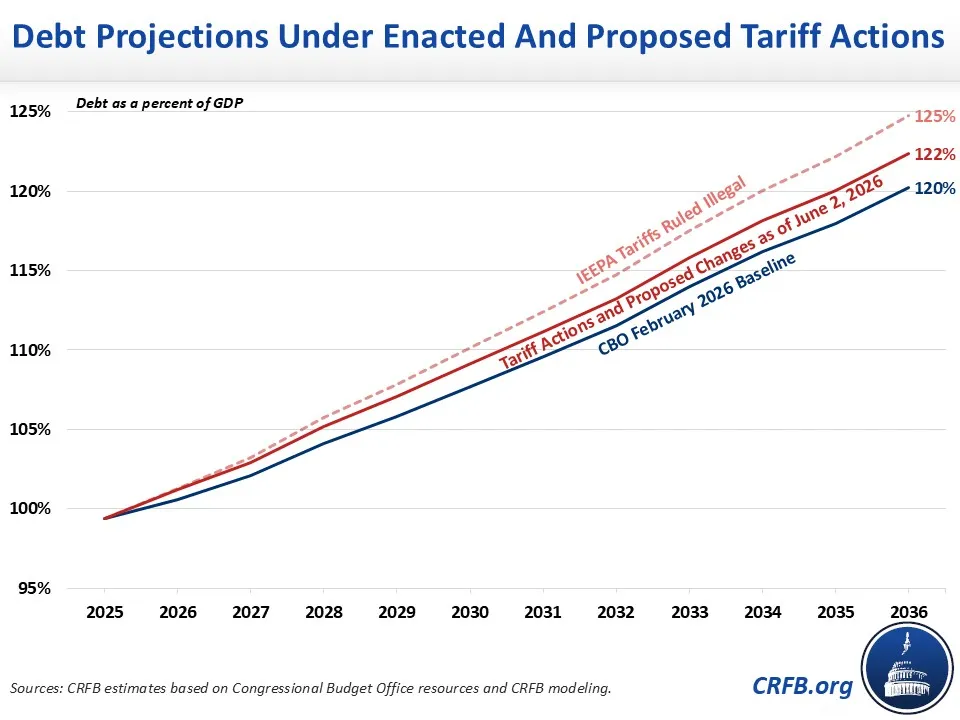
Incorporating these new tariffs, we project tariffs enacted under this Administration since January 2025 will raise $1.9 trillion of federal revenue through FY 2036, up from $1.0 trillion after the court ruling but down from an estimated $2.7 trillion under CBO’s February baseline. Assuming no other policy changes outside of tariffs, we estimate debt will rise to 122% of Gross Domestic Product (GDP) by 2036 with these tariffs in effect – down from 125% after the court ruling but up from 120% under CBO’s February projection.
Importantly, these new tariffs may also face legal challenges. The temporary Section 122 tariffs enacted in February were recently ruled illegal by the U.S. Court of International Trade, pending an appeal, and challenges could emerge to the new Section 301 tariffs as well. The U.S. Trade Representative will hold hearings about the proposed actions under Section 301 on July 7, 2026.
Assuming the proposed Section 301 tariffs are legal and implemented as proposed, they will help to replace about half the lost IEEPA tariff revenue; more action will be needed to fully offset the lost revenue. Additional savings could come from further tariffs, alternative forms of revenue raising, or spending reductions.
1 Our modeling assumes no impact from changing this threshold from 95% to 85%.