Research Shows Sovereign Debt Fund Likely to Fail, Increase Debt
President Trump has reportedly expressed interest in Senator Bill Cassidy’s (R-LA) proposal to establish a “Sovereign Debt Fund” to help fund Social Security, according to an interview with Senator Cassidy. This proposal would not only authorize massive levels of new debt, but based on recent research from the Center for Retirement Research at Boston College, it would very likely fail to generate sufficient returns even if it works as intended. Based on their median simulation, we estimate that the new investment would cover less than half of Social Security’s shortfall assuming high expected returns and less than one-tenth with low returns.
The Sovereign Debt Fund proposal would issue $1.5 trillion of debt, invest those funds in the stock market, and then allow Social Security to borrow to pay benefits for the next 75 years in the hopes that the investment fund would have enough assets to repay that borrowing by that point in time.
On an inflation-adjusted basis in 2026 dollars, we estimate this proposal would issue or authorize $150 trillion of additional debt over 75 years using Congressional Budget Office (CBO) projections, with $6 trillion of the debt to finance the investment fund and a massive $144 trillion to finance benefits in excess of revenue. The borrowing would total $655 trillion on a nominal basis and 150% of GDP by 2100. Based on the Social Security Trustees’ projections, the additional authorized borrowing would total $195 trillion on an inflation-adjusted basis in 2026 dollars, roughly $875 trillion nominally, and 175% of GDP.
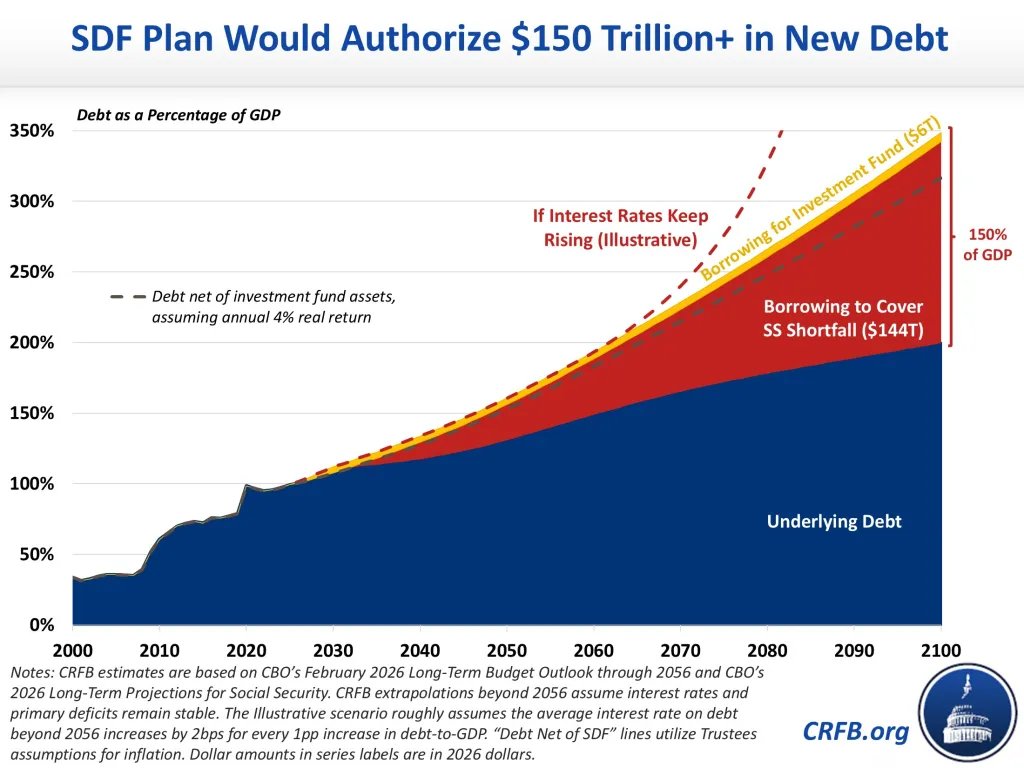
We previously warned that this level of debt could spark a fiscal crisis and also warned that the proposal would expose Social Security to significant stock market risk, push up interest rates on government debt, lower returns on private investment accounts, make the federal government a major shareholder of private companies, end Social Security’s current structure as a self-financed contributory program, and open the door to “free lunch” budget gimmicks for future tax cuts or spending.
Anqi Chen, Alicia Munnell, and Jean-Pierre Aubry of the Center for Retirement Research at Boston College raise a further concern: The proposal is unlikely to generate the needed returns even if it works as intended.
The authors ran 30,000 simulations based on different possible average rates of return to determine how much of the Social Security shortfall would be closed based on the 2025 Trustees’ Report. We’ve adjusted these estimates for the estimated shortfall from the 2026 Trustees’ Report, which incorporates more accurate demographic assumptions and the effects of the One Big Beautiful Bill Act (OBBBA).
Incorporating these adjustments, a 6.5% real (8.9% nominal) return on investment each year would theoretically generate a balance over 75 years nearly large enough to cover the borrowing authorized under the plan. Yet running this through a simulation that accounts for the possibility of high and low years, the research suggests the Sovereign Debt Fund would cover less than half of the borrowing it authorizes. In only about 30% of simulations would the fund return enough to cover all the borrowing.
The authors also point out that a 6.5% real average return is likely optimistic given the current strength of the stock market and the potential negative impact of issuing so much more debt, among other reasons. Under two other scenarios – a 4% mean real return or a 3.5% return with a 30-basis point boost in interest rates – we estimate the fund would only cover one-tenth to one-sixth of new borrowing.
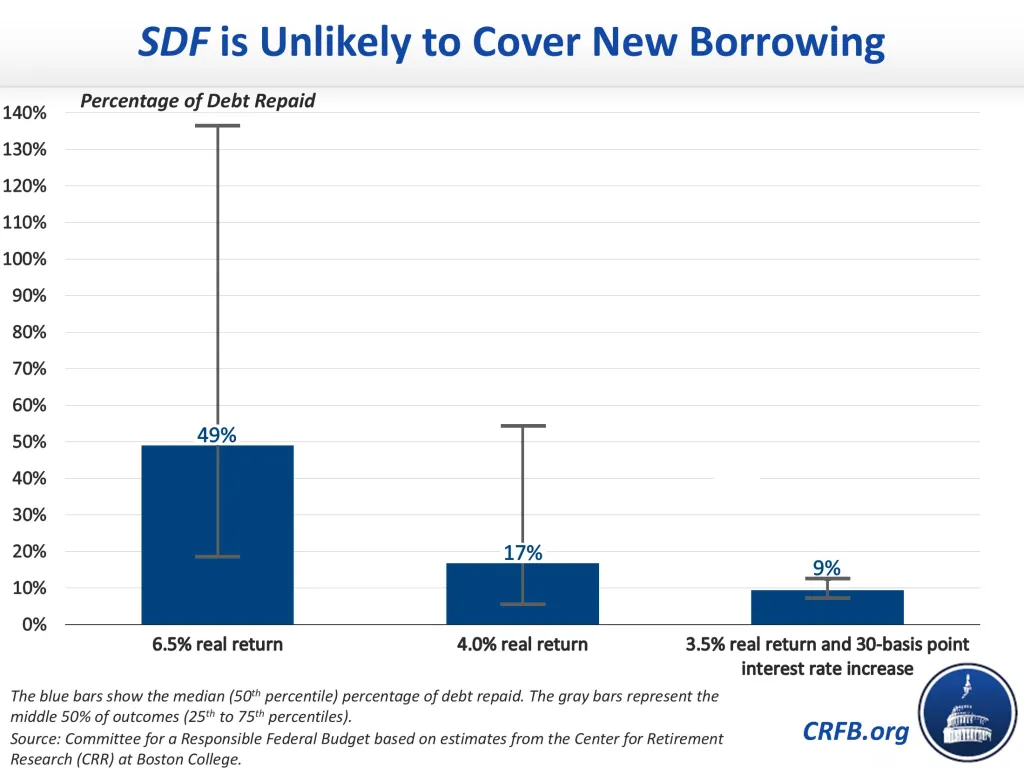
Under the 25th and 75th percentile of outcomes, we estimate the Sovereign Debt Fund would close 19% to 136% of Social Security’s gap with high returns, 5% to 54% with medium returns, and 7% to 12% with low returns and higher interest rates.
Their findings are in line with that of a similar exercise undertaken by economist Andrew Biggs. The gap between the mean and median outcomes reflects the fact that high average returns are driven in part by a small chance of extremely high returns in a given year.
The fatal flaw in the Sovereign Debt Fund plan is the decision to not only borrow for the investment but also authorize 75 years of borrowing to fund benefits in excess of tax collection. Chen, Munnell, and Aubry find that trust fund investment could be much more effective if done in combination with a solvency plan that generates near-term surpluses through higher taxes and/or lower scheduled benefits. Absent such a plan, however, the authors find that “the most likely outcome is that in the 75th year… the government will end up with a big pile of debt, requiring large interest payments.”
This pile of debt, long before the 75th year, would likely prove unsustainable and could spark a devastating fiscal crisis, which could dramatically reduce livings standards of Americans and people across the world.
Social Security faces fundamental financing challenges – unsustainable imbalances between revenues and benefits – that require urgent trust fund solutions. There are many options to save it, including numerous novel reforms that can improve the program in the process. A Sovereign Debt Fund – which drives the government deep into debt to pay benefits and to make risky new stock market investments – should not be one of them.