McKenzie Plan Offers Trust Fund Solutions to Social Security’s Finances
A recent Dallas Morning News op-ed by Pulitzer-winning journalist William McKenzie called on lawmakers to reduce federal deficits to 3% of Gross Domestic Product (GDP) and to begin the work of restoring Social Security solvency in order to prevent the 22% abrupt benefit cut currently expected in 2032.
McKenzie offers seven recommendations, including asking every 2026 Congressional candidate their plan to address the issue, pushing lawmakers to act sooner rather than later, adopting the more accurate chained Consumer Price Index (CPI) for measuring Social Security Cost-of-Living Adjustments (COLAs), adopting a plan from the Bipartisan Policy Center (BPC) to gradually increase the taxable maximum so it covers 86% instead of 83% of wages, gradually increasing the payroll tax rate from 12.4% to 13.4% as also recommended by BPC, implementing the Committee for a Responsible Federal Budget’s Six Figure Limit (SFL) to cap Social Security benefits at $100,000 per couple ($50,000 for singles), and creating a bipartisan Social Security commission like the one proposed by Representatives Tom Cole (R-OK) and Thomas Suozzi (D-NY) to develop a solvency plan.
Depending on their structure, we estimate the four proposed Social Security changes could be enough to restore Social Security solvency for the next 75 years and beyond.
McKenzie Plan Closes 75-Year Solvency Gap
| Policy Option | Percent of Solvency Gap Closed |
|---|---|
| Use chained CPI for COLAs | 15% |
| Increase taxable maximum to cover 86% of wages, up from 83% | 15% |
| Raise payroll tax from 12.4% to 13.4% over ten years | 20% |
| Apply Six Figure Limit to cap benefits at $100,000 per couple* | 20%-55% |
| Total Solvency Gap Closed | 70%-105% |
Source: CRFB estimates based on Social Security Administration and Open Research Group. Figures are rounded to the nearest 5%.
*The low option would cap benefits in 2027 at $100,000 per couple ($50,000 for singles), adjusted for claiming age, with those caps indexed forward for growth in the Chained Consumer Price Index for All Urban Consumers. The high option would enact the same caps beginning in 2027 but hold them fixed in nominal terms for 30 years, after which point they would be indexed to growth in average wages.
Under the most aggressive version of this plan, roughly one-third of the 75-year improvement would come from new revenue and two-thirds from benefits (under the less aggressive version, it would be 50-50). By the year 2100, we estimate the proposal would bring both costs and revenue to about 16% of payroll.
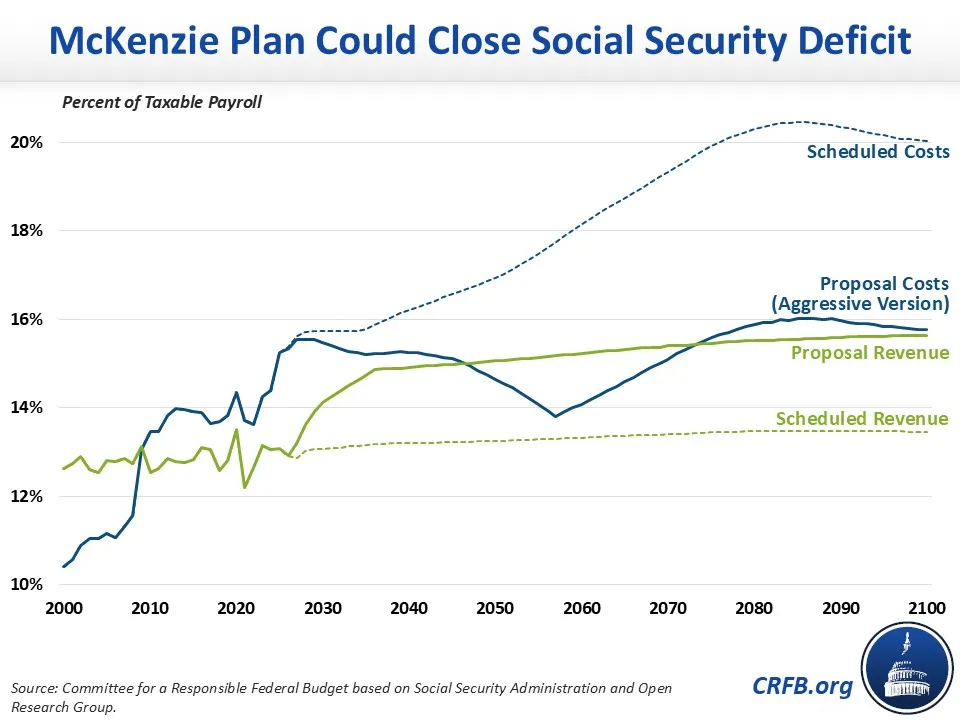
If this version of McKenzie’s proposal were enacted, we estimate the combined trust funds would become sustainably solvent, with reserves remaining healthy past the end of the 75-year period.
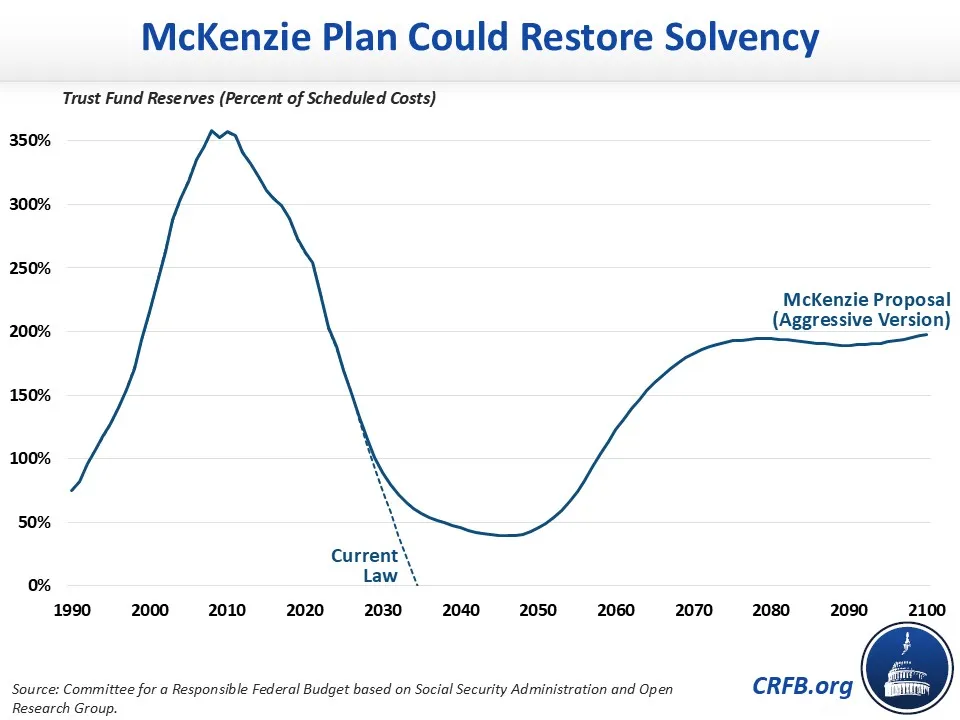
With Social Security insolvency just six years away, action is needed to save Social Security and prevent a 22% benefit cut. Whether lawmakers adopt McKenzie’s plan, our novel solutions, or another alternative, they should act soon. As McKenzie explained:
“If insolvency comes to pass, Social Security recipients would see their benefits decrease by 22%. In Texas, the Committee for a Responsible Federal Budget reports, monthly benefit reductions for the 4.25 million Texans who draw Social Security would decrease by $489.”
Tags
What's Next
-
Image

-
Image

-
Image