CBO Releases February 2026 Budget and Economic Outlook
The Congressional Budget Office (CBO) just released its February 2026 Budget and Economic Outlook, its first full ten-year baseline and economic forecast since January 2025. CBO projects that federal debt held by the public will rise from 99% of Gross Domestic Product (GDP) at the end of Fiscal Year (FY) 2025 to a record 120% of GDP by the end of 2036. The deficit will rise from $1.8 trillion (5.8% of GDP) in FY 2025 to $3.1 trillion by 2036 (6.7% of GDP) – averaging more than twice the oft-cited 3% of GDP target.
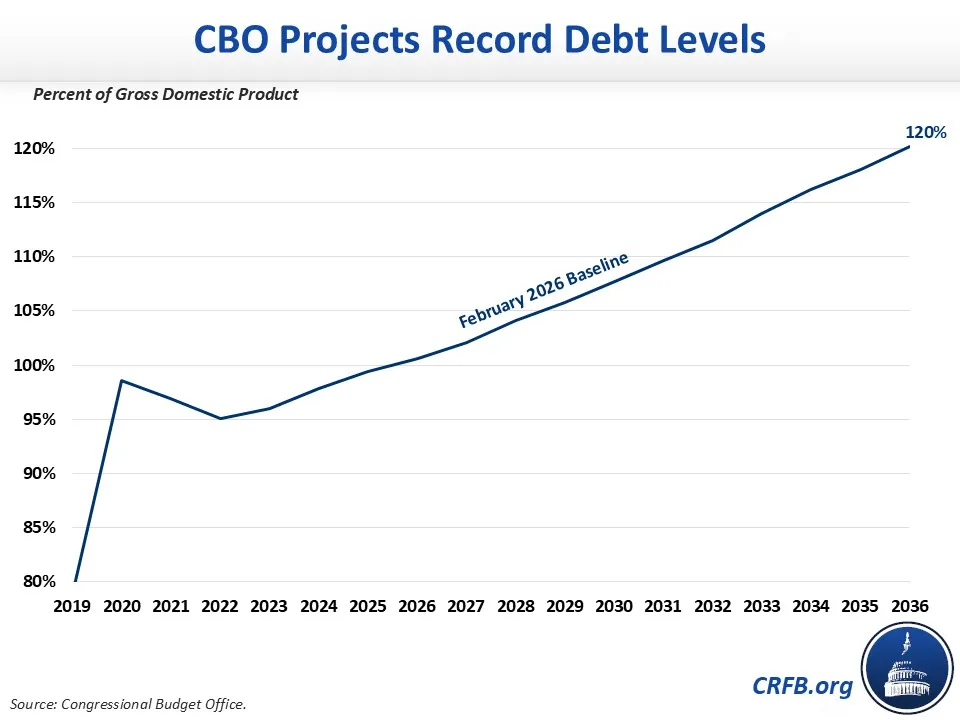
CBO's new baseline incorporates legislation and executive actions put into place since last January, including the enactment of the One Big Beautiful Bill Act (OBBBA), new tariffs, stronger near-term economic growth, higher interest rates, decreased immigration, and a variety of other changes.
Overall, CBO projects deficits will be $1.4 trillion higher through 2035 than they projected in January. This can be more than entirely explained by changes in policy. In particular, CBO estimates that OBBBA will add $4.2 trillion to the debt through 2034, including dynamic effects, and is only partially offset by $3.0 trillion of debt reduction from new tariffs through 2035 (assuming they remain in effect despite legal challenges). CBO also projects higher nominal GDP, and thus little change in projected debt-to-GDP.
Rising debt under CBO's baseline is driven by a large disconnect between spending and revenue, which is due in large part to growing interest costs. Net interest, the fastest growing part of the budget, will grow from a record 3.2% of GDP ($970 billion) in 2025 to 4.6% of GDP ($2.1 trillion) by 2036. Meanwhile, Social Security and health care spending will grow from 11.2% of GDP ($3.4 trillion) in 2025 to 12.5% of GDP ($5.9 trillion) by 2036.
CBO also projects two major trust funds will be insolvent within the decade – the Highway Trust fund in 2028 and the Social Security Old-Age and Survivors (OASI) Trust Fund in 2032. Upon insolvency, the law requires spending and benefits to be cut across the board, though CBO’s baseline assumes spending continues.
The Committee for a Responsible Federal Budget has put out a press release on CBO's new baseline and will publish our full analysis of CBO's Budget and Economic Outlook later today.