Bill Would Raise Revenue by Improving Tax Compliance
Senator Angus King (I-ME), joined by many of his colleagues, introduced the Stop CHEATERS Act (S. 4298) last month. The bill would provide $84 billion in additional multi-year mandatory funding to the Internal Revenue Service (IRS) and would likely reduce deficits by $100 billion or more over the next decade.
Funding the IRS would help reduce the “tax gap,” or the difference between taxes legally owed and actually collected by the federal government. According to the latest IRS data, the net tax gap for tax year 2022 was about $600 billion, or roughly 13% of all taxes owed. Reducing the tax gap with improved IRS funding has a history of bipartisan support – every President from Reagan to Biden has proposed efforts to narrow the tax gap. And providing this kind of funding would help to reduce fraud, errors, and improper payments – improving the efficiency of revenue collection.
The funding would be provided over six fiscal years and would be distributed across four accounts – enforcement, taxpayer services, technology and operations support, and business systems modernization – similar to how IRS funding in the 2022 Inflation Reduction Act was allocated. More than half of the funding would go to directly increasing tax enforcement, while the remaining funding would be used to improve operations, invest in technology, and provide taxpayer services – all of which would also likely help reduce the tax gap some.
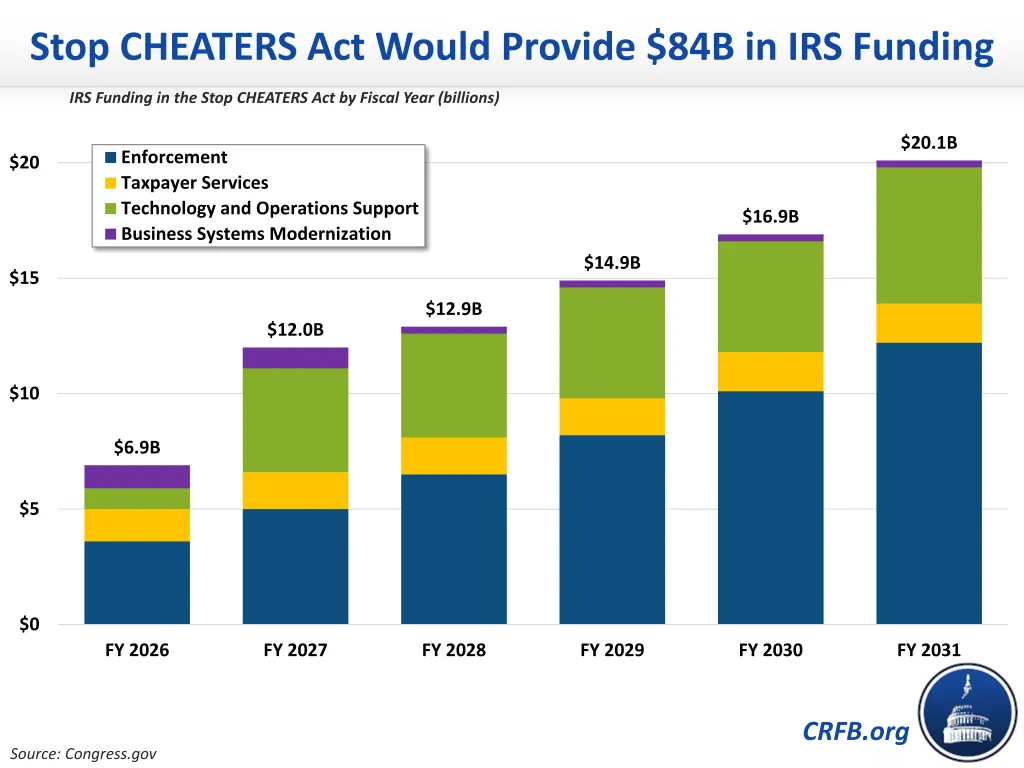
Congressional Budget Office estimates of past bills that increased or rescinded IRS funding suggest the Stop CHEATERS Act could potentially reduce deficits by $100 billion to $200 billion over a decade; Senator King’s press release points to an analysis from the Yale Budget Lab estimating nearly $1 trillion in potential savings.
While the bill includes a specific mandate for the IRS to focus enforcement efforts on high-income individuals and large corporations, Congress could also consider a broader approach to improve compliance across a wider range of individual taxpayers as well as smaller businesses, which is where the majority of the tax gap originates. Bills like this would help to reduce deficits by improving revenue collection without raising anyone’s taxes.