CBO Analysis Suggests $1 Trillion in Medicare Advantage Overpayments
A recent Congressional Budget Office (CBO) analysis projects that the federal government will pay between 5% and 10% more for Medicare Advantage (MA) enrollees than traditional Medicare (TM), and estimates that for a given person MA costs about 15% more than TM. This suggests the federal government will spend about $1 trillion on MA overpayments over the next decade, which is in line with other estimates. Reducing these overpayments can help to lower health care costs and reduce budget deficits.
Medicare Advantage (MA) is the privately-managed, government-funded alternative to traditional fee-for-service Medicare (TM). Although MA can often be more efficient than traditional Medicare, it ends up being more costly for the federal government due to upcoding, favorable selection, the quality bonus program, and other features. The risk-adjusted payments made to the MA plans tend to far exceed the likely actual cost of delivering health care to beneficiaries.
Earlier this year, the Medicare Payment Advisory Commission (MedPAC) estimated that MA cost the federal government 14% more in 2026 than TM for beneficiaries with the same health status. We estimated that this would translate into $1.3 trillion of additional federal costs over a decade, after accounting for the likely growth of the component parts.
In their latest “Federal Subsidies for Health Insurance 2026 to 2036,” CBO includes an appendix on MA spending with similar findings to MedPAC. As a starting point, CBO estimates that the “average per-beneficiary spending” will be 5% to 10% higher for MA enrollees compared to TM beneficiaries over the next ten years, which would translate into roughly $550 billion of federal costs over a decade. This difference is largely driven by “upcoding” – where plans increase the number of diagnosis codes to make a patient look sicker to increase payments – which CBO believes leads to about 4% more in costs even after accounting for coding intensity adjustments designed to counter this issue.
Yet, this difference in coding adjustment understates how much more costly MA is than FFS. CBO’s review of the literature finds that many MA enrollees are healthier and/or predisposed to use fewer health care services than their TM counterparts – a point that we and MedPAC and others have made before. This favorable selection issue means that MA should cost less than TM for the same beneficiary.
One way to approximate the total excess cost of MA relative to TM is to consider how much more a given beneficiary would cost in a MA plan. Based on a review of the literature, “CBO estimates that if a beneficiary switched from Medicare FFS to MA, federal spending on that enrollee would increase by roughly 15 percent.” Applied to the entire MA population and held steady over the decade, we estimate this amounts to roughly $1 trillion of overpayments. It also amounts to roughly $150 billion in higher Part B premiums, though some of those higher base premiums are offset by premium reductions offered to beneficiaries within MA plans.
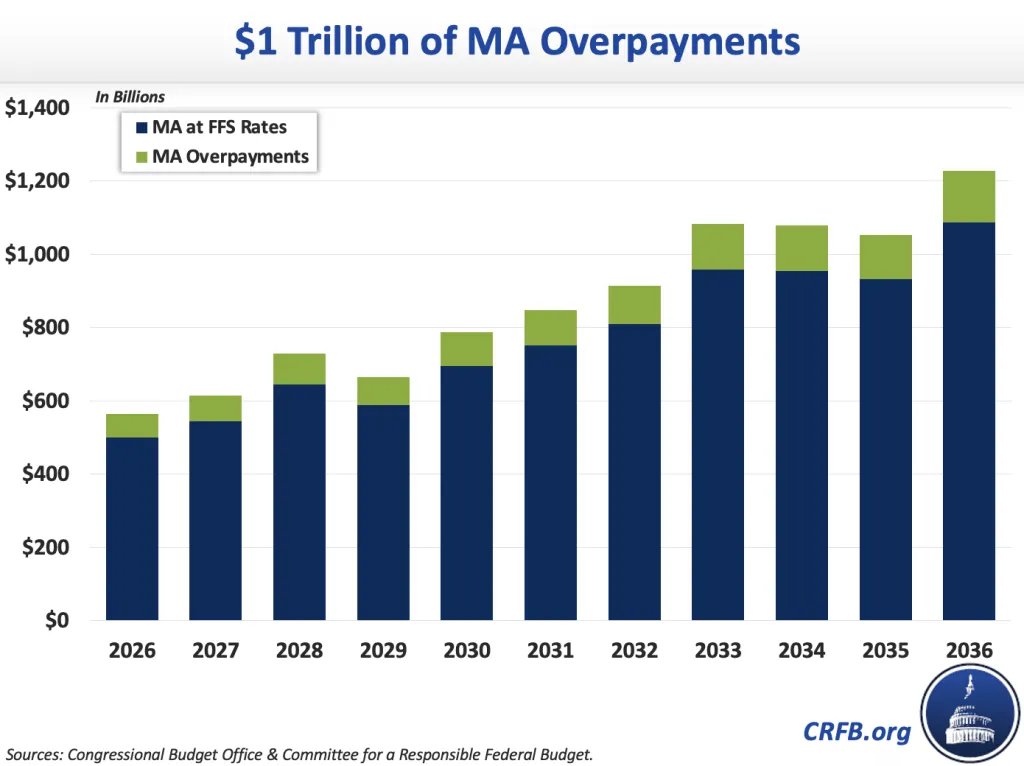
Of course, these are just estimates, and other studies have found MA overpayments to be somewhat higher or somewhat lower. But importantly, there is no dispute over the fact that MA costs the federal government significantly more than TM. CBO undertook an extensive review of the available literature that showed that every study found some degree of overpayments to MA: “all published studies of differential coding show that the CMS adjustment does not fully correct for coding differences.”
Given the strong evidence of substantial MA overpayments and the country’s high and rising national debt, policymakers should pursue reforms to lower MA costs. This could include our proposals to more accurately account for coding intensity and reform the Quality Bonus Program, Representative Doggett’s (D-TX) Saving MEDICARE Act, Representative Schweikert’s (R-AZ) Reform the Medicare Advantage Program Act, the bipartisan NO UPCODE Act support by Senators Cassidy (R-LA) and Merkley (D-OR), or any number of other options.
As lawmakers look for ways to address waste, fraud, errors, and abuse, MA is a ripe area for changes to curb excessive spending. At a time of high and rising debt and health care costs, it is important to make meaningful reforms to this program.