Guest Essay – Post-WWII Versus Now: Similar Debt, Different Circumstances
Below is a guest essay from Rebeca Stacey, a Summer 2026 Policy Intern at the Committee. The views expressed below are those of the author and may not reflect the views of the Board of Directors or staff of the Committee for a Responsible Federal Budget.
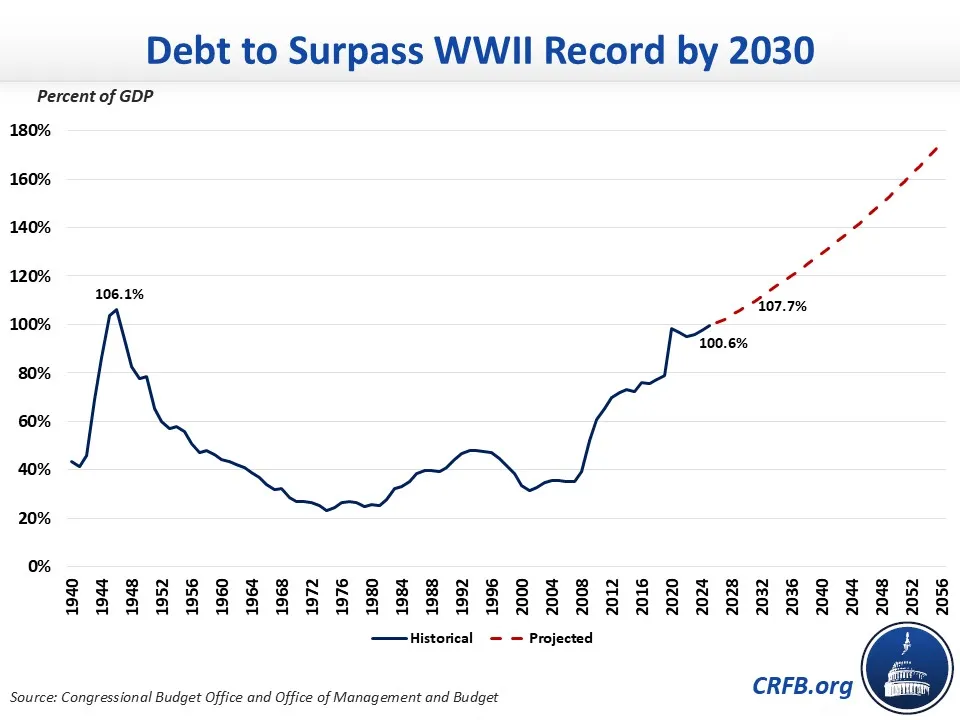
As a result of World War II financing, U.S. debt as a share of Gross Domestic Product (GDP) increased from 41.5% in Fiscal Year (FY) 1941 to 106.1% in FY 1946, immediately after the end of the war. However, this extraordinary level of borrowing was seriously mitigated in the years following, with the debt-to-GDP ratio dropping to near 23% by 1974.
Just this year, debt crossed 100% of GDP, its highest level since the postwar peak, and it is projected to surpass that record by 2030. When comparing these two very similar debt levels, it becomes natural to ask the question: if we were able to “grow out” of the federal debt back then, why can’t we do the same now?
Economists disagree on exactly why the United States was able to reduce its postwar debt burden. But whether the decline is attributed primarily to rapid growth relative to interest rates or to fiscal restraint and suppressed borrowing costs, the conditions that enabled it are starkly different today.
The biggest differences from 1946 and today include:
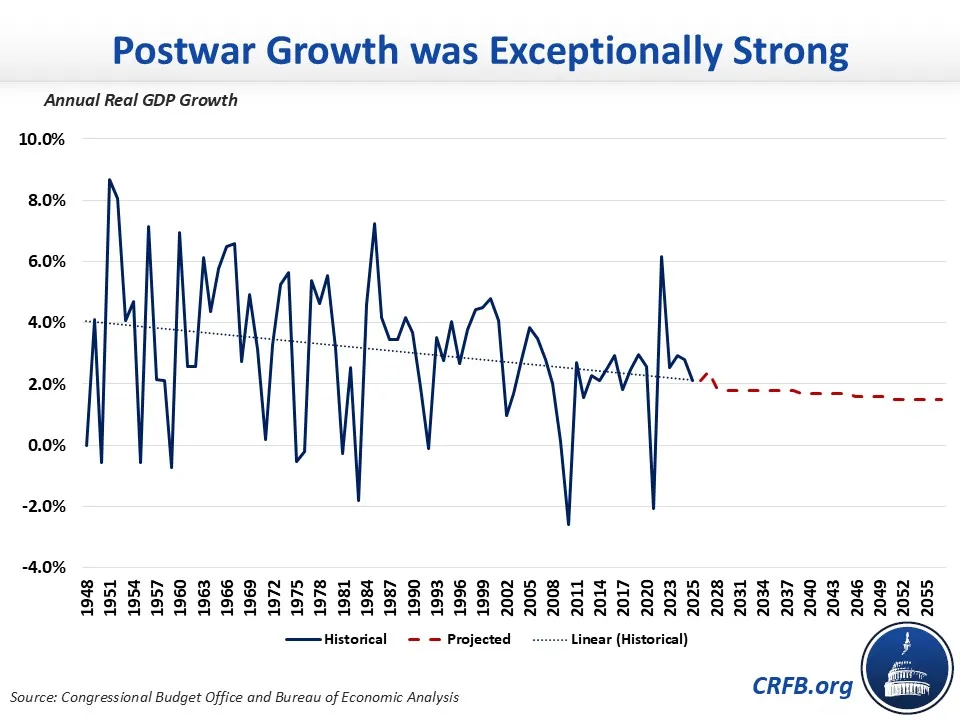
- Economic growth: Post-WWII, the economy grew at an average real GDP rate of 4%, compared to the 2000—2025 growth rate of about 2%. Moreover, the favorable G (economic growth rate) to R (average interest on the debt) differential has been shrinking over time and is projected to be reversed by FY 2031.
- Demographics: The postwar period saw exceptionally favorable conditions, including a surge in the total fertility rate (TFR) to a peak of 3.8 births per woman in 1957 which culminated in the “baby boom” and helped drive growth. Today, the TFR has dropped to 1.6 births per woman, and the growing portion of retirees is rapidly driving up federal spending, particularly on Social Security and Medicare.
- Fiscal policy: After the war, lowering the debt became a top priority, evidenced by the reversal of the budget from a deficit to a surplus by 1947 and the pegging of interest rates at low levels. Today, we have a growing budget deficit, and interest rates are much higher and likely to stay high for longer.
Economic Growth Has Moderated
In the postwar period, commonly referred to by economic historians as the “Golden Age of Capitalism,” GDP growth was crucial to dealing with the inescapable result of wartime financing: the mounting debt. Between 1948 and 1971, the economy grew in real terms at an average rate of around 4%. This is a considerably high number especially when compared to the real growth rate in the last 25 years, which averages around 2%.
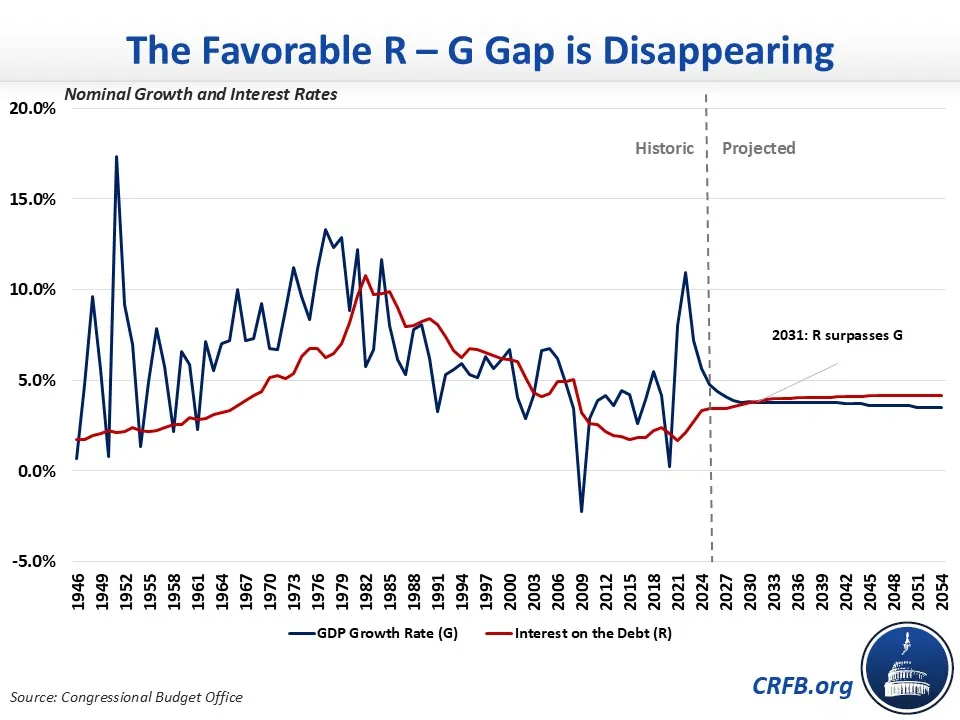
Importantly for postwar debt reduction, the differential between the growth rate of the economy (G) and the interest rate it pays on its debt (R) was favorable. In other words, the economy was growing faster than the cost of servicing its debt. This differential is widely regarded as crucial for a nation’s debt dynamics, with the idea that R less than G could imply a stable debt trajectory, since the economy’s output grows faster than the interest accumulating on existing debt. This has led some economists to argue that high debt is less concerning when economic growth persistently exceeds interest rates on the debt.
In the U.S., the G greater than R relationship has held for most of the last 60 years and for almost all of the past 15 years. This relationship was particularly favorable in the postwar period (1946—1971), when nominal GDP growth averaged 6.4% while average interest on the debt averaged 2.9%, a gap of 3.5 percentage points.
Unfortunately, the favorable gap between G and R has been narrowing in recent years. From 2000 to 2025 nominal GDP growth averaged 4.6% and interest on the debt averaged 3.3%, a gap of just 1.3 percentage points. Crucially, long-term projections from the Congressional Budget Office (CBO) show that lower economic growth in the future would bring G below R by FY 2031 and cause it to remain meaningfully higher through 2056. This would result in a rapidly rising debt-to-GDP ratio, potentially leading to a debt spiral and/or fiscal crisis.
Despite speculation that artificial intelligence (AI) will lead to a productivity boom, empirical projections are not so decisive. Current CBO projections on the impact of AI on productivity are still inconclusive. Insights from McKinsey suggest that using AI alone to boost productivity is a limited and unsustainable strategy. The Yale Budget Lab contends that productivity measures of AI in the short term are noisy and thus not robust enough to claim that we are at the beginning of an AI productivity boom. It is thus not wise to, as the Budget Lab states, “put all our eggs in the productivity data release basket.”
Demographics Look Very Different Today
Replicating the strong economic growth of the postwar period is also complicated by a dramatically different demographic environment. Despite the drop in government spending and overall upheaval at the end of the war, unemployment rose by only three percentage points from around 1% in 1945 to around 4% in 1946. New jobs, boosts in manufacturing, and the return of veterans into work ushered in economic prosperity. Consumers saved their income during the war, at an average rate of 21% compared to today’s rate of 3% and were eager to spend on appliances, automobiles, and houses, a behavior facilitated by the rise of credit.
More importantly, many Americans who had delayed marriage and childbearing during the war began starting families, while younger couples increasingly married and had children earlier than other cohorts had. This contributed to the baby boom, with 76 million Americans born between 1946 and 1964. As this unusually large generation entered its most productive working years, it helped expand the labor force and support economic growth during the postwar period.
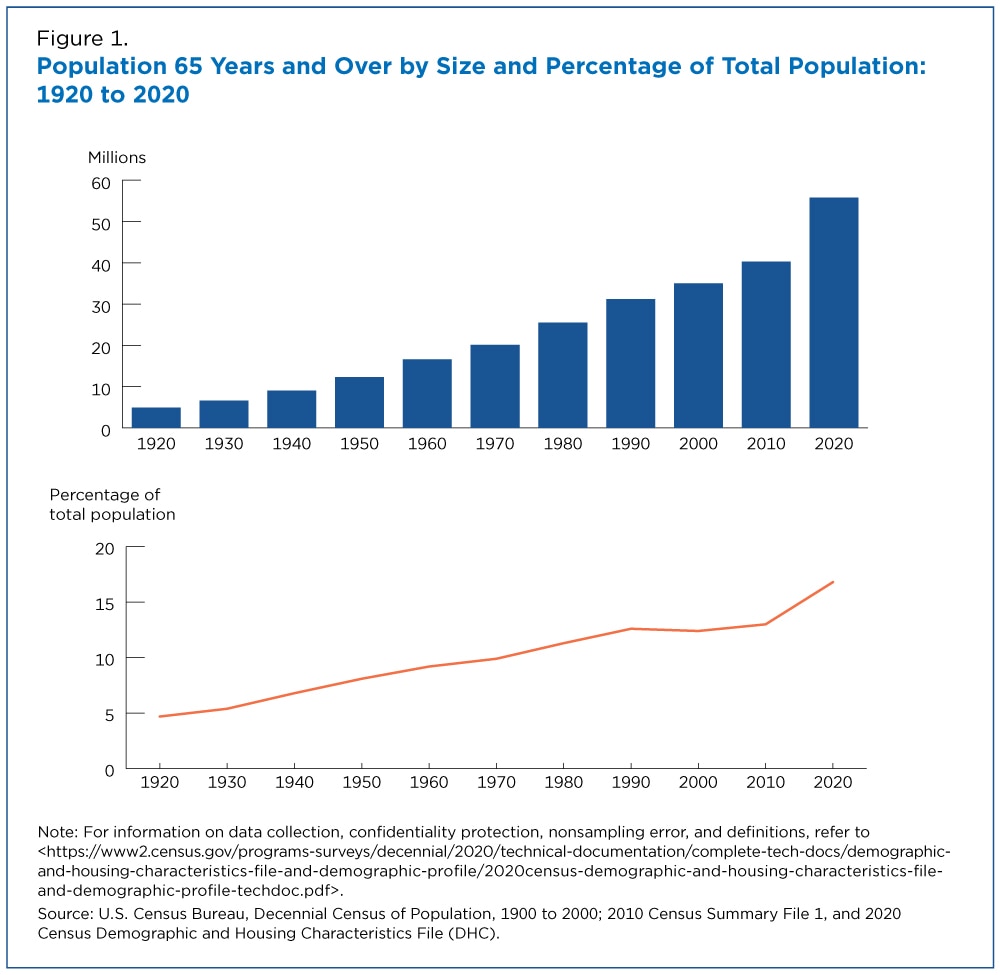
Demographics are not on our side this time around. The proportion of retirees is growing rapidly, with almost 20% of Americans aged 65 or older in 2020, compared with less than 10% in 1940. The same baby boomers who helped the economy grow in the post-WWII period are now the retirees who receive $2.7 trillion in federal outlays, driven mainly by Social Security and Medicare, which equals 38.6% of total outlays and six times more than the federal government spends on children and young adults. These demographic changes are a result of long life-expectancy coupled with societal changes like getting married later in life and having less children.
For instance, the TFR has dropped from around 3.6 births per woman in 1960 to just 1.6 births per woman as of 2024. CBO projects that TFR will drop to 1.5 through 2099.
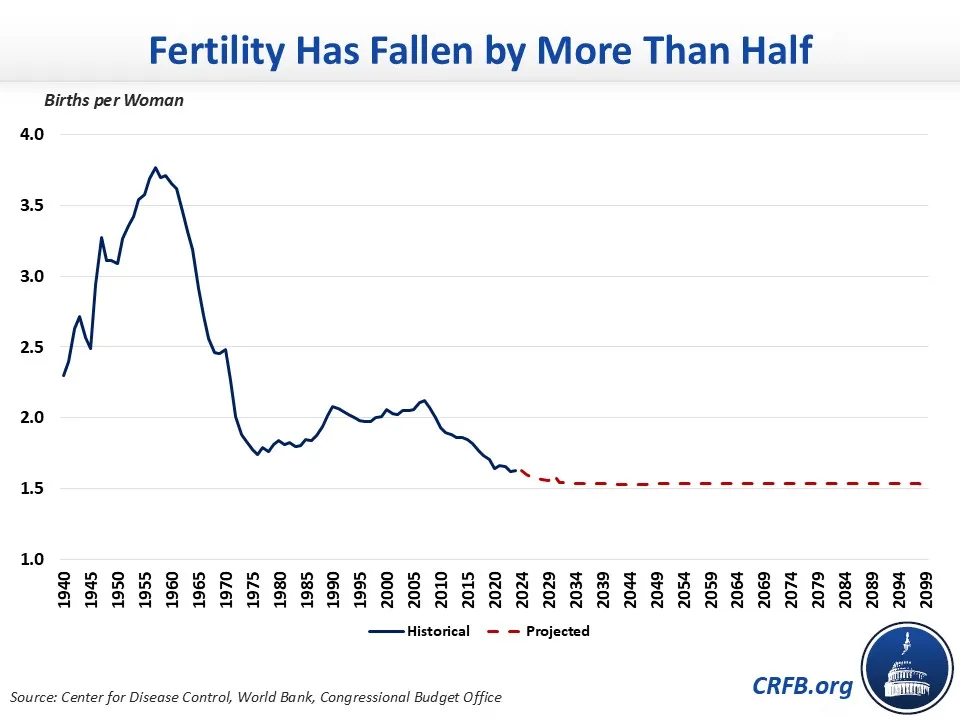
These demographic conditions create significant headwinds for economic growth and are far less favorable than those that prevailed after WWII.
An Unsustainable Fiscal Situation
Even if the U.S. experiences an unexpected growth spurt in the future—whether driven by AI or another factor—there are reasons to believe that high growth alone is not an antidote to high debt. In fact, another theory regarding fiscal sustainability suggests that rapid growth was not the main reason debt fell after WWII. A paper by the International Monetary Fund (IMF) estimates that the fall in the debt-to-GDP ratio in the aftermath of WWII was driven by primary surpluses and interest rate distortions, contrary to the classical view that G > R was the primary driver. Under this alternative explanation, today’s conditions are no more favorable.
After WWII, the government reduced the elevated debt by exerting budgetary restraint via spending cuts and tax hikes, reflected in the primary surplus average of 1.1% of GDP from 1947 to 1974. Additionally, from 1942 to 1951, the Fed and the Treasury agreed to keep long-term bonds at artificially low rates of 2.5% and below to reduce the government’s wartime borrowing costs. Once price controls were lifted after the war, inflation rose sharply while interest rates remained low, producing deeply negative real interest rates on outstanding government debt. Together, these factors played a major role in reducing the debt-to-GDP ratio over the postwar decades.
The IMF paper finds that under the counterfactual scenario with no interest distortions and no primary surpluses, the debt-to-GDP falls by only 32 percentage points by 1974 from 106% to 74% rather than 23% as in reality.
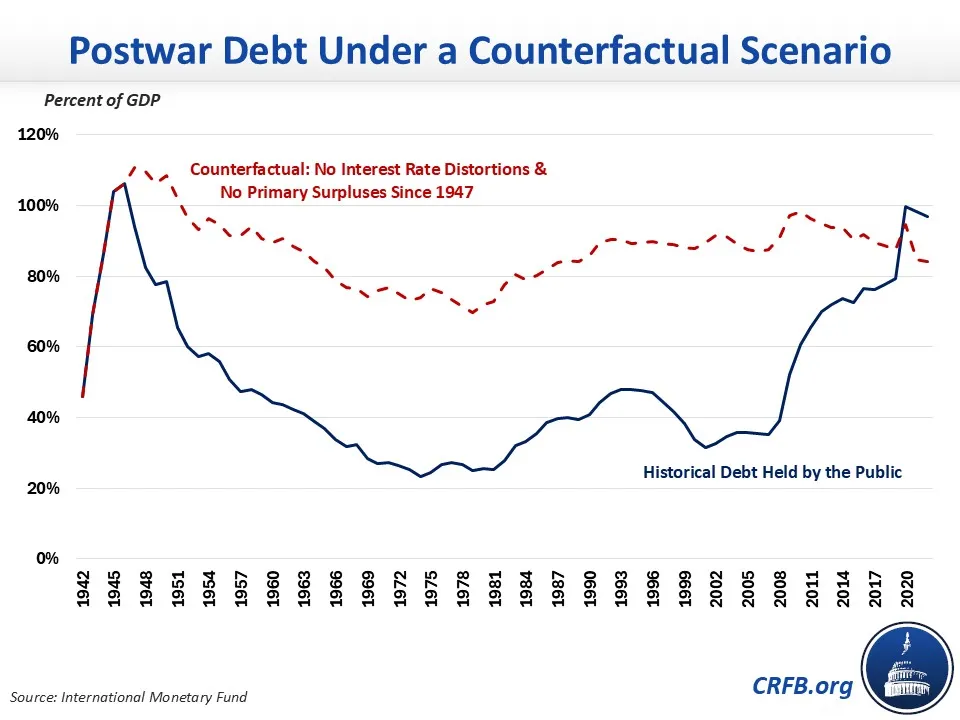
Unfortunately, the conditions that caused the debt-to-GDP ratio to remain high in the IMF’s counterfactual scenario are not all that different from our current fiscal and monetary reality—with the important caveat that economic growth today is considerably weaker than it was in the postwar period.
The 30-year Treasury bond is at its highest yield in 19 years and more than twice the size of the 1946 long-term yield rate of 2.19%. Because of record inflation, the Fed has kept the federal funds rate above 3% since September 2022.
Moreover, the U.S. has not seen a budget surplus or balanced budget since 2001, and instead has seen a growing deficit approaching 6% of GDP. The U.S. is borrowing at nearly the same rates that it was during the 1940s, with the difference that borrowing is no longer a result of a catastrophic global conflict, but rather a result of a complete bipartisan resignation from making tough decisions.
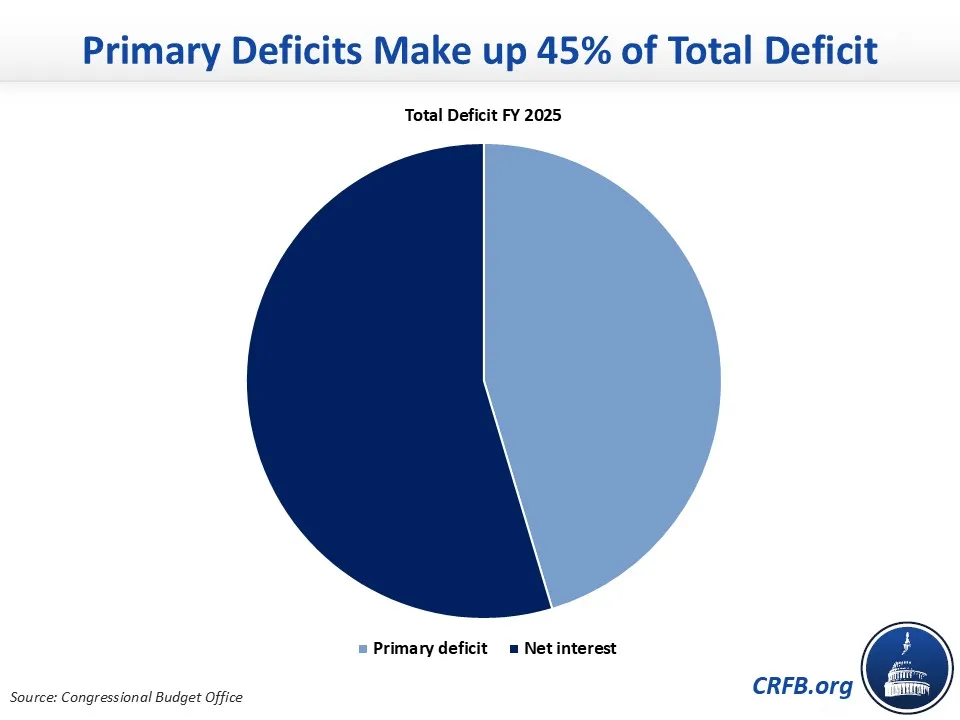
This view that growth alone is not enough to get us out of the debt is also shared by others. The idea that G > R implies a stable debt trajectory only when the deficit excluding interest payments (primary deficit) is small, is far from the case in the U.S. While it is true that interest payments are the biggest driver of the U.S. federal deficit, primary deficits are currently about 45% of the total deficit and 2.7% of GDP, and CBO projects that primary deficits will persist in the future.
Challenges Lie Ahead in Fixing Our Debt
As this comparison shows, no leading explanations for the postwar decline in debt offer an easy path for the United States today. If a favorable growth-interest differential was the key, slower projected growth and rising interest costs make those conditions difficult to replicate. If fiscal restraint and suppressed borrowing costs played the larger role, today’s persistent primary deficits and higher interest rates point in the opposite direction. Even unexpectedly strong growth is therefore unlikely to replicate the postwar decline in debt without serious fiscal reforms. As we head toward record levels of debt, it is important to understand the difficulties that lie ahead when it comes to putting our debt back on a downward and sustainable path.