How Much Will Trump’s New 10% (or 15%) Tariffs Raise?
UPDATE (March 5, 2026): CBO estimated the Supreme Court ruling that IEPPA tariffs are illegal will reduce revenue by $1.6 trillion through 2036 assuming no refunds, which matches our estimate inclusive of refunds.
The Trump Administration recently imposed a temporary broad-based 10% tariff using authority under Section 122 of the Trade Act of 1974, in response to the Supreme Court ruling that the majority of the Administration’s 2025 tariffs are unlawful. President Trump announced that the Section 122 tariffs will increase to 15%, but that change has not yet officially been made.
We estimate the 10% tariff would generate about $35 billion of net new revenue over the 150 days it is allowed to be in effect under the law, rising to about $50 billion at 15%. If the Section 122 tariff is extended by Congress or replicated through other authorities, we estimate the tariff would generate over $900 billion over the Fiscal Year (FY) 2026 to 2036 period at a 10% rate, or $1.3 trillion at 15%. While in effect, the Section 122 tariffs would replace over half of the revenue lost due to the Supreme Court ruling at 10% and over three-quarters at 15%. The White House had said it will use additional authorities – such as Section 301 of the Trade Act of 1974 and Section 232 of the Trade Expansion Act of 1962 – to impose further tariffs later this year.
Conventional Estimates of Net Tariff Revenue Impact
| 150 Days (March-July) | If Permanent (2026-2036) | |
|---|---|---|
| Revenue Raised | ||
| 10% Section 122 Tariffs | $35 billion | $925 billion |
| 15% Section 122 Tariffs | $50 billion | $1.3 trillion |
| Percent of IEEPA Tariffs Replaced | ||
| 10% Section 122 Tariffs | 52% | 54% |
| 15% Section 122 Tariffs | 77% | 77% |
| Memo: Lost Revenue from SCOTUS Ruling | -$65 billion | -$1.7 trillion* |
Sources: CRFB estimates based on Congressional Budget Office resources and CRFB modeling.
Notes: Numbers in billions are rounded to the nearest $5 billion. * Includes the assumption that collected IEEPA revenue will be refunded.
Based on our updated estimates using the Congressional Budget Office’s (CBO) recently released tariff model, we estimate the Supreme Court’s ruling against tariffs imposed under the International Emergency Economic Power Act (IEEPA) will reduce federal revenue by $1.7 trillion through FY 2036, assuming collected IEEPA tariffs are refunded. This estimate is slightly lower than a rougher, prior $1.9 trillion estimate.
In response to the court ruling, the Administration enacted a temporary 10% Section 122 tariff with exemptions that roughly mirror those of tariffs enacted under IEEPA. While the tax base is quite similar to the IEEPA tariffs, those tariffs had many rates over 10% – including an up to 15% rate for the European Union, a 20% rate for China, and a 50% rate for Brazil. For that reason, the 10% Section 122 tariff would only raise about half as much as the IEEPA tariffs over the next 5 months – about $35 billion as opposed to $65 billion. If boosted to 15%, the Section 122 tariffs would raise $50 billion.
While the Section 122 tariffs are temporary and would thus generate only a tiny fraction of the $1.7 trillion of lost IEPPA revenue over the next decade, the Administration has indicated that it ultimately intends to fully replace the lost revenue from IEEPA tariffs. The Administration has stated it is initiating several Section 301 and other investigations, which would allow it to impose additional tariffs under alternative legal authorities.
If tariffs from these investigations were sufficient to replicate the revenue generated from Section 122 tariffs – or if Congress were to make the Section 122 tariff permanent – it would raise about $925 billion of net new revenue through 2036 at 10% or $1.3 trillion at 15% through FY 2036 in total. Fully replacing the IEEPA tariff revenue would require an additional $400 to $800 billion in net new revenue.
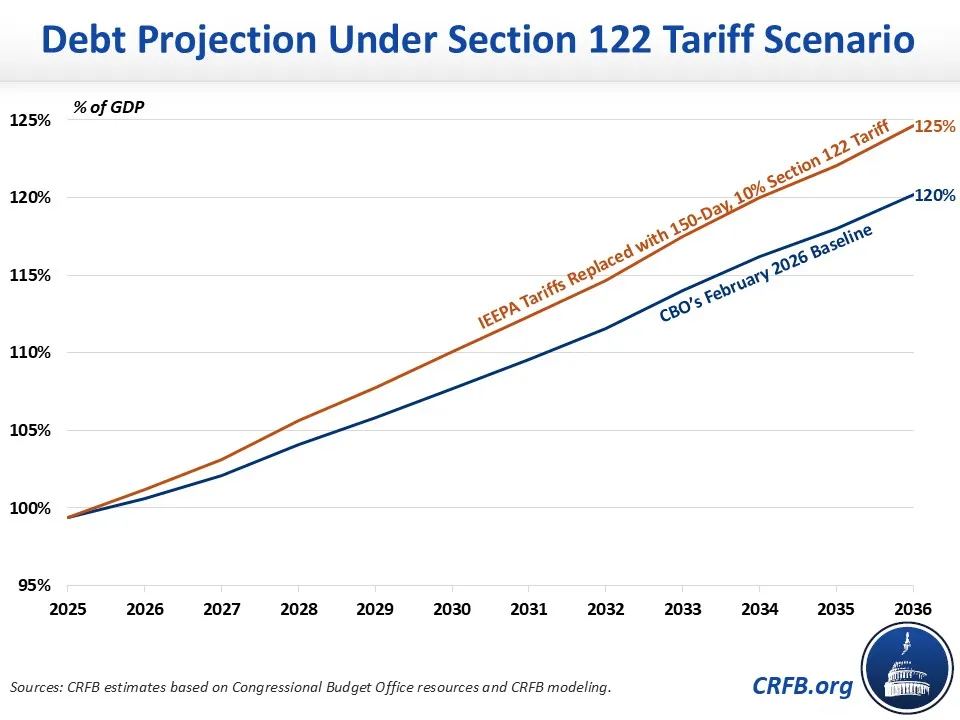
In a future analysis, CRFB will estimate the full impact of new tariff policies. Based on the policies currently in effect – a 10% Section 122 tariff for the next 5 months – we estimate deficits and debt would be significantly higher than CBO’s February baseline that includes IEEPA revenues. Specifically, we find debt would rise to 125% of GDP ($58 trillion) by 2036,1 as opposed to 120% ($56 trillion). Deficits in that scenario will rise to 7.1% of GDP ($3.3 trillion) as opposed to 6.7% of GDP ($3.1 trillion).
President Trump’s tariffs were generating meaningful revenue amid a bleak fiscal outlook. However, relying on uncertain legal authorities or temporary measures can undermine the stability of enacted tariffs. We encourage policymakers to enact revenue or offsets sufficient to fully replace lost IEEPA revenue, and to codify these changes – whether from tariffs or other sources – into law.
1 Importantly, this estimate assumes that collected IEEPA tariff revenue will be refunded in the near future. However, the Supreme Court did not rule on the issue of refunds directly, and it is unclear if, how, or when any refunds will be issued. Absent these refunds, the IEEPA ruling would lose $1.6 trillion of revenue through FY 2036 instead of $1.7 trillion and debt projections would be slightly lower.