Proposed EV Fee Could Raise $30 Billion
Note: The Congressional Budget Office has released an official estimate of the potential revenue from the proposed registration fee on Electric Vehicles, finding that it would raise $12 billion over ten years. You can read more about their estimate here.
A new bipartisan highway reauthorization bill proposes, among many other changes, new annual registration fees on electric vehicles (EVs) and plug-in hybrids, starting at $130 and $35, respectively, to help fund the Highway Trust Fund (HTF). We estimate the fees would raise about $30 billion over a decade.
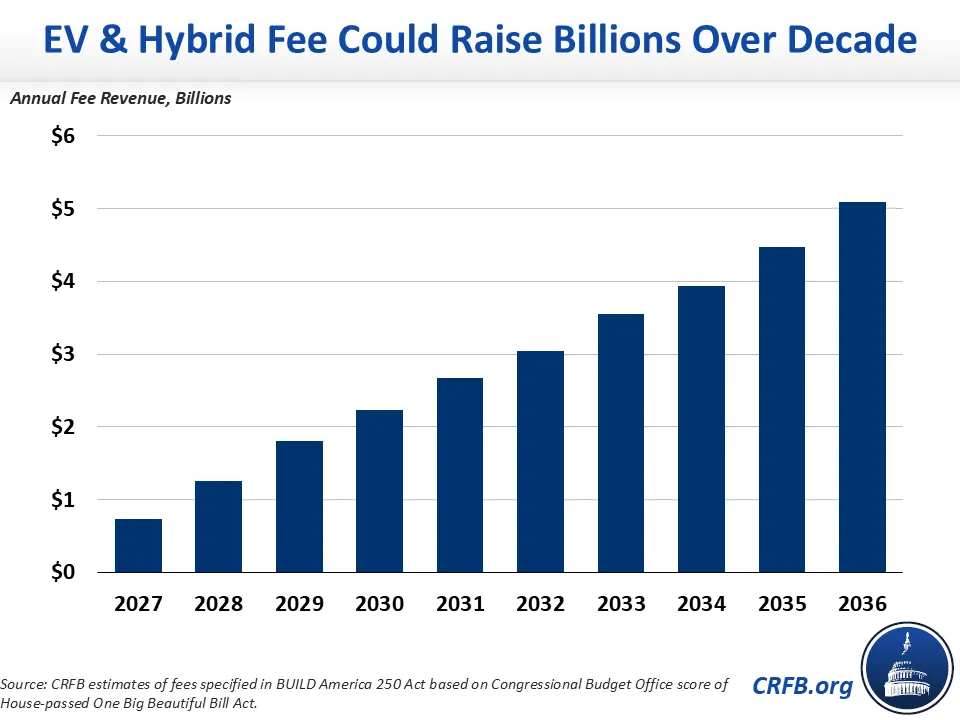
The BUILD America 250 Act, released by House Transportation and Infrastructure Chairman Sam Graves (R-MO) and Ranking Member Rick Larsen (D-WA), includes new registration fees on EVs and plug-in hybrids. Starting on October 1, owners of EVs would start paying $130 a year and owners of plug-in hybrids would start paying $35 as part of annual vehicle registration fees in their states (or an alternative means in states without annual fees). Starting in 2029, those fees would increase by $5 every two years until they reach $150 and $50, respectively.
Revenue from these fees would go to the HTF, which is mostly funded by an 18.4 cent per gallon tax on gasoline and 24.4 cent tax on diesel. The fees would ensure EV owners (who do not pay gasoline taxes) and hybrid owners (who pay far less) contribute to highway funding. The Highway Trust Fund faces a $138 billion shortfall through 2036 under CBO’s baseline and is projected to become insolvent by July 2028; this fee revenue would partially alleviate that shortfall.
Imposing EV fees can be an important step to bringing the Highway Trust Fund back into balance, as the growing popularity of EVs and increased fuel efficiency reduces revenue from the gas tax.
Yet even with this additional revenue, the Highway Trust Fund will remain severely out of balance. Lawmakers should consider additional revenue, spending reductions, or some combination to prevent insolvency. A gas tax holiday would go in the wrong direction, costing the trust fund nearly $40 billion per year and undermining the tenuous funding of transportation infrastructure in this country.