Defense Funding Put in Context
President Trump has requested $1.5 trillion of defense spending in his Fiscal Year (FY) 2027 budget request, including $1.15 trillion of base funding and $350 billion of additional mandatory funding. If enacted, this would represent a 42% increase from this year’s total levels – including mandatory funding from the One Big Beautiful Bill Act (OBBBA) – and a 67% increase from last year’s base funding levels (including a 28% base-funding-to-base-funding boost).
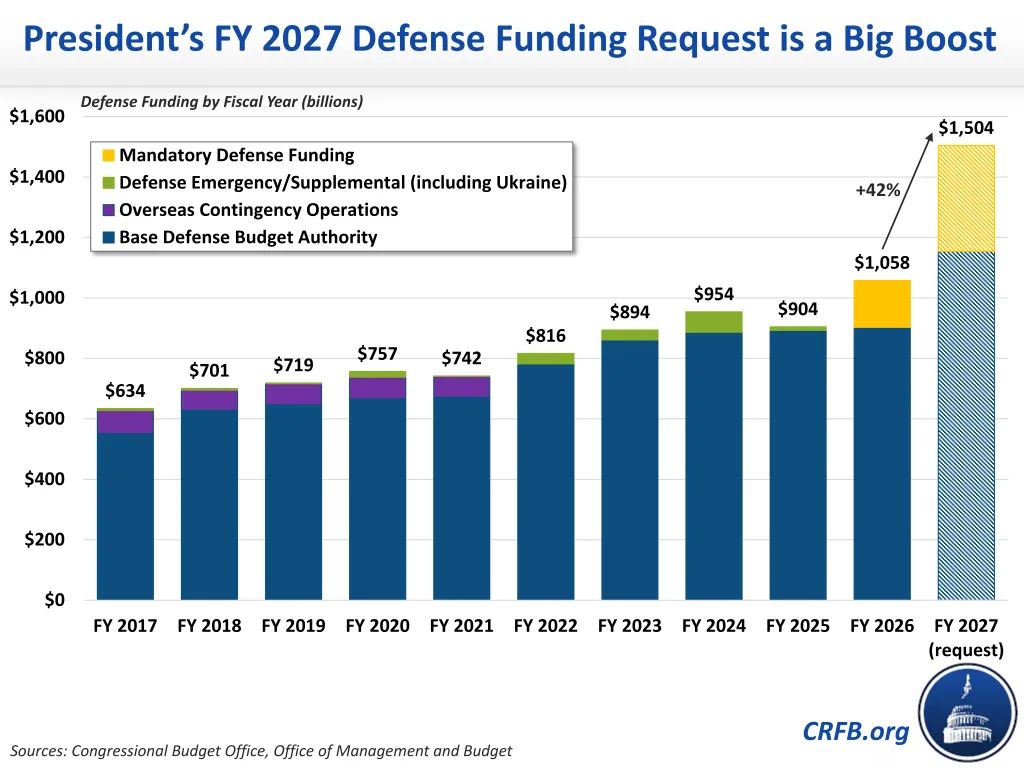
This massive increase would be on top of already-significant defense spending levels. The federal government appropriated $4.6 trillion for defense over the past five years, compared to $3.6 trillion over the prior five years.
Of that $4.6 trillion, $4.3 trillion came from ordinary base defense appropriations – up from $3.2 trillion in the prior five years. More than $300 billion came from additional funding, including roughly $135 billion from supplementals to support or replace weapons used by Ukraine, more than $10 billion on supplementals related to other conflicts or initiatives, and nearly $175 billion of mandatory defense funding included in OBBBA.
Defense Funding Over Past Five Years
| Type of Funding | Budget Authority (FY 2022-2026) |
|---|---|
| Base Defense Budget Authority | $4.3 trillion |
| Ukraine Defense Funding | $135 billion |
| Other U.S. Military Supplemental Funding | $13 billion |
| Mandatory Defense Funding (OBBBA) | $173 billion* |
| Total Defense Funding | $4.6 trillion |
| Note: FY 2017-2021 Total Defense Funding | $3.6 trillion |
*Figure includes defense-related funding outside of the National Defense (050) budget function
Source: Congressional Budget Office, Committee for a Responsible Federal Budget.
Since 2022, Congress has passed five supplemental appropriations bills providing a total of $188 billion for the war in Ukraine, about half of which was meant for the U.S. military. Specifically, Congress appropriated $48 billion in funding for U.S. military activities related to the war in Ukraine, with the majority of that funding going to U.S. European Command and the European Defense Initiative. Another $46 billion has been appropriated to replenish weapons platforms, munitions, and other physical resources that the U.S. has provided to the Ukrainian military from its own stockpiles. Apart from funding that directly supports the U.S. military, Congress has appropriated $41 billion to help Ukraine purchase its own military hardware and to help allies rebuild their stockpiles.
On top of the Ukraine funding, Congress also appropriated $7 billion for the U.S. military related to the conflict in Israel and Gaza and $6 billion related to submarine construction, Taiwan, and the U.S. Indo-Pacific Command.
Then, last year, Congress passed OBBBA, which for the first time included $173 billion in “mandatory” defense-related funding, including $64 billion for enhancing military readiness and deterrence, $39 billion for weapons procurement and bolstering the defense supply chain, $31 billion for air superiority and missile defense, $28 billion for enhancing shipbuilding capacity, and $11 billion for other purposes. Much of this funding was earmarked for purposes similar to those the Administration is currently citing to justify its latest funding request.
Much or most of the $173 billion of defense funds appropriated under OBBBA appear to remain unspent, based on the fact that total military spending since July of 2025 (when OBBBA was enacted) is only about $25 billion (3%) higher than over the same period in the year prior. The Department of Defense (DoD) may also be sitting on substantial discretionary funds, although it is unclear how much. In fact, the DoD has never passed an audit, despite a law that requires it to do so.
There is little doubt that the United States has immense defense and national security needs. But having allocated $4.6 trillion over the past five years to defense, there should also be little doubt that there is substantial waste, fraud, abuse, and errors within the defense budget.
Before Congress considers an enormous expansion of the defense budget, they should work to understand what previously-appropriated dollars are still available and make sure existing dollars are being spent wisely and cost-effectively.
With our debt now larger than the economy and deficits twice the 3% of Gross Domestic Product (GDP) target, policymakers should focus on better allocating existing dollars rather than significantly increasing appropriations. Any net increase in the defense budget should be fully offset – preferably twice over – as continuing to add to the debt would pose a significant threat to our national security and our economy.
What's Next
-
Image

-
Image

-
Image