CBO Estimates Trump Class Battleships to Cost $275 Billion Over 30 Years
Last week, the Congressional Budget Office (CBO) published an estimate of the potential cost of constructing the Navy’s newly proposed, nuclear-powered battleship class, known as the BBGN or the “Trump Class.” CBO estimates the first ship of the class would cost $23 billion, while all 15 ships that would be produced between 2028 and 2056 under the Navy’s 2027 shipbuilding plan would average slightly more than $18 billion each, for a total cost of $275 billion over the next 30 years, in 2026 dollars.
This estimate is considerably higher than the Navy’s estimate of $15 billion for the first ship and $10 billion each for the next two.1
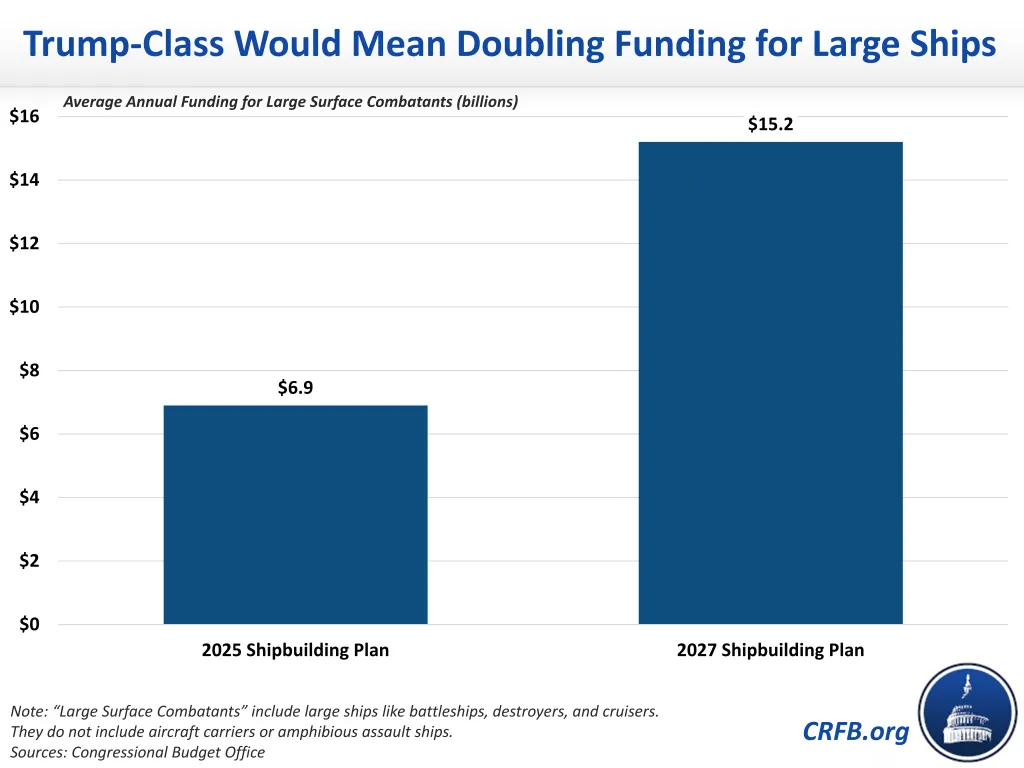
Building the Trump Class would require increasing construction of large surface combatants – such as battleships, cruisers, and destroyers – by roughly 60% over the coming 30 years.2 Such a significant increase in large surface combatant construction would require more than twice the amount of annual funding, from $6.9 billion per year under the Navy’s 2025 shipbuilding plan to $15.2 billion per year under the 2027 plan.3
Complicating matters is the fact that only a few shipyards in the United States are capable of building such large and complicated vessels, and they are already experiencing significant delays in their current workloads.
With a full-load displacement of 35,000 tons and a length of between 840 and 880 feet, the Trump Class battleships would be the largest active surface combatants in the world, more than twice the size of the Zumwalt Class guided missile destroyers, which are currently the largest surface combatant ships in the U.S. Navy fleet.4
They would also be the most heavily armed ships ever built for the U.S. Navy, with an arsenal including antiair, land-attack, antiship, hypersonic, and nuclear cruise missiles, as well as advanced laser weapons and rail guns.
While the Trump Class battleships would certainly add considerable firepower to the U.S. Navy fleet, many experts have expressed significant doubts as to the necessity of building such large surface combatant vessels in light of current trends in modern naval warfare and the types of threats the U.S. Navy will encounter today and into the future.
With the nation’s high and rising national debt representing a serious national security threat, as well as an economic threat, policymakers should carefully weigh the costs and benefits of these battleships and any new spending or tax cuts as they decide how best to allocate scarce budget dollars.
1 The Navy’s estimate was for a conventionally powered battleship class instead of a nuclear powered class, as is called for in the 2027 Shipbuilding Plan. CBO estimates that the first ship of a conventionally powered Trump Class would cost $21.3 billion, while the rest of the class would average $15.9 billion per ship, which is still significantly higher than the Navy’s estimate. All estimate figures are in 2026 dollars.
2 Measured in displacement tonnage.
3 The Navy’s 2027 shipbuilding plan includes a similar number of small surface combatants as the 2025 plan at a slightly reduced cost of $4 billion per year, as opposed to $4.4 billion per year under the 2025 plan.
4 The only ships in the U.S. Navy fleet that would be similar or larger in size to the Trump Class battleships would be the Nimitz and Ford Class aircraft carriers, as well as the America and Wasp class amphibious assault ships, which like aircraft carriers are designed to launch aircraft in support of amphibious assault missions.
Tags
What's Next
-
Image

-
Image

-
Image