Recent Metal Tariff Changes Will Lose $90 Billion, Instead of Raising Revenue
On April 2 the Administration issued a proclamation adjusting tariffs on imports of aluminum, steel, and copper. Contrary to the initially reported proposal that would have raised revenue, we estimate these changes will actually reduce revenue by about $90 billion through Fiscal Year (FY) 2036, before accounting for economic effects.
Conventional Estimates of Net Tariff Revenue Impact Through FY 2036
| Revenue Impact | |
|---|---|
| Tariff Changes from January 6, 2025 to November 15, 2025 | $2.7 trillion |
| IEEPA Ruled Illegal * | -$1.7 trillion |
| Temporary Section 122 10% Tariff | +$35 billion |
| Recent Changes to Steel/Aluminum/Copper Tariffs | -$90 billion |
| Tariff Changes from January 6, 2025 to April 2, 2026 | $930 billion |
| Memo: Total Lost Revenue Since November | -$1.8 trillion |
Sources: CRFB estimates based on Congressional Budget Office resources and CRFB modeling.
Notes: Numbers are rough and rounded. * Estimate for revenue loss from Supreme Court ruling against IEEPA tariffs assumes refunds.
The recent changes were initially reported as a decrease in the tariff rate on steel and aluminum derivative products from 50% to 25% but applied to the entire value of the products. This would have raised revenue by about $70 billion through FY 2036. However, the issued proclamation removed some products from being subject to Section 232 tariff rates altogether and reduced the rate for some derivative products to 15% rather than 25%,1 among other details. As a result of these differences, we now estimate the issued proclamation will reduce revenue by roughly $90 billion through FY 2036.
The Administration’s aggregate tariff changes will raise $930 billion through FY 2036, according to our estimates; they would have raised $2.7 trillion prior to the Supreme Court’s ruling against tariffs imposed under the International Emergency Economic Power Act (IEEPA).
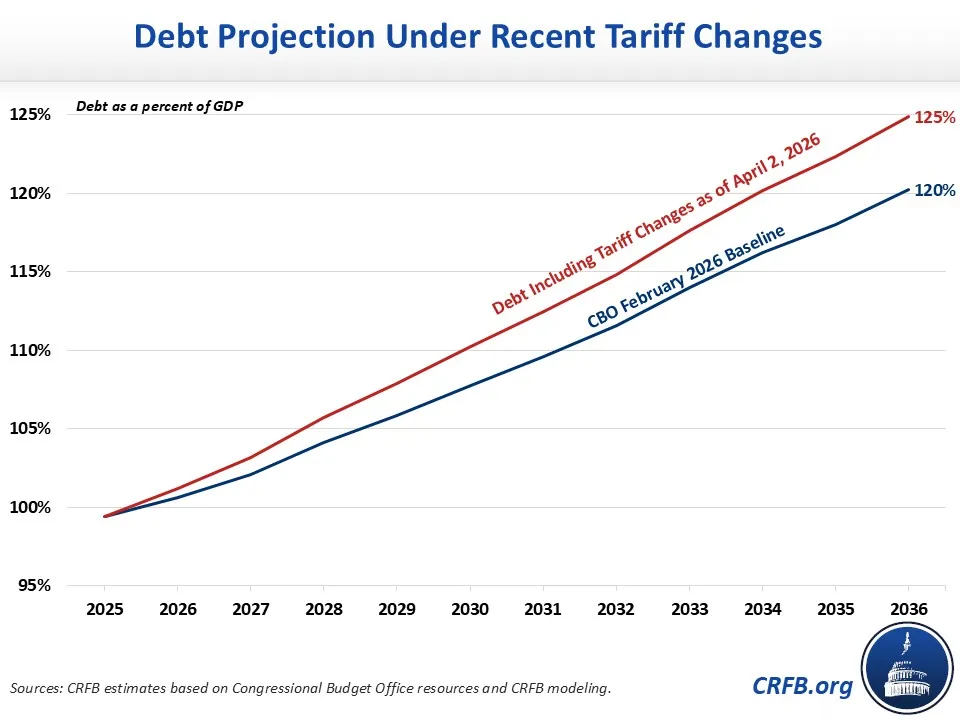
Under the current tariff regime, we project debt will rise to 125% of Gross Domestic Product (GDP) by 2036, or 5 percentage points higher than in the Congressional Budget Office’s (CBO) February 2026 Budget and Economic Outlook. We will continue to estimate changes to tariffs as they are implemented. These estimates assume the 10% Section 122 tariff expires in July 2026, as Section 122 tariffs are subject to a statutory time limit of 150 days.
Importantly, these estimates do not include the Administration’s recent proclamation adjusting tariffs on imports of pharmaceuticals, as they are not yet in effect.
While the Administration has repeatedly stated its intention to recoup lost revenue from the Supreme Court’s ruling against IEEPA tariffs, the latest changes to tariffs under Section 232 will further reduce revenues. We encourage policymakers to replace lost tariff revenues with revenue or spending offsets to avoid worsening an already unsustainable fiscal situation.
1 We assume the 15% rates for these derivative products to be permanent.