Improving Accountability in Medicaid Medical Loss Ratios
Managed care organizations (MCOs) – private insurance plans that operate the program under contract from the state – enroll over three quarters of the 67 million people covered by Medicaid. Introduced primarily as a cost-control mechanism, spending in managed care has grown from about $60 billion (22% of total spending) in 2010 to roughly $300 billion (45%) in 2025.1 However, oversight has not kept pace, leaving open questions about whether states are optimizing managed care’s ability to constrain costs.
Whereas fee-for-service (FFS) payments are open-ended, MCOs are generally paid a fixed amount per enrollee. These “capitation payments” are designed to cover the predicted costs of each beneficiary’s care, as well as of administering the plan, and enough profit to incentivize plans to remain in the market. States set capitation payments in advance, so plans take on the risk that beneficiaries will need more care than anticipated. If costs are higher, plans may lose money. If costs are lower, the plans profit.2 In this way, plans are incentivized to keep total spending low. However, those same incentives might encourage plans to spend less on health care to keep more for administrative costs or profits.
To avoid this outcome, states can set a minimum medical loss ratio (MLR). The MLR is essentially the ratio of a plan’s spending on medical care as a share of its total capitation payments (see Appendix I for more details) – measuring the share of plan dollars not going to administrative costs and profits.
Unfortunately, MLR rules have proven a weak tool for holding plans accountable and – along with other incentives in managed care – have interfered with one of managed care’s key aims: to reduce spending while maintaining quality care.
In this paper we explain:
- The conflicting incentives that maintain or increase managed care payments over time, and MLR’s role in that process;
- How plans game the MLR to diminish its effectiveness; and
- An alternative policy idea to encourage plans to reduce health care costs over time and share the savings with the state and federal government rather than rely on remittances.
The federal government spends over $2 trillion a year on federal health care – including $700 billion for Medicaid – at a time when debt is nearing an all-time high. While Medicaid is undergoing significant changes in the coming years, policymakers should take any opportunities they can to reduce unnecessary spending to ensure Medicaid continues to serve beneficiaries for years to come.
MLR As a Financial Accountability Tool
After its establishment in 1965, states ran, and jointly financed with the federal government, Medicaid programs almost exclusively on a fee-for-service (FFS) basis. Under FFS, states pay doctors, hospitals and others for each service or good they provide.
States introduced managed care to Medicaid programs as early as 1968 to help reduce costs and increase budget predictability, among other goals.3 In a managed care model, states pay insurance companies a monthly capitation payment – a fixed amount per enrollee adjusted annually – during the contract period (usually three to five years). Unlike most fee-for-service programs MCOs use various tools to lower costs and improve quality. For example, plans can build networks of providers and limit coverage outside those networks, negotiate lower rates for certain providers, and pay different amounts to providers based on quality or other factors. MCOs can also impose utilization controls like prior authorization or referral requirements and are often expected to use care coordinators to manage care for targeted groups of beneficiaries.
Because most MCOs are paid the same amount regardless of how much medical care beneficiaries use, they take on risk. If medical spending is more than expected – either because beneficiaries are sicker and need more expensive services or because beneficiaries consume more services overall – then the plan will lose money. Alternatively, if expenses are less than predicted – either because beneficiaries use less care than predicted, the plan implements quality improvement activities that decrease costs, or the plan denies or fails to provide access to care – the MCO saves money and may retain the extra as profit or surplus revenue.
Developing capitation rates is complex. State actuaries develop the rates, which must be actuarially sound: fair, reasonable, and based on realistic expectations about expected health care costs during the period. Actuaries project: the number and cost of services that beneficiaries are expected to use during the year; the amount plans need to administer the services; an amount to compensate the plan for the risk they are taking on, or profit; and any other state needs such as quality improvement.4 A key source for these calculations includes historical rates, that is, the rates that were paid in previous years.
In developing the per capita amount, states must strike a balance: overpaying plans imposes significant budgetary costs, while underpaying could lead plans to withdraw from the Medicaid market. But once payment rates are set, states ability to dictate how those dollars are spent are limited to the terms of the managed care contract.
To ensure Medicaid dollars are spent on actual health care, and to provide a check on how rates were set at the beginning of the contract, many states impose a minimum medical loss ratio (MLR). It requires a certain percentage of capitation payments go to health care as opposed to funding an MCO’s administrative costs and profits. Federal rules and laws require that minimum MLRs be set to 85%, though states can and often do set them higher.5
At a high level, an MCO’s MLR is calculated as the ratio of (see Appendix I):

Beginning in 2017, federal rules required Medicaid managed care plans to calculate and report their MLR.6 States have significant discretion on how high to set the MLRs above the 85% floor,7 as well as on how MLR standards are set, calculated, and enforced.
States also decide what happens if plans fall below the minimum MLR. In 33 of the 41 states with managed care MLR requirements, plans must pay back funds if they fall below the MLR rate.8 These “remittances” are calculated based on the difference between the actual and minimum MLR. In 2021, MLR remittances totaled $1 billion, of which approximately $700 million was returned to the federal government. Five states do not require remittances, but may take other action like modifying future contracts or excluding an MCO from contracting.
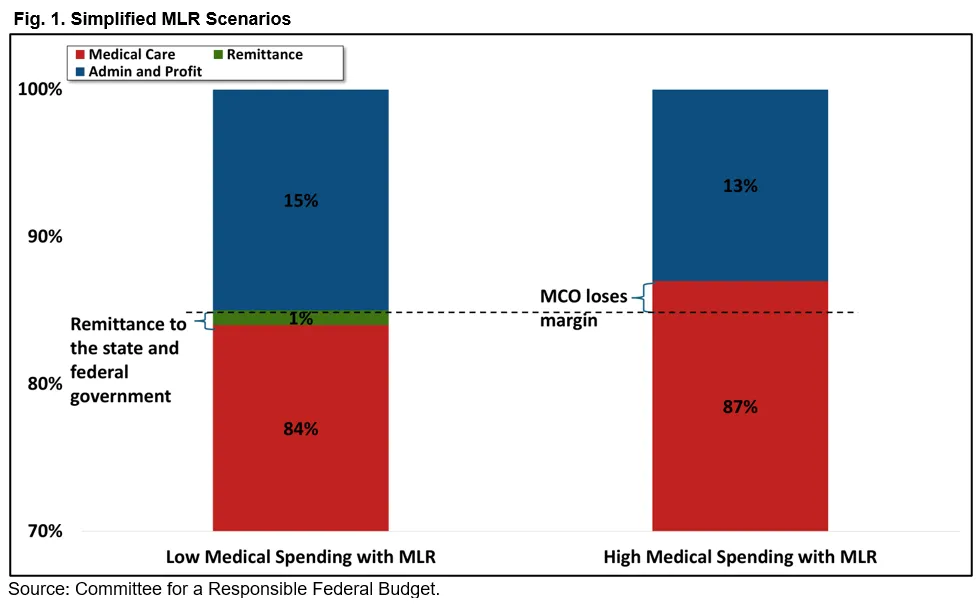
A minimum MLR can help ensure that a meaningful share of Medicaid spending supports health care delivery rather than administrative expenses or profit. At the same time, MLRs are not a direct cost‑containment mechanism and cannot, on their own, distinguish between efficient and inefficient medical spending. In combination with other tools – such as rate-setting, reporting requirements, and audits – MLRs can theoretically improve accountability and oversight. However, they can also create adverse incentives and come with trade‑offs.
MLR Requirements Blunt Managed Care Savings Potential
Managed care theoretically offers a way for states to align incentives to deliver Medicaid benefits in a fiscally responsible manner. Unlike FFS – in which providers are incentivized to increase the volume of care delivered to generate revenues – capitation payments incentivize MCOs to keep beneficiaries healthy to consume fewer services so that the MCO can retain the remaining payments. As a result, we should have expected states to see a downward spending trend and improved quality compared to when they used FFS. In practice, the evidence that managed care saves money compared to FFS, on net, is weak. Some studies have found pockets of savings or quality improvement; but others have found increased spending and reduced quality.9
There are myriad reasons that MCOs may have failed to reduce costs as expected. Some of these include the challenges of serving a complex population, multiple layers of administrative requirements, and significant barriers to entry. Once MCOs are in place, they enjoy the benefits of incumbency and face little pressure to manage payment rates.
MLRs exacerbate these tensions. Because the MLR limits administrative costs and profits to a portion of total capitation payments, MCOs’ profit (or excess revenues) only grow if total spending grows.10 Perversely, the MLR helps create incentives for MCOs to increase rates and spending year over year, or at least weaken the incentive to control medical spending by holding down provider prices, addressing inefficient providers, or initiating cost-saving efforts.
Once bound by the MLR, any effort an MCO makes to further reduce health care costs can also reduce MCO profits, while boosting health care costs could actually increase profits over time. Maximizing profit in a given year jeopardizes profits in future years. Future capitation rates are based significantly on historic experience, that is, on last year’s rates. If a plan maximizes profit in one year, they could be required to pay remittances, and see their rates reduced in the following years. The incentive to increase rates year-over-year can make the MLR inconsequential: if rates for medical care and administration are high, then meeting the MLR has little meaning.
For the same reasons, plans do not always prioritize eliminating waste and abuse.11 When a managed care plan discovers overpayments to a provider, it must report the recoveries to the state and return the funds. Doing so decreases health care spending, which could boost required remittances and lower the amount they are paid in the following year.
Partially as a result of these incentives, managed care plans have often been found to leave waste and abuse concerns wanting. The Government Accountability Office reported numerous examples of plans’ overpayments and warned that unidentified overpayments and unallowable costs lead to increased rates and spending over time.12
MLRs Are Easily Gamed
MCOs can take actions to easily get around MLR requirements, rendering the calculation ineffective as an accountability tool. These workarounds are part of the reason that MLR remittances have not generated meaningful savings to date. In 2021 – the most recent year for which data is available – 31 MCOs in 14 states paid remittances totaling only $1 billion (with about $700 million going to the federal government). In 2024, Congress allowed states with minimum MLR remittances for certain plans to retain extra funds,13 saving an additional $180 million per year for the federal government.14
To avoid remittances, plans continually assess their spending rates to make sure they end the contract year meeting the MLR target. They sometimes strategically spend on activities that increase the numerator but may add little value (see Appendix II).15
Vertically integrated plans have ample opportunities to defang MLR. When plans own provider networks – such as health systems or pharmacy benefit managers – MCOs can simply pay their own providers more than others. Doing so boosts their medical spending and increases their MLR, but the extra goes to their own bottom line. In fact, MLR may incentivize plans to consolidate more. As plans gain market share, they can drive down prices at competing providers. And they can do so while boosting payments to their own providers and avoiding MLR remittances.16
Multiple studies have shown that major carriers UnitedHealth and CVS/Aetna pay their own extensive provider networks at higher rates.17 Molina Healthcare, an insurer that gets over 80% of its enrollment from Medicaid managed care, also owns an extensive network of providers.18 Data is limited on the rates that Medicaid MCOs pay providers because plans do not have to report these figures, which they consider to be trade secrets. However, one study of the commercial market found that UnitedHealthcare’s payments to its own providers were 17% higher than the relative price of its competitors. In markets where UnitedHealthcare has more than a quarter of the market share, this percentage increases to 61%.19 It is reasonable to assume that plans in the Medicaid sector increase rates as well.
CMS has rules that address this sort of problem when it comes to owning pharmacy benefit managers (PBMs) but less clear guidance on health systems or provider groups.20 CMS’ 2024 rule required additional reporting on MCOs’ payments to PBMs, but when it came to plan-owned providers, CMS indicated that states should be aware of the issue but declined to take further action.21
In lieu of federal action, some states have capped payments to affiliated providers. Colorado’s actuary reprices claims paid by one MCO to their parent hospital system to the rates they pay to unaffiliated hospital systems. Oregon’s actuary repriced claims from doctor visits for certain affiliated providers using average rates for similar services billed by other network providers, where possible. Other states have taken similar measures.22 Nonetheless, there are no nationwide requirements for states to scrutinize plans’ vertically-integrated providers and many do not.
Shared Savings Programs Can Improve Incentives and Reduce Costs
Rather than a blunt MLR with remittances that encourages plans to inflate total health and quality spending, states could employ a shared savings program – paired with accountability for quality – to better align incentives. Current MLR rules incentivize plans to minimize administrative costs and maintain or inflate health and quality spending. But plans should have an incentive to reduce health spending as well, as long as people are getting the quality care they need. Under a shared savings program, as the plans reduce health spending, both the plan and the states (and thus the federal government) share in the gains of cost control.
Broadly speaking, a “shared savings” program would retain MLR ratios but replace the current 100% remittance with a system that shares savings between the MCO and the Medicaid program. In this way, plans would have continued incentive to reduce health care costs even after meeting the MLR ratio, while still being encouraged to stay below the MLR if possible and to ensure a reasonable share of spending goes to health care. A second higher loss ratio could also be established to protect beneficiaries from plans’ limiting access to care.
To understand how this would be effective, consider a plan that estimates their MLR to be just meeting the required minimum of 85%. Under a remittance system, the plan has no incentive to reduce health expenditures, even if a small investment in a quality or efficiency initiative could reduce health costs; and in fact, the plan is incentivized to increase medical costs in order to boost profits. But if the remittance requirement was replaced with 50/50 shared savings for MLRs between 80% and 85%, the plan would profit from pursuing cost-saving measures.
Although the first order effect of this policy would be to reduce savings from remittances, it would likely save money overall both by driving down costs in the immediate term and by reducing costs over time as future capitation payments are reduced in response to lower costs. While no cost estimate is available at this time, even a modest decline in costs, compounded over time, would produce meaningful savings given that managed care accounts for more than half of all Medicaid spending.
Texas already employs a type of shared savings program for MCOs, allowing them to retain up to 12% of the payments they receive from the state.23 Texas includes both medical and administrative costs in the calculation. This approach is intended to encourage efficiency across the entire operation, not just shifting costs between categories. Under this approach, MCOs benefit, but also retain incentives to continue to lower costs in both medical care administration as time goes on.
An early analysis of the program suggested that the program saved a modest amount relative to an MLR regime in the first two years (it should be noted that control groups or counterfactuals are all but impossible to implement in the real world).24 To ensure that MCOs are not achieving these large savings at the expense of beneficiary health outcomes, states could follow Colorado’s example and require plans to achieve specified quality metrics in order to share savings.25
Conclusion
Managed care plans take on enormously complex responsibilities in administering Medicaid benefits and face many constraints. In theory, capitation payment should limit the federal and state fiscal exposure while MCOs should hold down underlying cost growth. In reality, there is little evidence that MCOs have achieved this key goal of saving taxpayer dollars.
MCO’s do not, on the whole, appear to aggressively negotiate with providers, invest in technology, and avoid wasteful and abusive spending by nefarious or inefficient providers. As a result, not only are state and federal costs higher than necessary, but the health care system experiences less pressure to contain costs.
MLR rules were designed to prevent plans from underserving beneficiaries and pocketing the payments. But unfortunately, blunt MLR tools are both easily gamed and create perverse incentives that often encourage plans to boost rather than hold down medical costs.
Managed care incentives should be structured to encourage plans to reduce inefficient and avoidable medical spending and those savings should be reflected in future capitation rates. Even modest improvements in medical cost growth over time could generate savings that could exceed those achievable through remittances alone. Well‑designed risk mitigation frameworks including shared savings arrangements in place of MLR remittances can complement quality assurance requirements by reinforcing incentives for care coordination, utilization management, and payment reform, rather than unintentionally discouraging those investments once minimum thresholds are met.
Appendix I – MLR Components and Calculation Details
At a high level, Medicaid MLRs are calculated by dividing the amount of health care expenditures by the capitation payments. However, the actual calculation is significantly more complex.
Numerator
Inclusions and Adjustments
- Incurred claims, including unpaid incurred but not reported claims and amounts paid to network providers under both fee-for-service and capitated arrangements
- Incentive or bonus payments made, or expected to be made, to network providers that are tied to clearly defined, objectively measurable, and well-documented clinical or quality improvement standards that apply to providers
- Amounts paid to providers under state directed payments
- The amount of claims payments recovered through fraud reduction efforts can be included as though they were paid, up to the amount of fraud reduction expenses
- Expenses on fraud prevention efforts
- Expenses on activities that improve health care quality
- Prescription drug rebates and overpayment recoveries must be deducted from the costs of all items above
Expenses that Must be Excluded
- Administrative expenses not described above incurred directly by the insurer, or paid to a third party for secondary network savings, network development, administrative fees, claims processing, utilization management, and other delegated functions under the contract
- Indirect or overhead costs, even those that are reasonably related or incremental to activities that improve healthcare quality, such as office space, human resources, software and other costs associated with staff exclusively engaged in activities that improve healthcare quality
- Fines or penalties assessed by regulatory authorities
- MLR remittances
Expense Allocations
- Expenses must be included under only one type of expense (e.g. medical, administrative, or activities that improve healthcare quality), unless the expense includes components that meet multiple definitions, in which case it must be pro-rated between types.
- For example, if a managed care plan pays a dental subcontractor a capitated amount that covers payment of network dental providers, activities that improve healthcare quality, claims payment, and profit, the portion of the capitated amount for each purpose must be estimated, with only the portions permissible in the numerator included in the numerator
- When an expense or overhead cost benefits multiple contracts or populations, for example, Medicare and Medicaid members, or multiple states, it must be allocated on a pro rata basis, and expenses that are wholly attributable to the contract must not be apportioned to other entities
- Expenses must be allocated using a generally accepted accounting method expected to yield the most accurate results
Denominator
Inclusions and Adjustments
- Premium revenue after risk adjustment including capitation and event-based payments (such as delivery payments for maternity and birth costs)
- Revenue must be reduced for any amounts not earned back from withholding arrangements, and adjusted for any applicable risk-sharing mechanisms such as reinsurance or risk corridors
- State and federal taxes are allowed to be deducted from premium revenue, as are assessments paid in lieu of taxes paid by non-profit plans.
- Revenue can be reduced by the amount of unpaid cost-sharing amounts that the MCO made a reasonable, but unsuccessful effort to collect
- Revenue included in premiums for state directed payments
Exclusions
- Revenue earned from incentive or bonus programs included in MCO contracts is not included in premium revenue
Other Rules
- Credibility adjustments are applied to low enrollment
- Newer experience may not be subject to minimum MLRs
- Recalculation is required when significant changes occur after the first calculation
- Calculations must include an Attestation by an officer of the company, usually the Chief Financial Office
Appendix II: Quality Incentive Payments
MCOs’ treatment of quality incentive payments illustrates a way that historically, MCOs have evaded MLR’s constraints.
MLR incentivizes some plans to spend more, even when such expenditures are of questionable value. Although addressed in a 2024 regulation, this issue has been most keenly felt through provider bonuses and incentive payments. Federal rules have long allowed certain administrative activities that improve healthcare quality to be included in the numerator of MLR calculations (see Appendix I). The intent is to recognize that some non-clinical investments can improve outcomes over time. However, some MCOs used this allowance to game MLR by spending “quality” funds on dubious efforts, particularly timed to ensure that they don’t run afoul of the MLR. For example, in 2023, CMS found that “some managed care plans did not require a provider to improve their performance in any way to receive an incentive payment.” Furthermore, CMS “identified provider incentive performance periods that did not align with the MLR reporting period and provider incentive contracts that were signed after the performance period ended.”26
Audits conducted in Ohio and Washington state, evaluating 2020 and 2021 respectively, found numerous matters of concern. In Ohio, only 1% of provider incentive contracts followed all leading practices. For 15% of provider incentives, contracts were either not submitted to the state or did not exist. Five plans paid provider incentives without contracts.27 In Washington, only 2% of provider incentive payments followed all leading practices, and 72% followed two or fewer.28
Plans’ ability to pay unmerited bonuses to game MLR was curtailed in 2024.29 CMS finalized a rule that will address longstanding concerns that plans were spending on “quality” activities that do not actually enhance quality, such as lobbying or marketing activities, or are of dubious health benefit to beneficiaries.30
1 Congressional Budget Office (CBO), “Spending and Enrollment Detail for CBO’s March 2011 Baseline: Medicaid,” March 2011, https://www.cbo.gov/sites/default/files/recurringdata/51301-2011-03-medicaid.pdf, CBO, “Baseline Projections: Medicaid,” February 2026, https://www.cbo.gov/system/files/2026-02/51301-2026-02-medicaid.pdf, and Schneider, Andy, “How Did We Get Here? An Early Legislative History of Medicaid Managed Care,” Center for Children and Families, March 21, 2023, https://ccf.georgetown.edu/2023/03/21/early-legislative-history-medicaid-managed-care.
2 To address various risks of unexpected costs, some states use risk corridors, which share financial gains and losses between the state and plans when experience is significantly different from expectations, kick payments for high-cost events, carve outs of volatile services, and other mechanisms.
3 Andy Schneider, “How Did We Get Here? An Early Legislative History of Medicaid Managed Care,” Center for Children and Families, March 21, 2023, https://ccf.georgetown.edu/2023/03/21/early-legislative-history-medicaid-managed-care.
4 This process is referred to as “rate-setting.” The state assigns an amount to different types of beneficiaries, such as those who are entitled to care on the basis of being pregnant, or children, for example, and may assign different amounts based on beneficiaries’ health conditions. MACPAC, “Medicaid Managed Care Capitation Rate Setting,” March 2022, https://www.macpac.gov/wp-content/uploads/2022/03/Managed-care-capitation-issue-brief.pdf.
5 Federal law requires capitation rates to be set such that the MCO could reasonably achieve an MLR of at least 85%. 42 C.F.R. 434.8(b)(9).
6 Centers for Medicare & Medicaid (CMS), “Medicaid and Children's Health Insurance Program (CHIP) Programs; Medicaid Managed Care, CHIP Delivered in Managed Care, and Revisions Related to Third Party Liability,” Final Rule, 81 FR 27498, CMS, May 16, 2016, https://www.federalregister.gov/documents/2016/05/06/2016-09581/medicaid-and-childrens-health-insurance-program-chip-programs-medicaid-managed-care-chip-delivered.
7 “Since 2019, states have been required to develop managed care capitation rates such that each MCO can reasonably achieve an MLR of at least 85 percent for the rate year.”
MACPAC, “Medicaid Managed Care Capitation Rate Setting,” March 2022, https://www.macpac.gov/wp-content/uploads/2022/03/Managed-care-capitation-issue-brief.pdf.
8 An additional three states (OH, RI, UT) occasionally require MCOs to pay remittances. See Hinton, Elizabeth et. al., “A View of Medicaid Today and a Look Ahead: Balancing Access, Budgets and Upcoming Changes,” Kaiser Family Foundation, November 13, 2025, https://www.kff.org/medicaid/50-state-medicaid-budget-survey-fy-2025-2026/#fd7eda3b-0a6b-4cc7-8557-9cdef36b41cb.
9 “Early proponents of managed care argued that private insurers would be more effective at delivering higher-quality care and at reducing the cost of care. States also desired budget predictability. While there are incidences of success, research evaluating managed-care programs show that these initial hopes were largely unfounded.” Montoya, Daniela Franco, Puneet Kaur Chehal, and E. Kathleen Adams, “Medicaid Managed Care's Effects on Costs, Access, and Quality: An Update,” Annual Review of Public Health 41 (2020), https://doi.org/10.1146/annurev-publhealth-040119-094345. See also Pope, Chris, “Reining in Medicaid Managed Care,” Manhattan Institute, May 28, 2026, https://manhattan.institute/article/reining-in-medicaid-managed-care.
10 Many MCOs are nonprofit organizations and therefore do not actually retain “profits.” Nevertheless, these organizations have incentives to ensure that excess funds are retained at the end of contract cycles.
11 MLR regulations allow plans to count fraud prevention activities in the numerator. See Appendix I.
12 Compounding the challenge, federal error rate testing does not apply to managed care payments to providers, so regulators have limited information on the prevalence of fraud, waste, and abuse. United States Government Accountability Office (GAO), “Medicaid: CMS Should Take Steps to Mitigate Program Risks in Managed Care,” May 2018, https://www.gao.gov/assets/gao-18-291.pdf.
13 The law allowed states that did not require remittances for plans serving their expansion populations – for whom the state receives a higher rate of federal matching funds – to implement them and retain a share consistent with their regular FMAP, rather than their much higher enhanced FMAP. First temporarily enacted under The SUPPORT Act of 2018 (P.L. 115-271) and then made permanent in the Consolidated Appropriations Act of 2024 (P.L. 118-42).
14 Congressional Budget Office (CBO), “Consolidated Appropriations Act, 2024,” March 5, 2024, https://www.cbo.gov/publication/60058.
15 A separate, longstanding method plans have used to avoid MLR remittances is spending on activities with questionable value, like provider quality bonuses and incentive payments (See Appendix II). Federal rules have long allowed certain administrative activities that improve healthcare quality to be included in the numerator of MLR calculations. The intent is to recognize that some non-clinical investments can improve outcomes over time. However, some MCOs gamed this allowance by spending quality funds on dubious efforts, particularly timed to ensure that they don’t run afoul of the MLR. CMS finalized a rule to address egregious activities, but the incentive to continue to game the MLR remains. CMS, “Medicaid Program; Medicaid and Children's Health Insurance Program (CHIP) Managed Care Access, Finance, and Quality,” Final Rule, 89 FR 41126, CMS, May 10, 2024, https://www.federalregister.gov/documents/2024/05/10/2024-08085/medicaid-program-medicaid-and-childrens-health-insurance-program-chip-managed-care-access-finance.
16 Argüello, Andrés and Natasha Murphy, “Medical Loss Ratio Reform Can Help Curb Corporate Power and Lower Health Care Costs,” Center for American Progress, October 6, 2025, https://www.americanprogress.org/article/medical-loss-ratio-reform-can-help-curb-corporate-power-and-lower-health-care-costs/, Kakani, Pragya et al., “Profit Regulation And Strategic Transfer Pricing By Vertically Integrated Firms: Evidence From Health Care,” National Bureau of Economic Research, April 2026, http://www.nber.org/papers/w35043, and Rooke-Ley, Hayden, “Medicare Advantage and Vertical Consolidation in Health Care,” American Economic Liberties Project, April 2024, https://www.economicliberties.us/wp-content/uploads/2024/04/Medicare-Advantage-AELP.pdf.
17 See Angeles, January and Michael Bailit, “How Insurers That Own Providers Can Game the Medical Loss Ratio Rules,” Health Affairs, September 29, 2025, https://www.healthaffairs.org/content/forefront/insurers-own-providers-can-game-medical-loss-ratio-rules and Frank, Richard G. and Conrad Milhaupt, “Related businesses and preservation of Medicare’s Medical Loss Ratio rules,” Brookings Institution, June 29, 2023, https://www.brookings.edu/articles/related-businesses-and-preservation-of-medicares-medical-loss-ratio-rules/.
18 See Schneider, Andy and Nancy Kaneb, “Medicaid Managed Care: The Big Five in Q4 2025,” Georgetown Center for Children and Families, February 20, 2026, https://ccf.georgetown.edu/2026/02/20/medicaid-managed-care-the-big-five-in-q4-2025/ and Miller, Brian J. and George L. Wolfe, “Managed Care Marketplaces: Growing Drivers of Payer-Provider Vertical Integration,” April 2017, https://www.akingump.com/a/web/57128/aoiok/wolfe-article.pdf.
19 Arnold, Daniel, “UnitedHealthcare Pays Optum Providers More Than Non-Optum Providers,” Health Affairs, November 3, 2025, https://doi.org/10.1377/hlthaff.2025.00155.
20 CMS guidance prohibits plans from recording PBM spread as medical expenses. CMS, “Medical Loss Ratio (MLR) Requirements Related to Third-Party Vendors,” May 15, 2019, https://www.medicaid.gov/federal-policy-guidance/downloads/cib051519.pdf.
21 CMS, “Medicaid Program; Medicaid and Children's Health Insurance Program (CHIP) Managed Care Access, Finance, and Quality,” Final Rule, 89 FR 41129, CMS, May 10, 2024, https://www.federalregister.gov/documents/2024/05/10/2024-08085/medicaid-program-medicaid-and-childrens-health-insurance-program-chip-managed-care-access-finance.
22 Washington state’s recent capitation rates adjusted administrative rates when it appeared that an affiliated company was being paid excessive rates. In addition, to address concerns about provider consolidation and impact on provider reimbursement, some states require MCOs to set fee schedules to limit the effect of higher prices commanded by consolidated entities. However, doing so blunts one of managed care’s main tools in reducing total spending.
23 Texas Health and Human Services Commission, “Assessment of Financial Incentives for Alternative Payment Models: Texas Delivery System Reform Incentive Payment Program Transition Plan,” June 2021, https://www.hhs.texas.gov/sites/default/files/documents/laws-regulations/policies-rules/Waivers/medicaid-1115-waiver/assessment-financial-incentives-apm.pdf.
24 Texas Health and Human Services Commission, “Evaluation of the Texas Healthcare Transformation Quality Improvement Program 1115(a) Demonstration Waiver Interim Evaluation Report,” September 30, 2015, https://www.medicaid.gov/Medicaid-CHIP-Program-Information/By-Topics/Waivers/1115/downloads/tx/Healthcare-Transformation-and-Quality-Improvement-Program/tx-healthcare-transformation-intrm-eval-rpt-09302015.pdf.
25 Colorado Department of Healthcare Policy and Financing, “Denver Health Medicaid Choice. CO Medicaid Managed Care Rate Books, FY 2024−25,” June 27, 2024.
26 CMS, “Medicaid Program; Medicaid and Children's Health Insurance Program (CHIP) Managed Care Access, Finance, and Quality,” Proposed Rule, 88 FR 28155, CMS, May 3, 2023, https://www.federalregister.gov/documents/2023/05/03/2023-08961/medicaid-program-medicaid-and-childrens-health-insurance-program-chip-managed-care-access-finance.
27 CMS Center for Program Integrity, "Ohio Medicaid Managed Care Medical Loss Ratio Audit, Audit Period: Calendar Year 2020 Reporting Period," July 2025, https://www.cms.gov/files/document/ohio-medicaid-managed-care-medical-loss-ratio-audit-report.pdf.
28 CMS Center for Program Integrity, "Washington Medicaid Managed Care Medical Loss Ratio (MLR) Audit, Audit Period: Calendar Year 2021 Reporting Period," August 2025, https://www.cms.gov/files/document/washington-medicaid-managed-care-med….
29 Additionally, the 2024 Medicaid Managed Care Final Rule included a requirement that states review provider incentive payments to ensure that they are prospectively defined, including the MLR period to which they will be assigned, and based on the achievement of objectively defined, quantitative quality or performance metrics, which should allow states to ensure that any loopholes that allowed MCOs to pay providers discretionary incentives to avoid paying a rebate to the state are closed. CMS, “Medicaid Program; Medicaid and Children's Health Insurance Program (CHIP) Managed Care Access, Finance, and Quality,” Proposed Rule, 88 FR 28155, CMS, May 3, 2023, https://www.federalregister.gov/documents/2023/05/03/2023-08961/medicaid-program-medicaid-and-childrens-health-insurance-program-chip-managed-care-access-finance.
30 Schneider, Andy and Allie Corcoran, “Medicaid Managed Care: What Can the Annual MLR Report Tell Us?,” Georgetown Center for Children and Families, March 4, 2022, https://ccf.georgetown.edu/2022/03/04/medicaid-managed-care-what-can-the-annual-mlr-report-tell-us.