Social Security Retirees Receive Far More Than They Paid In
With Social Security only 6 years from insolvency, one impediment to the enactment of thoughtful solutions is the myth that Social Security benefits directly represent seniors’ hard-earned money that they paid for in full through past payroll tax contributions and thus are entitled to as an unmalleable earned benefit.
Although politicians and special interests weaponize this misperception to fight against any changes to the program, it is based on a fundamental misunderstanding of how the program works and of how much it pays out. Fixing the system will require putting this myth to bed.
In this piece, we explain:
- Scheduled benefits are projected to be about 133% of taxes for beneficiaries retiring this decade, on a present value basis. Benefits will be about 265% as large as just the worker share of payroll taxes on a present value basis.
- At the same time, program costs over the next 75 years are projected to total about 135% of future taxes.
- On a nominal basis, a typical retiree’s scheduled benefits will be almost 4 times as large as total taxes paid and more than 7 times as large as their own taxes paid.
- Although the ratio of benefits to taxes varies wildly by person, scheduled benefits are projected to be at least as large as taxes paid for all income quintiles of beneficiaries retiring this decade.
- Social Security is not a savings program or a prefunded pension, but rather a pay-as-you-go social insurance program with benefits only very loosely related to contributions. Because the program costs far more than it collects in revenue, reforms are needed to prevent insolvency and avoid an abrupt 22% benefit cut.
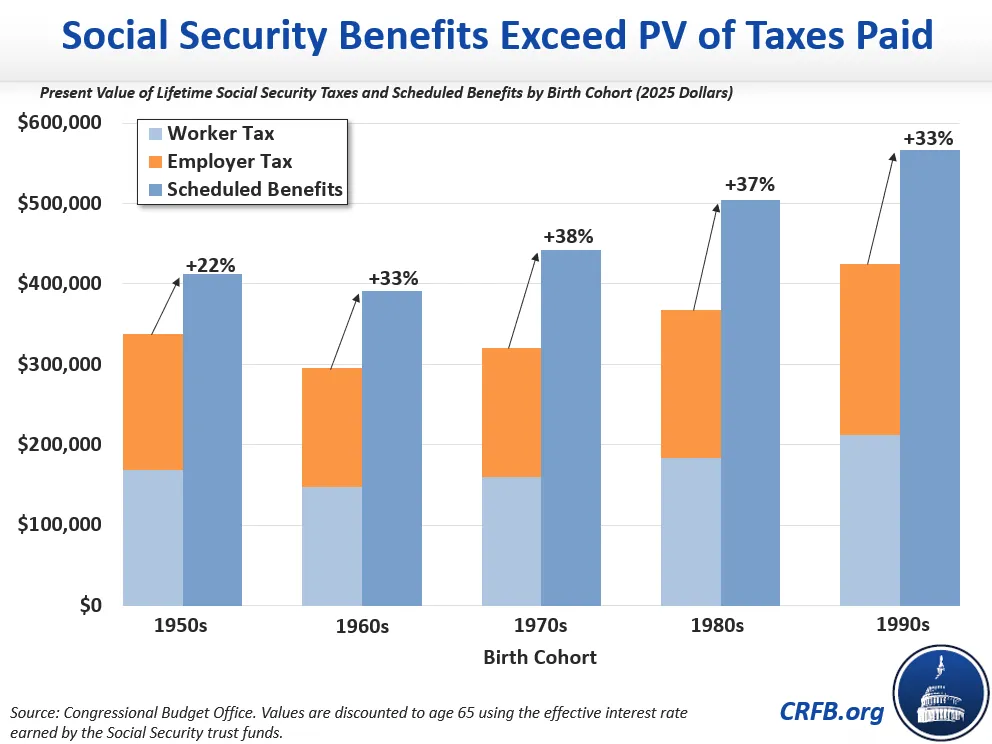
Despite claims to the contrary, workers collect more in benefits than they and their employers pay in taxes, even on a present value basis. In a 2025 analysis comparing all taxes to all benefits, the Congressional Budget Office (CBO) found that those born in the 1960s (and thus retiring this decade) are scheduled to receive 133% as much in benefits as they and their employers pay in taxes on a present value basis.1 In other words, retirees are scheduled to receive all of their contributions, plus interest, plus an additional 33 cents for every $1 they and their employer paid in.
When only looking at the worker contribution, benefits are about 265% as large as taxes – meaning workers get more than 2.6 times of what they pay in directly plus interest on those payments.
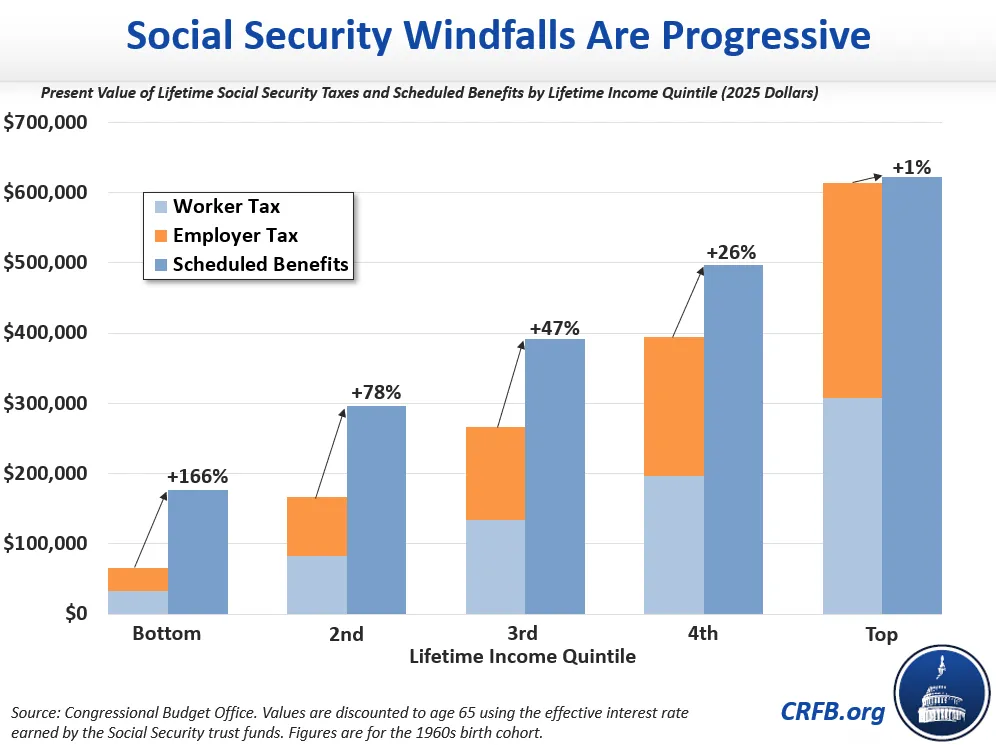
Importantly, these reflect averages, and individual retirees may receive far more or far less in benefits than what they and their employer paid in taxes. For those in the bottom quintile, scheduled benefits will average about 266% of combined taxes (532% of worker taxes). In the middle quintile, they will average 147% of combined taxes (294% of worker taxes). And the richest quintile of retirees will get back roughly what they and their employers paid into Social Security on a present value basis, though twice as much as they paid in alone.
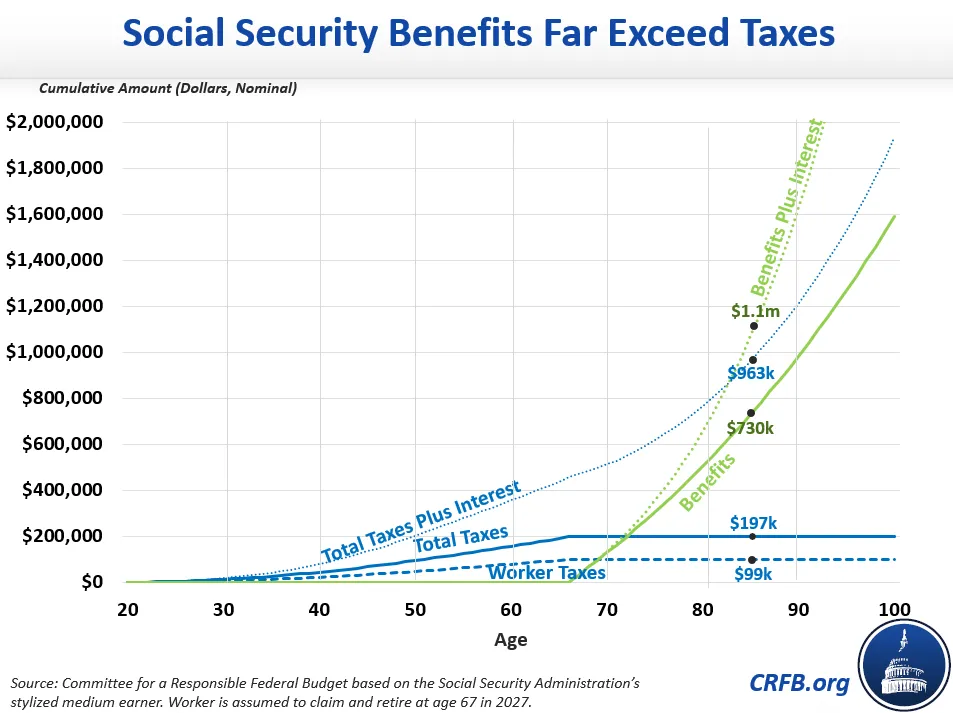
On a strictly nominal basis comparing dollars paid in to dollars paid out, this effect is far more pronounced.
A median-wage worker retiring in 2027 can expect about $730,000 in scheduled benefits, compared to less than $200,000 paid in taxes by them and their employer.2 In other words, a typical retiree’s scheduled benefits will total 3.7 times taxes paid in, with benefits exceeding taxes after just six years of benefits. Benefits will be 7.4 times as large as taxes paid directly by the worker, with benefits exceeding those direct payments after just three years.
The reality is that Social Security is not a savings program where workers’ payroll tax contributions are saved in an account and used to pay their benefits. Nor are benefits based on or calculated to match a worker's payroll tax contributions. Rather, Social Security is a pay-as-you-go social insurance program where current workers’ payroll taxes finance the benefits of current retirees.
And benefits are not based on workers’ contributions, but rather a combination of workers’ wage histories and a progressive replacement rate formula, with adjustments based on birth year, age of retirement, years of work, marital status, spouse’s income, life expectancy, and other factors.
The other reality is that the same benefit formula that pays out 33% more in benefits than what is collected in taxes is also projected to cost 35% more than what it collects in revenue over the next 75 years, according to the Social Security Trustees. Benefits thus not only exceed what was paid in, but also exceed what is payable under the current system.
The solution is not, of course, to indiscriminately cut current benefits to match past contributions. But neither is it to treat the current benefit formula as sacrosanct. With scheduled benefits far in excess of what workers paid in and what current payroll taxes can cover, reforms to adjust benefits (or taxes) are not reneging on Social Security’s promises, but rather securing them.
To prevent an abrupt 22% benefit cut in six years, policymakers must tell the truth about the program’s challenges and urgently begin the work of enacting trust fund solutions that better balance Social Security’s costs and revenues. Peddling myths about the program will only make this important work harder.
1 CBO defines the present value of lifetime benefits as the lifetime sum of Social Security benefits received – excluding benefits received by young widows, young spouses, and children – net of income taxes that beneficiaries pay on those benefits, discounted to age 65 and expressed in 2025 dollars. The present value of lifetime taxes equals the lifetime sum of the worker’s and employer’s share of payroll taxes, discounted to age 65 and expressed in 2025 dollars.
2 We assume they retire at their Normal Retirement Age of 67 and collect through the average life expectancy at age 67 of 85.