Section 301 & 338 Tariffs Replace Less Than 60% of Lost IEEPA Revenue
NOTE (August 20, 2026): CBO estimated that changes in trade policy through July 31, 2026 increase projected primary deficits by $0.7 trillion and total deficits by $0.9 trillion over the FY 2027-2036 period relative to the February 2026 baseline. This matches our estimates (excluding the impact of the Canada Section 338 tariff not yet enacted).
Today, the Trump Administration announced final action imposing tariffs of 10% to 12.5% on certain imports from 60 economies in response to their “failure to impose and effectively enforce a prohibition on the importation of goods produced with forced labor.” The Trump Administration also recently announced final action on a 25% tariff on certain imports from Brazil and announced a new 50% tariff on certain imports from Canada. Taken together, we estimate these tariffs would raise roughly $950 billion through Fiscal Year (FY) 2036.
The multi-country tariffs announced today, along with the Brazilian tariffs put into effect earlier this week, are being enacted under Section 301 of the Trade Act of 1974 – intended for addressing unfair foreign practices affecting U.S. commerce – and will take effect tomorrow. The Canadian tariff will be imposed under Section 338 of the Tariff Act of 1930, intended for offsetting foreign actions that burden or discriminate against U.S. commerce.
Combined, these tariffs would replace less than 60% of the projected revenue lost from the Supreme Court’s ruling against tariffs imposed under the International Emergency Economic Powers Act (IEEPA). In total, tariffs under the Trump Administration since January 2025 could raise an estimated $1.9 trillion.
Conventional Estimates of Net Tariff Revenue Impact Through FY 2036
| Revenue Impact | |
|---|---|
| 60-Economies Section 301 Tariffs | +$900 billion |
| Brazil Section 301 Tariff | +$15 billion |
| Canada Section 338 Tariff | +$40 billion |
| Impact of Section 301 & 338 Tariffs | +$950 billion |
| Tariffs Enacted through November of 2025 | +$2.7 trillion |
| Impact of IEEPA Removal Due to Court Ruling* | -$1.7 trillion |
| Temporary Section 122 10% Tariff | +$35 billion |
| Changes to Steel/Aluminum/Copper Tariffs | -$90 billion |
| Further Changes to Steel/Aluminum/Copper Tariffs | -$10 billion |
| Total Impact of Tariffs Since January 2025 | +$1.9 trillion |
| Memo: Total Lost Revenue Since November 2025 | -$825 billion |
Sources: CRFB estimates based on Congressional Budget Office resources and CRFB modeling.
Notes: Numbers are rough and may not sum due to rounding. * Estimate for revenue loss from Supreme Court ruling against IEEPA tariffs includes refunds.
Today’s Section 301 action will impose tariffs of 10 to 12.5% on imports from roughly 60 economies, effective tomorrow, while the enacted Brazil action imposes an across-the-board additional 25% tariff on Brazilian imports. However, both actions include exemptions that largely mirror those used under the earlier IEEPA and Section 122 tariffs. While the targeted economies comprise the vast majority of our imports by dollar value, the tariff rates are substantially less than the originally announced reciprocal tariffs on April 2 that had ranged from 10% to 50% alongside other tariffs under IEEPA authority such as a 40% additional rate on Brazil and 10% additional rate on China. Section 301 tariffs are intended to address unfair trade practices, are not subject to a statutory time limit, and may remain in effect until the Administration determines they are no longer necessary to address unfair trade practices.
The additional 50% Section 338 tariff on Canada applies to a small subset of imports from the country largely pertaining to motor vehicles, alcohol, and dairy products. Tariffs under Section 338 of the Tariff Act of 1930 are intended to address unreasonable and discriminatory measures against U.S. commerce, can remain in place indefinitely, and can be up to 50%.
We previously estimated Section 301 tariffs of 10% to 12.5% across dozens of economies could raise $980 billion through FY 2036. Due to lower or capped tariff rates for some countries and a broader set of product exemptions, we estimate the final action will instead raise roughly $900 billion.
We estimate the 25% Section 301 tariff on Brazil could raise $15 billion and that the 50% Section 338 tariff on Canada could raise roughly $40 billion. Together, proposed and enacted Section 301 and 338 tariffs could raise about $950 billion through FY 2036.
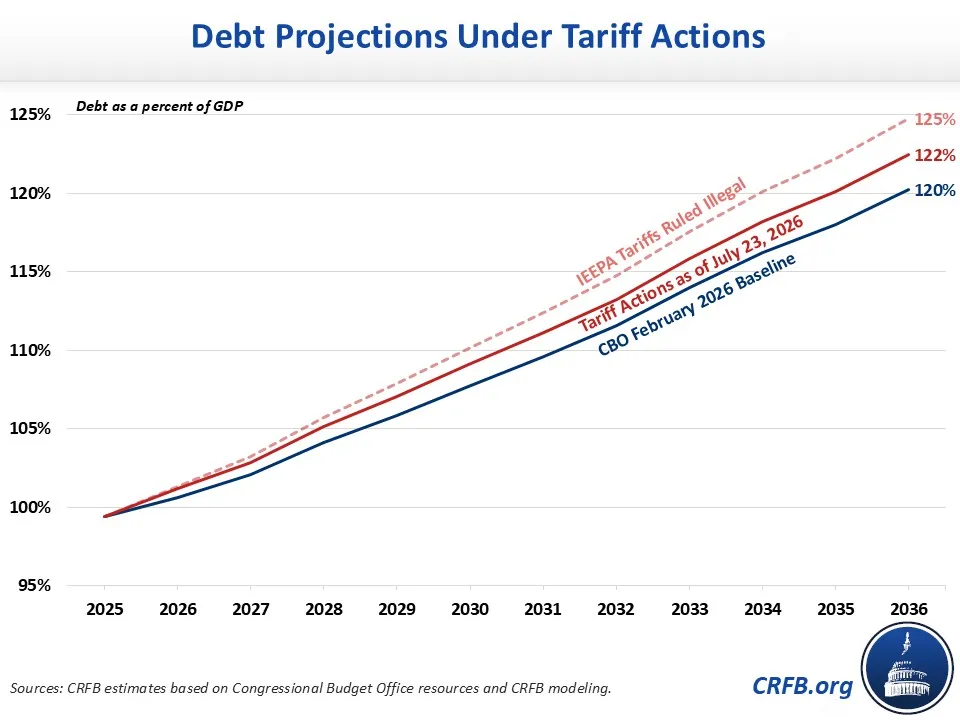
While the tariffs will generate significant revenue, they cover less than 60% of the revenue projected under IEEPA authority. We currently estimate that the tariffs enacted and proposed under this Administration since January 2025 will generate about $825 billion less revenue through FY 2036 than estimated in CBO’s February 2026 baseline, bringing debt to 122% of GDP by 2036 instead of 120% of GDP under CBO’s baseline.
Importantly, these new tariffs may also face legal challenges. The temporary Section 122 tariffs enacted in February were recently ruled illegal by the U.S. Court of International Trade, pending an appeal, and challenges could emerge to the new Section 301 and Section 338 tariffs as well.
Assuming the Section 301 and Section 338 tariffs are permanent and withstand legal challenge, these actions will generate significant revenue but not fully offset the Supreme Court’s ruling against IEEPA tariffs in February. Fully replacing that revenue would require additional tariffs, other revenue increases, spending reductions, or some combination of the three.