Federal Improper Payments Total $186 Billion in FY 2025
The federal government made at least $186 billion of improper payments in Fiscal Year (FY) 2025, according to new Government Accountability Office (GAO) estimates, with over half made through health care programs. Estimated improper payments rose 15% ($24 billion) from FY 2024 and have totaled around $3 trillion since 2003.1 Policymakers should work to reduce these improper payments as part of a strategy to improve government efficiency, lower deficits, and reduce government waste, fraud, abuse, and errors.
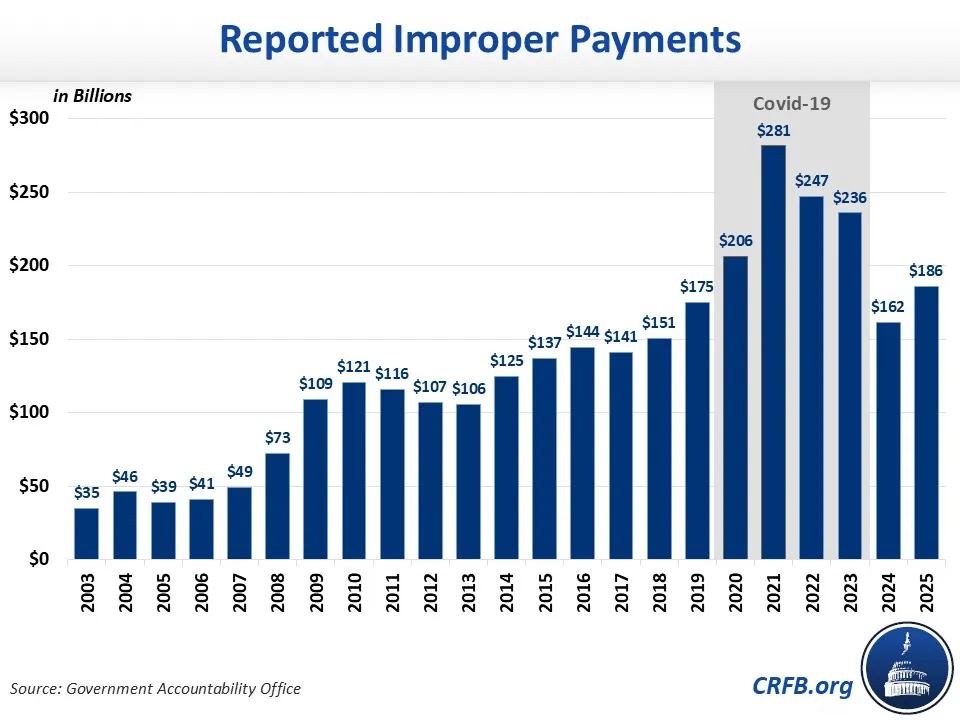
Improper payments are payments that should not have been made, were made in incorrect amounts, or failed to comply with recording or other applicable requirements. Improper payments may be the result of fraud, insufficient documentation, or error on the part of the government or the recipient. GAO’s improper payment estimates focus on 64 programs from 15 agencies, encompassing roughly three-quarters – $4.5 trillion – of total non-interest spending.2 The estimates are compiled from agency-reported data on PaymentAccuracy.gov as well as agency financial reports, and improper payment rates are calculated by dividing estimated improper payments by total program outlays.
Roughly four-fifths of all improper payments in FY 2025 – about $153 billion – were overpayments. The remainder consisted of underpayments ($10 billion), unknown payments ($14 billion), and technically improper payments ($8 billion), where the recipient received the correct amount but the process failed to comply with statutory or regulatory requirements.
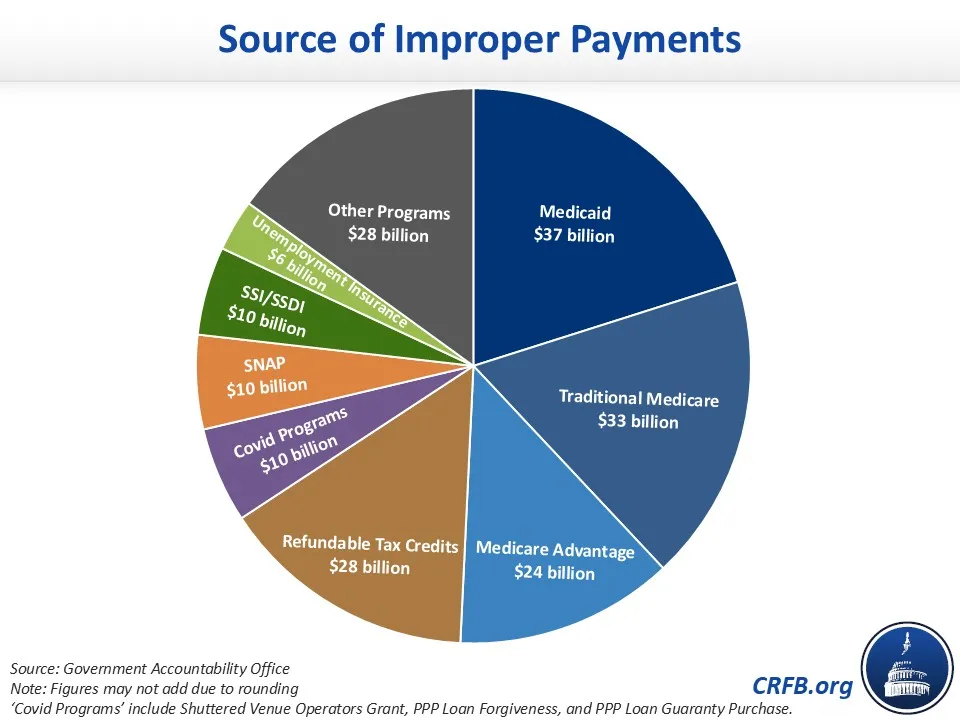
More than half of the total amount of improper payments comes from health care programs, including $57 billion (31%) from Medicare and $37 billion (20%) from Medicaid. Another 15% comes from refundable tax credits, including the Earned Income Tax Credit ($21 billion), the refundable portion of the Child Tax Credit ($5 billion), and the American Opportunity Tax Credit ($2 billion). And despite six years having passed since the beginning of the COVID-19 pandemic, at least 5% of improper payments were related to COVID relief programs, most notably $10 billion from the Shuttered Venue Operators Grant Program, which supported live venues, theaters, and cultural institutions.
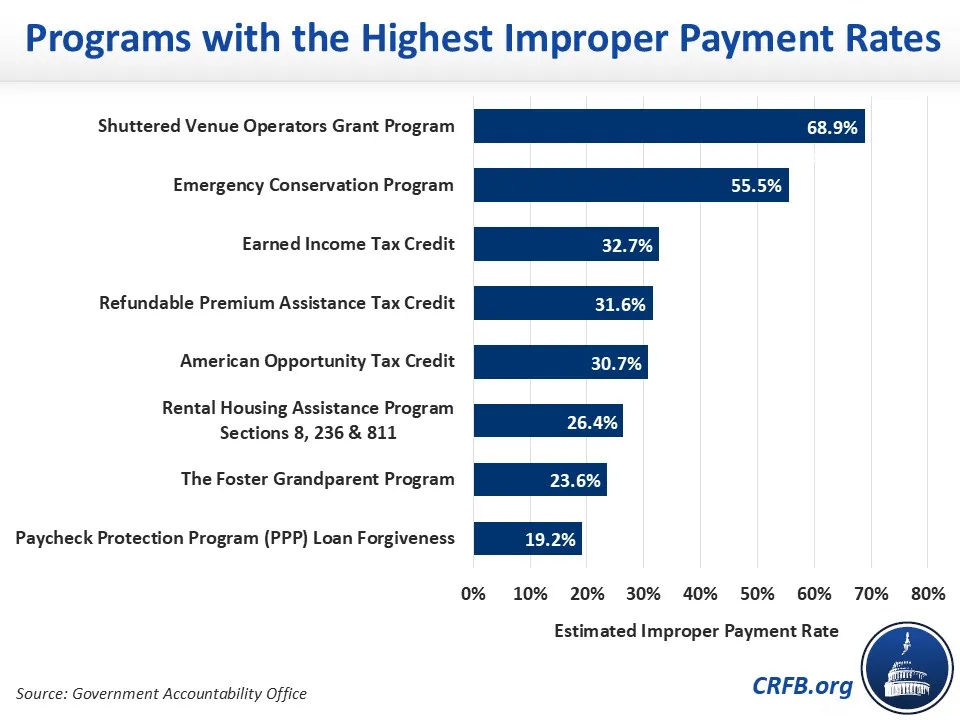
Pandemic relief programs and refundable tax credits had particularly high error rates. The Shuttered Venue Operators Grant posted the highest improper payment rate of any program at 68.9%, and the Paycheck Protection Program’s rate remained elevated at 19.2%. Among refundable tax credits, the Earned Income Tax Credit, refundable premium tax credits, and the American Opportunity Tax Credit all had error rates above 30%.
Importantly, GAO’s improper payment estimates do not incorporate the majority of the federal tax gap – the difference between taxes legally owed and taxes actually paid on time – which the IRS estimated to be roughly $600 billion in tax year 2022.
With debt now larger than the economy and deficits at twice the 3% of Gross Domestic Product (GDP) target, policymakers will need to identify substantial spending reductions and increase revenues to put the debt on a more sustainable path. Reducing waste, fraud, abuse, and errors won’t be sufficient to fix our fiscal situation, but it’s a good place to start. That involves taking improper payments seriously and identifying solutions to reduce their impact on the deficit. In the coming months, the Committee for a Responsible Federal Budget will be putting forward new analyses and ideas to tackle government waste, fraud, abuse, and errors.
1 It’s important to note that the GAO’s total for improper payments includes the entire amount of each payment, not just the amount over or under what should have been paid. For instances in which a payment should not have been made at all, the improper amount is the same as the total amount. However, in the case of most overpayments or underpayments, the improper amount is usually only a small fraction of the total amount. While reducing or eliminating improper payments would likely generate significant savings for the federal government – and should be pursued for that reason and others – the amount of potential savings from doing so is only a fraction of the total amount of improper payments reported each year by GAO. GAO’s totals also include “unknown” payments, which are payments that cannot be confirmed as proper or improper due to insufficient documentation.
2 The $186 billion total does not capture the full extent of government-wide improper payments – for example, the Temporary Assistance for Needy Families (TANF) program, which spent roughly $16.5 billion in FY 2025, reports no improper payment estimate.