Latest IMF Outlook Highlights Strong Growth Amid Rising Debt
The International Monetary Fund (IMF) recently released its latest World Economic Outlook, highlighting persistent global growth but heightened risks.
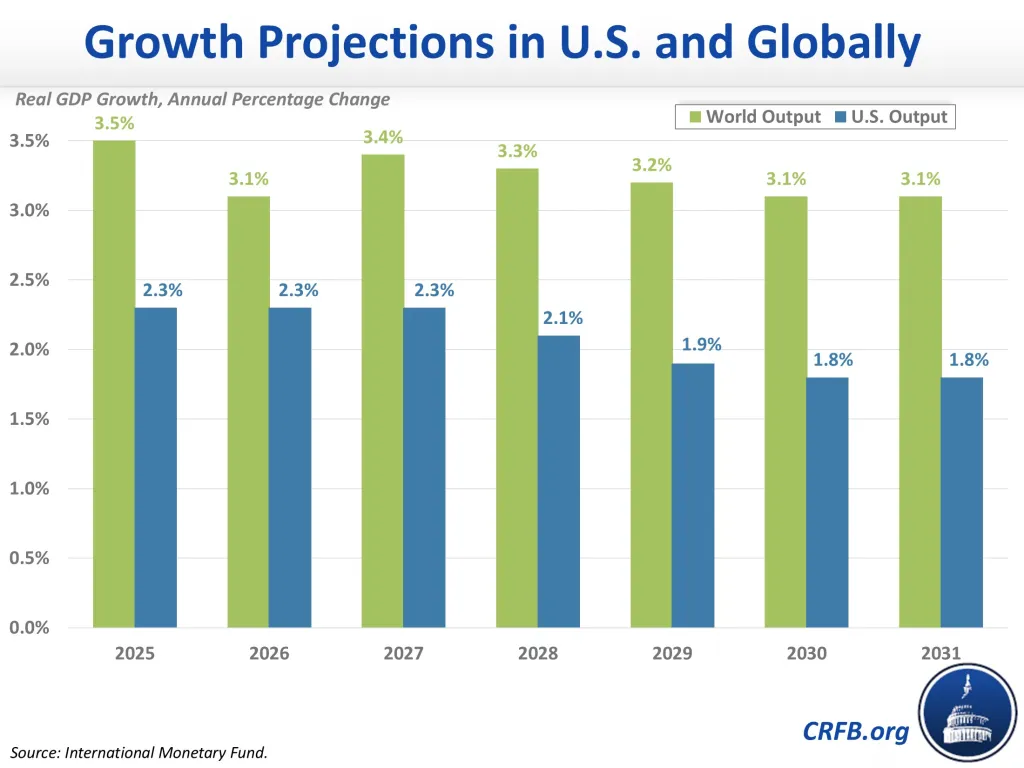
The IMF estimates that global Gross Domestic Product (GDP) will decline from 3.5% annual growth in 2025 to a projected 3.1% in 2026 and average 3.2% between 2026 and 2031, while the U.S. will remain stable and below the global aggregate at 2.3% in 2026 and 2027 and 2.0% between 2026 and 2031. The U.S. will continue to be outpaced by China, with China’s real GDP growth projected to nearly 4.5% in 2026 and averaging 3.8% between 2026 and 2031.
The rest of the Gang of Twenty (G20) will largely lag behind, with several European countries seeing slower growth at less than 1.0% per year on average through 2031, including Germany, France, and Italy. Real GDP growth will average 1.4% in the United Kingdom and 1.2% in Belgium through 2031. Annual economic growth in Japan will slow from 1.2% in 2025 to 0.8% in 2026 and average 0.6% through 2031.
Global headline inflation is projected to total 4.7% in 2026, up from 4.1% in 2025, before easing back to 4.1% in 2027. Inflation projections have been revised up by a cumulative 0.7 percentage points compared with the World Economic Outlook in April. The increase in inflation this year is largely attributed to higher energy prices due to disruptions in the Middle East and higher than expected food prices on account of increased energy and fertilizer costs, disrupted shipping routes, and increased transportation costs.
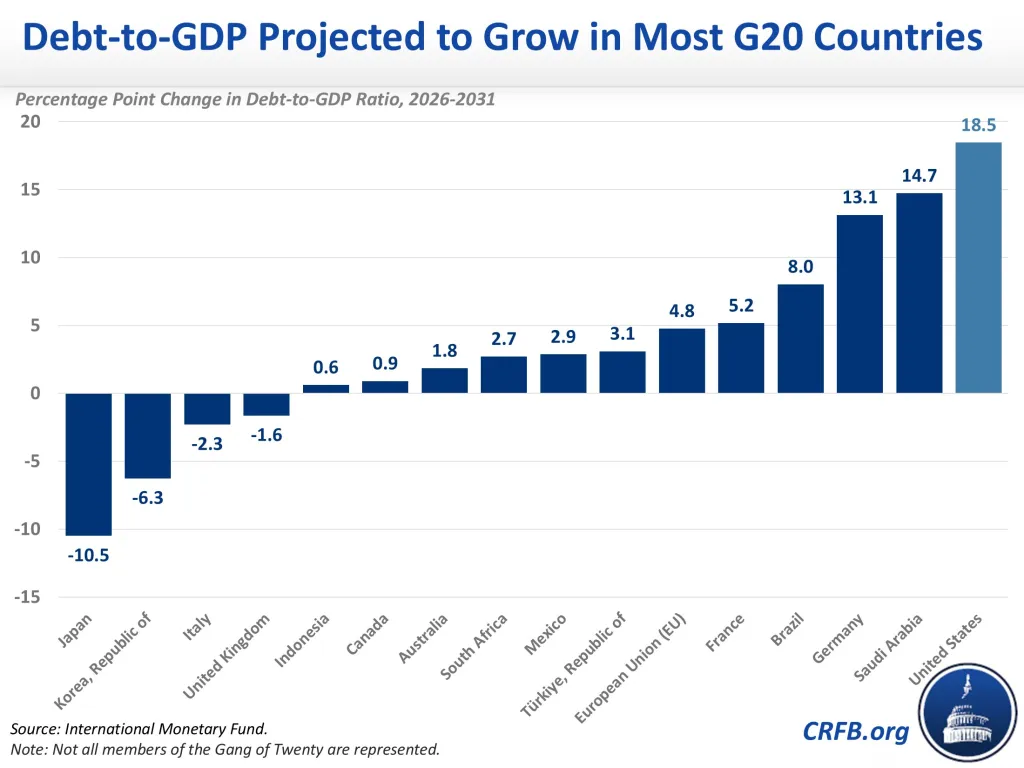
Public debt is projected to climb over the next five years coupled with high financing costs across the world, and several major economies are now facing historically large deficits. Meanwhile, in advanced economies, fiscal policy is expected to be broadly neutral in 2026 and tighten near the end of the five-year period. Between 2027 and 2031, the IMF projects net debt in the U.S. will grow by 17 percentage points from roughly 100% of GDP to 117%, one of the largest increases in advanced economies. The U.S. budget deficit will worsen over the budget window largely due to implementation of the One Big Beautiful Bill Act, partly offset by tariff revenue. Germany's debt-to-GDP ratio will grow by 10 percentage points from 53% to 63% due to higher infrastructure and defense spending. In contrast, the debt-to-GDP ratio will decline in other G20 economies, including Japan going from 124% of GDP to 116% of GDP due to low borrowing costs and favorable debt dynamics.
Borrowing costs are on the rise in most advanced economies; in the U.S., rates on 10-year government bonds have risen nearly a percentage point since February. Higher interest rates are driving interest costs, which are projected to total roughly 2.3% of global GDP in 2026. Higher borrowing costs in advanced economies also affect low-income countries where interest payments now consume a record 15% of all tax revenue, compared to around 20% in the U.S.
Despite a strong growth outlook, IMF Managing Director Kristalina Georgieva warned against relying on growth alone to fix current debt issues, acknowledging that growth “helps but it cannot deliver fast enough the necessary adjustments.”
To start the process of bringing down deficits, the IMF recommends improving tax systems, changing the composition of public spending to be less distortionary and more growth friendly, implementing immediate fiscal consolidations in countries with elevated debt or high risks, and providing timely, targeted, and temporary responses to energy shocks, with a focus on vulnerable countries. Countries around the globe are impacted by high debt and high interest rates, and the longer we wait to act, the more painful future adjustments will need to be.
Tags
What's Next
-
Image

-
Image

-
Image