Social Security and Medicare Trustees Release 2026 Reports
The Social Security and Medicare Trustees released their annual reports today, finding that both programs have significantly worse financial outlooks and are fast approaching insolvency.
The Trustees project that the Social Security retirement trust fund will run out of reserves in just six years, in 2032, and the Medicare Hospital Insurance (HI) trust fund will go insolvent just half a year later, in 2033. Both programs require timely trust fund solutions to address their solvency challenges.
CRFB will soon publish full analyses of each Trustees' report and will host a virtual event on the findings tomorrow. In their reports, the Trustees project that:
- Social Security’s Old-Age and Survivors Insurance (OASI) trust fund will be insolvent in 2032, or 2034 if funds are reallocated from the disability (SSDI) trust fund.
- Medicare’s Hospital Insurance (HI) trust fund will deplete its reserves by 2033.
- Over the next 75 years, Social Security’s theoretically combined trust funds face an actuarial shortfall of 4.42% of taxable payroll (1.5% of GDP), a 16% increase from last year’s projection of 3.82%.
- The HI trust fund faces a 75-year shortfall of 0.56% of payroll (0.2% of GDP), a 33% increase from last year’s projection of 0.42%.
- Total Medicare costs are projected to rise from 4.1% of GDP in 2026 to 7.5% by 2100 under current law payment rates. Under the actuary’s alternative scenario, costs will rise to 9.8% of GDP by the end of the century.
Under the law, trust fund programs like Social Security and Medicare cannot spend more than they receive in revenues once their trust funds are exhausted. As a result, the looming insolvency of Social Security’s retirement program will lead to a 22% benefit cut when today’s youngest retirees turn 68, growing to 38% by 2100. If Social Security’s retirement trust fund was theoretically combined with the Social Security disability fund, beneficiaries would face a 17% benefit cut just two years later in 2034, growing to 35% by 2100.
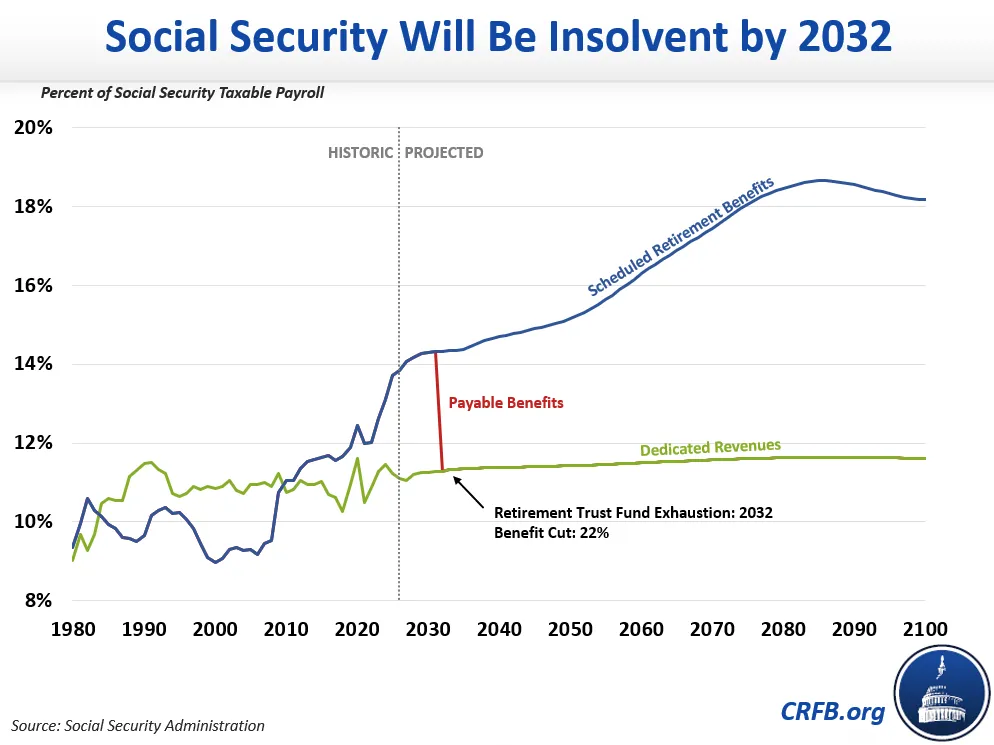
Due to a combination of demographic, legislative, and other changes, Social Security’s 75-year shortfall grew to 4.42% of taxable payroll this year, a 16% increase from last year’s report.
The Medicare Trustees project the HI trust fund will be insolvent in 2033, leading to an 11% cut in hospital payments, growing to a 16% cut by 2040. That cut could jeopardize access to health care for seniors and some workers with disabilities by delaying or denying payments to health care providers.
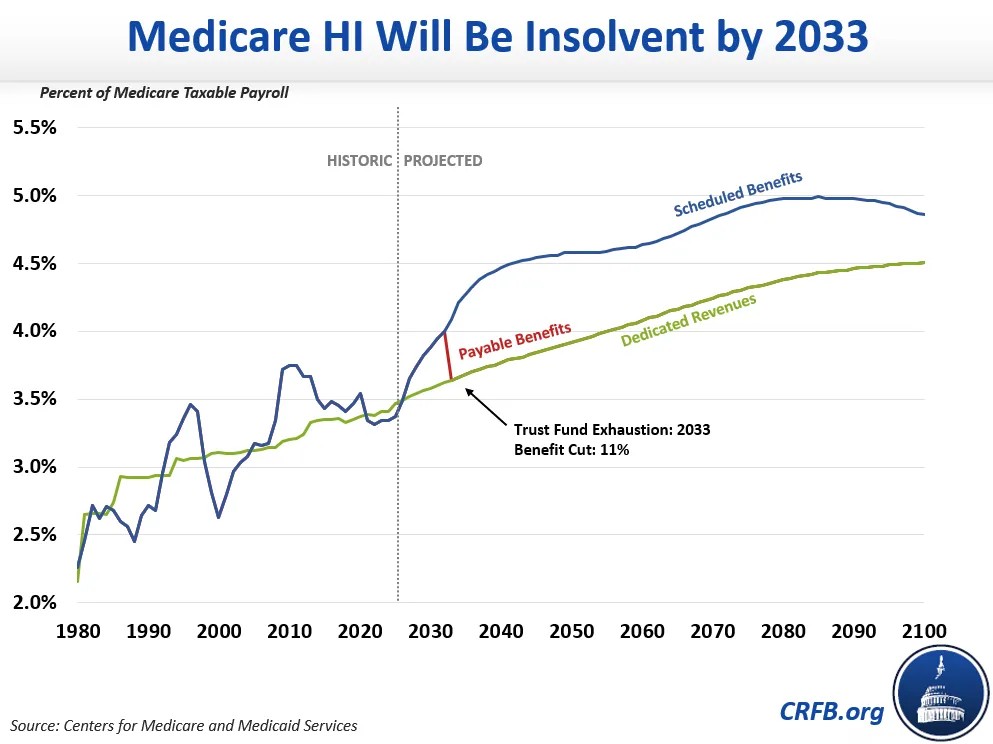
The Medicare Trustees find that Medicare Part B (physician insurance) and Part D (prescription drug benefits) will grow along with the HI program, although they cannot go “insolvent” because they are funded mainly out of general revenue on an as-needed basis. The Trustees project total gross Medicare costs will grow from 4.1% of GDP today to 7.5% of GDP by 2100. Under the actuary’s alternative scenario, costs could grow to 9.8% of GDP by the end of the century. Most of this cost growth would be funded by general revenue and thus require additional borrowing. Some would be funded through higher premiums on beneficiaries.
Over 75 years, the three trust funds face a combined shortfall of roughly 1.8% of GDP. Closing that shortfall will require reducing costs, boosting revenue, or some combination. Doing so would not only avoid a deep, abrupt cut but could also put the national debt on a more sustainable trajectory. Lawmakers should pursue trust fund solutions sooner rather than later to save these important programs.
The Committee for a Responsible Federal Budget will publish our full analyses of the Social Security and Medicare Trustees' reports later today. RSVP to our virtual event tomorrow at 2pm.