New Analysis Shows Social Security Benefit Taxation Raises Important Revenue
Last week, the Congressional Budget Office (CBO) released a new report analyzing the current system of taxing Social Security benefits. This is welcome timing, given CRFB’s recent paper, New Approaches to Social Security Benefit Taxation, which explores ways to reform the current system of taxation of benefits while advancing the solvency of the Social Security and Medicare Hospital Insurance trust funds.
Currently, Social Security benefits are partially subject to income taxes based on a complicated three-tier system with anywhere from 0% to 85% of benefits counted as taxable income. Revenue from taxation of the first 50% of benefits is credited toward the Social Security trust funds while revenue from additional taxation, up to the next 35%, is credited to Medicare’ Hospital Insurance (HI) trust fund.
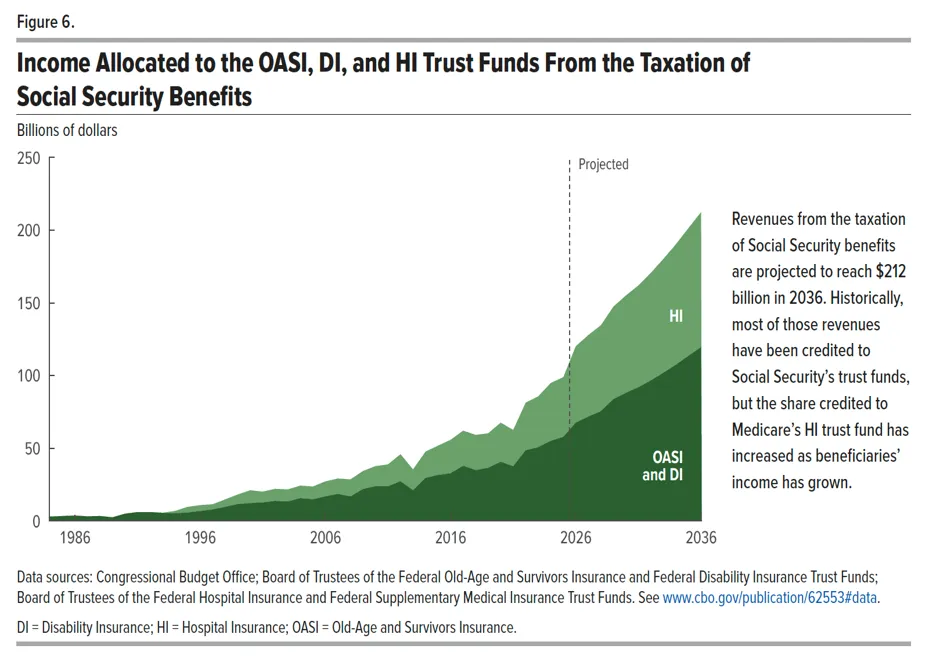
CBO’s paper details how this benefit taxation is designed and discusses its implications for effective marginal tax rates, economic growth, tax complexity, distributional outcomes, trust fund solvency, and revenue over time. Consistent with our recent analysis, CBO finds that repealing benefit taxation – as some politicians have called for or proposed – would advance the insolvency of Social Security’s retirement fund from 2032 to 2031 and Medicare’s hospital fund from 2040 to 2031. At the same time, they identify several flaws with the current system.
CRFB’s recent paper, New Approaches to Social Security Benefit Taxation, suggests a number of ways to address these and other flaws. For example, taxing 85% or 93% of all benefits removes the very high effective marginal rates created by the phase-in of the current three-tiered structure, while moving toward tax neutrality; distributional concerns could be addressed by extending the bonus senior deduction or replacing it with a credit. More structural reforms – for example taxing benefits like a private pension (taxing benefits in excess of post-tax payments) or like a Roth IRA (taxing contributions instead of benefits) could go even further to improve efficiency, equity, fairness, and simplicity. These and other options could also help improve the solvency of Social Security and Medicare.
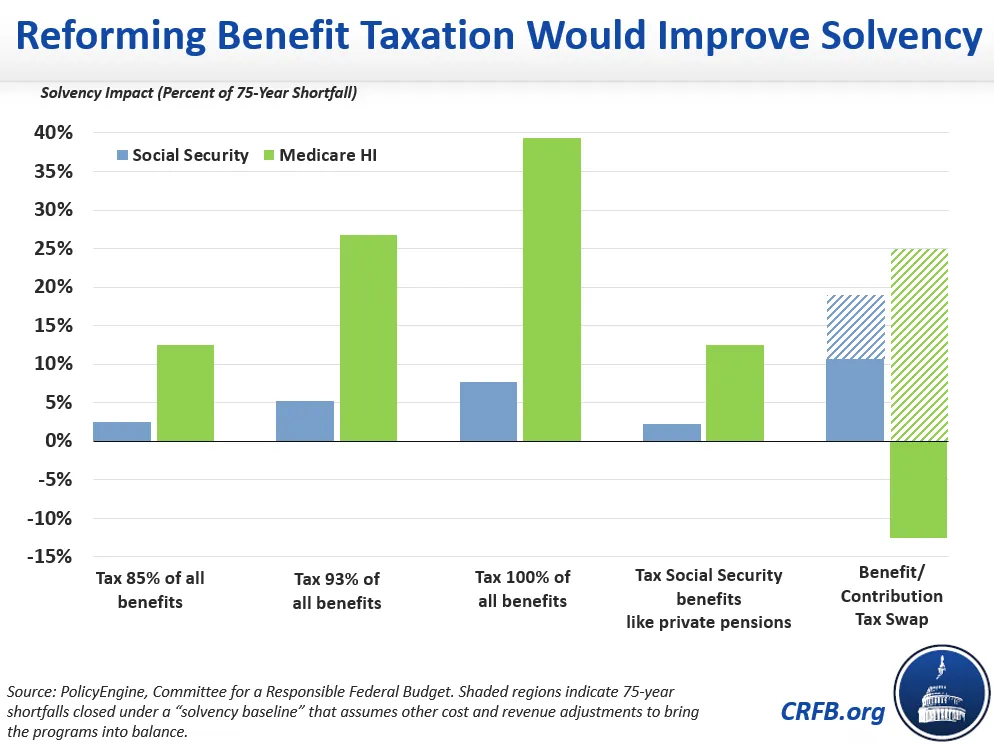
Our paper puts forth 18 different options– with scores – to reform taxation of benefits, demonstrating that there are many ways to improve benefit taxation. But repealing taxation of benefits would be a major step backwards, not only undermining principles of fair taxation, but driving Social Security and Medicare to insolvency in the process.
Tags
What's Next
-
Image

-
Image

-
Image