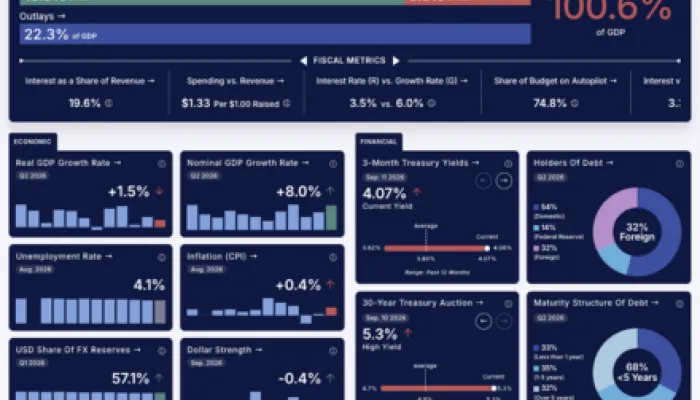
GDP Grew 2.2% in FY 2026
According to advance estimates from the Bureau of Economic Analysis, Gross Domestic Product (GDP) increased at an annualized rate of 3.4% in the third quarter of calendar year 2026 (the final quarter of Fiscal Year 2026) – about 0.8% on a nonannualized basis. Incorporating the slower growth in prior quarters, GDP growth was 2.2% in FY 2026, when comparing the annual average in FY 2025 to the annual average in FY 2026; it was 2.1% when measuring third quarter 2025 over third quarter 2026.

This quarter’s strong 3.4% growth is welcome news for households and taxpayers; sustained and broad-based growth at that rate over the next decade could stabilize the debt around its current (very high) level, 100% of GDP.
However, there is a massive difference between growing 3.4% in a single quarter and doing so on a sustained basis. Quarterly growth is volatile. Over the past two decades, GDP growth has exceeded an annualized 3% rate in two-fifths of all quarters. But growth has only exceeded 3% in four calendar years – and not once in the past two decades has it grown by 3% or more two years in a row.1 FY 2026 GDP grew by 2.2% – closely in line CBO’s February projections of 2.3%. This represents a relatively healthy level of growth in light of the nation’s aging population and other headwinds, but far short of what it would take to fix the debt without meaningful fiscal reforms.
Policymakers should work to both reduce deficits and promote stronger economic growth. These goals are mutually reinforcing – lower debt can support long-term growth and higher growth reduces debt – and can result in significant improvement for the U.S. Treasury and American households.
Strong Q3 economic growth is a welcome sign, and lawmakers should prioritize policies that boost growth while reducing deficits. However, growth alone is not a reliable source to ensure we put our debt on a sustainable downward trajectory.
1 Measured by Q4/Q4 growth, the economy grew 3% in 2013, 3.4% in 2019, 5.8% in 2021 coming out of the COVID recession, and 3.4% in 2023. Using average annual growth, only 2021 experienced above 3% growth.