Proposed Section 301 Tariffs Could Bring IEEPA Revenue Replacement to 80%
Today, the Trump Administration proposed a new round of tariffs under Section 301 of the Trade Act of 1974 against 14 economies it has determined engage in unfair trade practices related to structural excess capacity and overproduction in manufacturing sectors. Our rough preliminary estimates suggest these tariffs could raise $375 billion of revenue through Fiscal Year (FY) 2036. In combination with enacted Section 301, 338, and temporary 122 tariffs, about 80% of the projected revenue loss through FY 2036 following the Supreme Court’s ruling against tariffs imposed under the International Emergency Economic Powers Act (IEEPA) could be recovered.
The proposed tariffs generally range from 15% to 20%, net of existing Section 301 tariffs concerning forced labor and with exemptions and other provisions that largely align with the existing tariffs. Rates could reach up to 25% for India and 35% for Vietnam, and there is a 10% additional tariff on certain goods from China. Our estimates assume the tariffs are implemented at the rates outlined in today’s press release, though final rates could be higher or lower depending on the outcome of trade agreements.
Public hearings for the proposed tariffs are scheduled for January 25, 2027; we assume the tariffs are enacted in the month following.
Conventional Estimates of Net Tariff Revenue Impact Through FY 2036
| Revenue Impact | |
|---|---|
| 14-Economies Section 301 Tariffs (Excess Production) | +$375 billion |
| 60-Economies Section 301 Tariffs (Forced Labor) | +$900 billion |
| Brazil Section 301 Tariff | +$15 billion |
| Canada Section 338 Tariff | +$40 billion |
| Impact of Section 301 & 338 Tariffs | +$1.3 trillion |
| Tariffs Enacted through November of 2025 | +$2.7 trillion |
| Impact of IEEPA Removal Due to Court Ruling* | -$1.7 trillion |
| Temporary Section 122 10% Tariff | +$35 billion |
| Changes to Steel/Aluminum/Copper Tariffs | -$90 billion |
| Further Changes to Steel/Aluminum/Copper Tariffs | -$10 billion |
| Total Impact of Tariffs Since January 2025 | +$2.2 trillion |
| Memo: Total Lost Revenue Since November 2025 | -$455 billion |
Sources: CRFB estimates based on Congressional Budget Office resources and CRFB modeling.
Notes: Numbers are rough and may not sum due to rounding. * Estimate for revenue loss from Supreme Court ruling against IEEPA tariffs includes refunds.
In July, we estimated that the Administration’s Section 301, 338, and 122 tariffs would replace less than 60% of the projected revenue loss from the Supreme Court’s ruling against tariffs enacted under IEEPA authority, leaving a roughly $825 billion revenue gap through FY 2036 relative to the Congressional Budget Office’s February 2026 baseline estimate of net new revenue from tariffs. Our preliminary estimates suggest today’s proposed tariffs could raise $375 billion, shrinking the remaining gap to about $455 billion and bringing the IEEPA replacement percentage to about 80% through FY 2036; beyond FY 2027, the annual replacement rate is roughly 90%.
We estimate that the proposed tariffs would help to bring debt to 121% of GDP by 2036 instead of 120% of GDP under CBO’s February baseline. This projection for debt is 1 percentage point lower than our prior estimate in July.
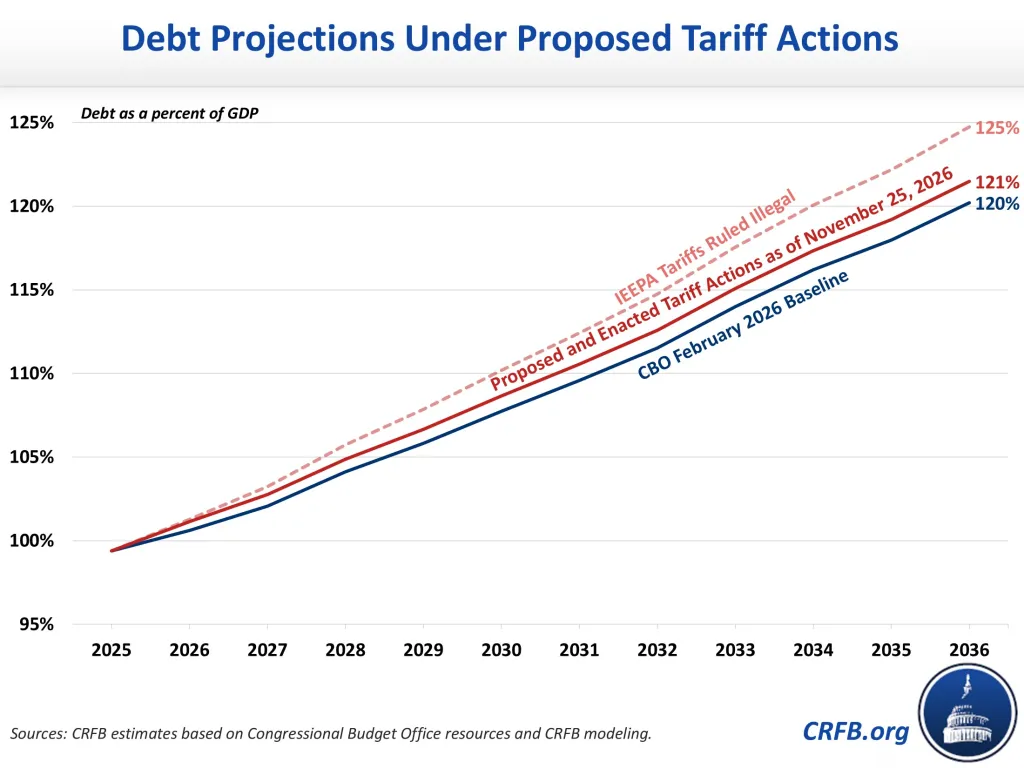
Importantly, these new tariffs may face legal challenges. The temporary Section 122 tariffs enacted in February were ruled illegal by the U.S. Court of International Trade, though litigation is ongoing. The Section 301 tariffs for forced labor and Section 338 tariffs on Canada are also facing lawsuits.
Assuming the tariffs are permanent and withstand legal challenge, the additional revenue is welcomed at a time of high and rising debt levels. Policymakers should pursue additional deficit reduction and build on this significant revenue gain. If policymakers wish to repeal or weaken the tariffs, they should propose alternative sources of spending cuts or revenue increases to avoid worsening an already dire fiscal outlook.
Tags
What's Next
-
Image
-
Image
-
Image