House Highway Bill Costs At Least $100-$235 Billion Over a Decade
The House Transportation and Infrastructure Committee recently approved a five-year reauthorization of surface transportation programs – the BUILD America 250 Act – on a bipartisan basis. Based on our preliminary estimates, this bill would increase federal highway and transit spending by $100 billion over the next decade on top of the higher levels set by the 2021 bipartisan infrastructure law. Relative to a pre-2021 baseline, it would increase spending by $235 billion. New fees on electric vehicles would only cover $30 billion of this cost.
Federal surface transportation bills are generally authorized on a five-year basis, with the last one occurring in the 2021 Infrastructure Investment and Jobs Act (IIJA), also known as the bipartisan infrastructure law. The IIJA was billed as a temporary, one-time increase in infrastructure spending, authorizing $566 billion of tax breaks and spending increases over a decade, including a five-year $90 billion increase in “contract authority” – a form of mandatory budget authority authorized by highway bills – that lawmakers claimed would be allowed to elapse after the one-time boost.
The BUILD America 250 Act would not only maintain those IIJA increases, but also further increase contract authority above and beyond the IIJA’s levels. Specifically, the bill would authorize $475 billion of contract authority over five years, which we estimate is roughly $180 billion above pre-IIJA levels through Fiscal Year (FY) 2031 or $75 billion above the one-time IIJA levels. If extended out for an additional five years – as under normal scoring conventions – the BUILD America 250 Act would allow $965 billion of contract authority, a $380 billion increase above pre-IIJA levels or $165 billion above the one-time IIJA levels.
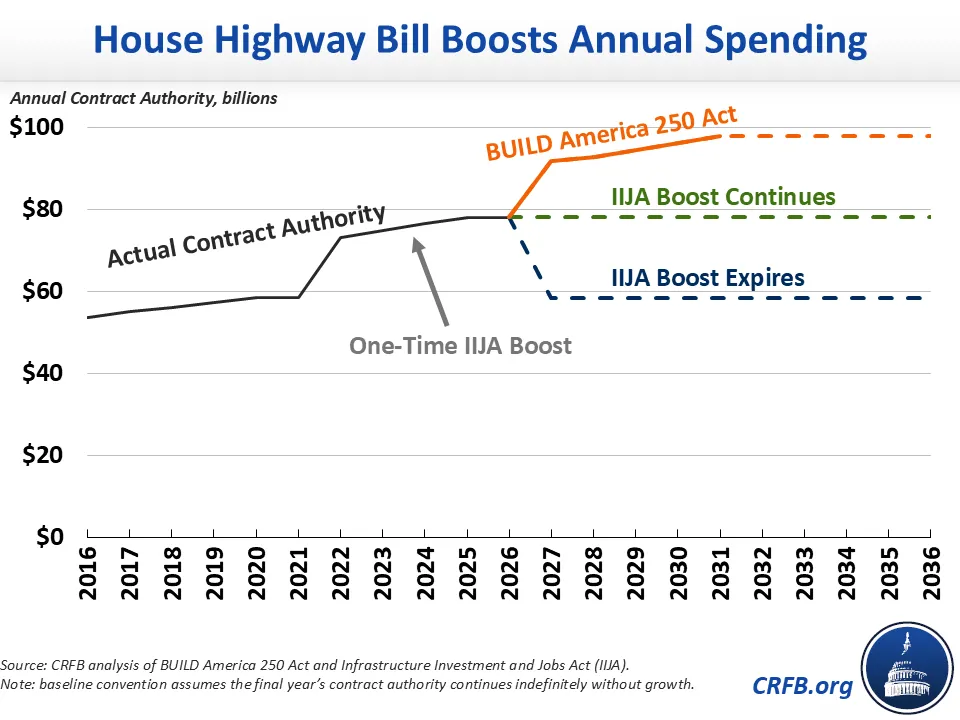
Over a decade, this increase would translate to a $235 billion increase in outlays compared to pre-IIJA levels and a $100 billion increase above the allegedly one-time IIJA levels.
Comparing BUILD America 250 Act to Highway Baselines
| 2027-2031 CA (5 Years) | 2027-2036 CA (10 Years) | 2027-2036 Outlays | |
|---|---|---|---|
| Pre-IIJA Baseline | $295 billion | $585 billion | n/a |
| BUILD America 250 Act | $475 billion | $965 billion | n/a |
| Increase from Pre-IIJA | +$180 billion | +$380 billion | +$235 billion |
| Post-IIJA Baseline | $400 billion | $800 billion | n/a |
| BUILD America 250 Act | $475 billion | $965 billion | n/a |
| Increase from Post-IIJA | +$75 billion | +$165 billion | +$100 billion |
Source: CRFB estimates based on CBO data and legislative text. Rounded to nearest $5 billion. CA = Contract Authority.
Importantly, the financing aspect of highway bills is typically handled by the Ways and Means Committee, which has not yet taken up the bill. Highway bill funding runs through the Highway Trust Fund (HTF) and primarily comes from the federal tax on gasoline and diesel; that revenue will only be enough to cover obligations through FY 2028, at which point funding will be limited to incoming revenues – resulting in a 40% cut to highway spending. However, the Transportation and Infrastructure Committee has also included a new electric vehicle registration fee, which we estimate would raise $30 billion over a decade. That new revenue would only be enough to cover one-eighth of the increase in outlays above pre-IIJA levels or 30% of the increase above post-IIJA levels. With the increase in contract authority, it would not cover any of the pre-existing trust fund shortfall.
Rather than boosting funding for highway spending, policymakers should instead focus on aligning HTF revenue with spending.
What's Next
-
Image

-
Image

-
Image