Debt Rises to 175% of GDP Under CBO’s Long-Term Outlook
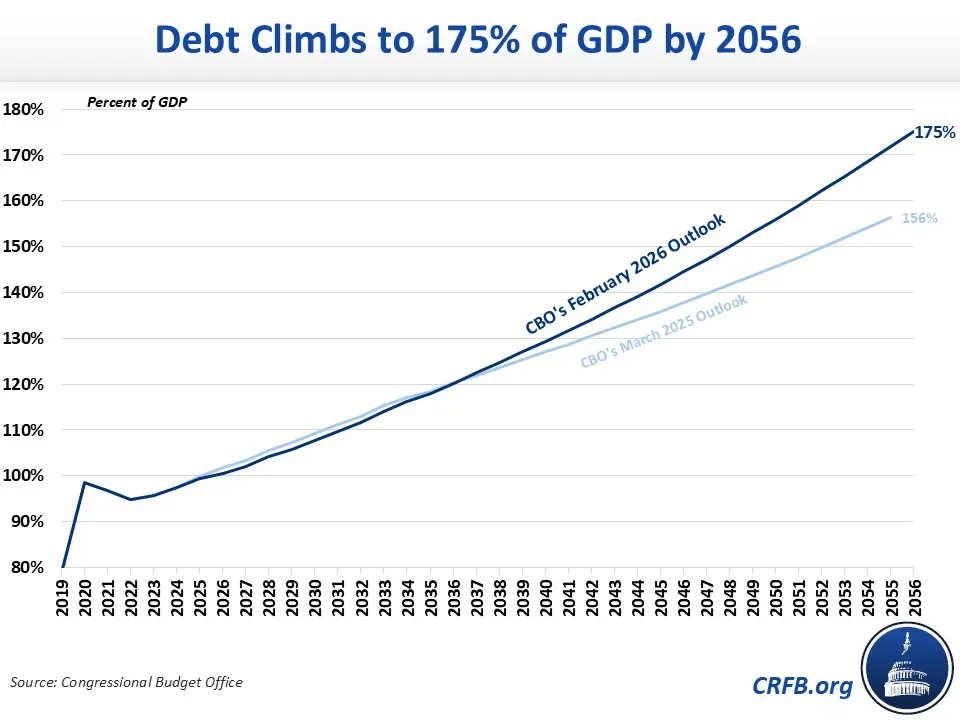
The national debt will rise to 175% of Gross Domestic Product (GDP) by 2056 – or $168 trillion – according to the Congressional Budget Office's (CBO) long-term budget outlook data. CBO estimates deficits would climb to 9.1% of GDP by 2056, with spending rising to 27.9% of GDP and revenue to 18.8% of GDP. Importantly, these estimates do not account for the Supreme Court ruling that tariffs under International Emergency Economic Powers Act (IEEPA) authority are illegal or subsequent actions, as CBO finalized data prior to the ruling.
Under its extended February baseline, CBO estimates that debt held by the public will rise from about 99% of GDP at the end of Fiscal Year (FY) 2025 to a record 108% of GDP in 2030, 129% of GDP in 2040, and 175% of GDP by 2056. Debt is nearly double the 50-year historic average today, will reach double its pre-pandemic level by 2051, and is on course to double today’s levels in the mid-2060s.
Debt is projected to be over 15% of GDP higher in 2055 than estimated in CBO’s March 2025 outlook – 172% instead of 156% – with additional borrowing from the One Big Beautiful Bill Act (OBBBA) and the effects of higher interest rates not nearly countered by higher tariff revenue, lower discretionary spending, and higher expected nominal GDP.
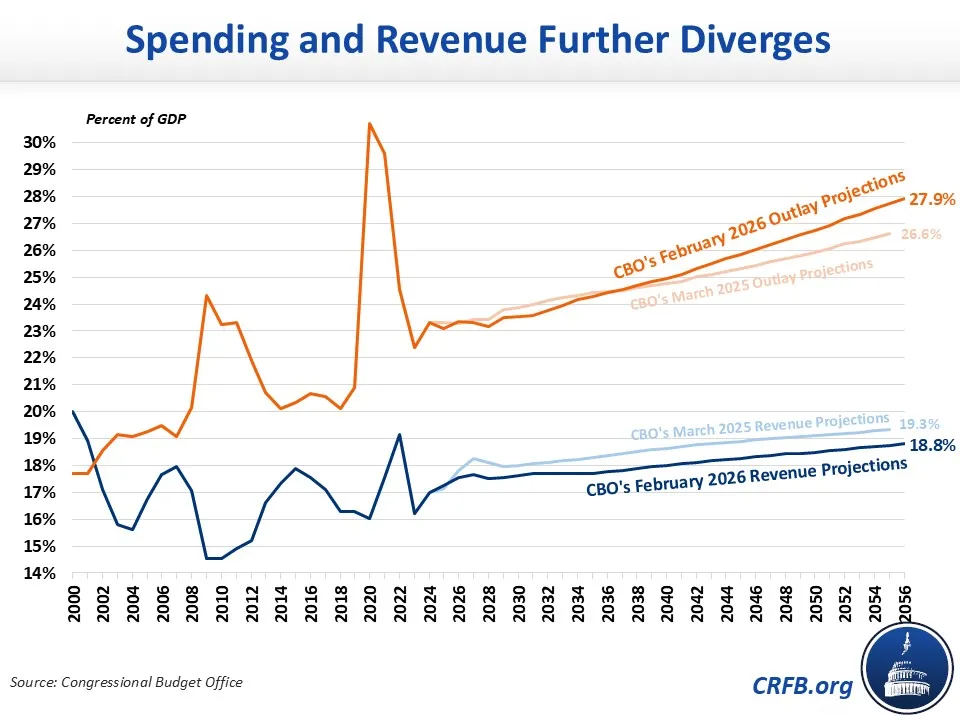
The significant increase in long-term debt relative to CBO’s March 2025 outlook is due to a growing divergence between spending and revenue.
Revenues are projected to rise from 17.2% of GDP in 2025 to 18.8% of GDP by 2056, as the combination of real bracket creep and tax cut expirations boosts individual income tax collection by 1.4% of GDP. This is lower than CBO’s 2025 projections of 19.3% of GDP by 2055, with OBBBA reducing revenue more than tariffs and other changes to revenues.
Spending, meanwhile, is projected to rise from 23.1% of GDP in 2025 to 27.9% of GDP by 2056. Over that time period, Social Security is projected to grow by 0.8% of GDP, major health care programs by 2.1% of GDP, and interest costs by 3.7% of GDP. Other spending is projected to decline by 1.8% of GDP.
Projected spending is lower as a share of the economy than in the 2025 baseline through 2036, but higher thereafter – reaching 27.7% of GDP as opposed to 26.6% of GDP in 2055. Over time, spending reductions from OBBBA are more than countered by other factors – especially rising interest costs, which explain more than the entire projected spending increase as a share of the economy in 2055.
As a result of the growing divergence of revenue and spending, deficits are projected to climb from 5.8% of GDP in 2025 to 9.1% of GDP by 2056. While primary deficits will remain relatively stable around 2% of GDP over the long term, interest is projected to more than double from a record 3.2% of GDP in 2025 to 6.9% of GDP by 2056. Over the 2026 to 2055 period deficits will average 7.1% of GDP, notably higher than the 6.3% of GDP average in CBO’s March 2025 outlook.
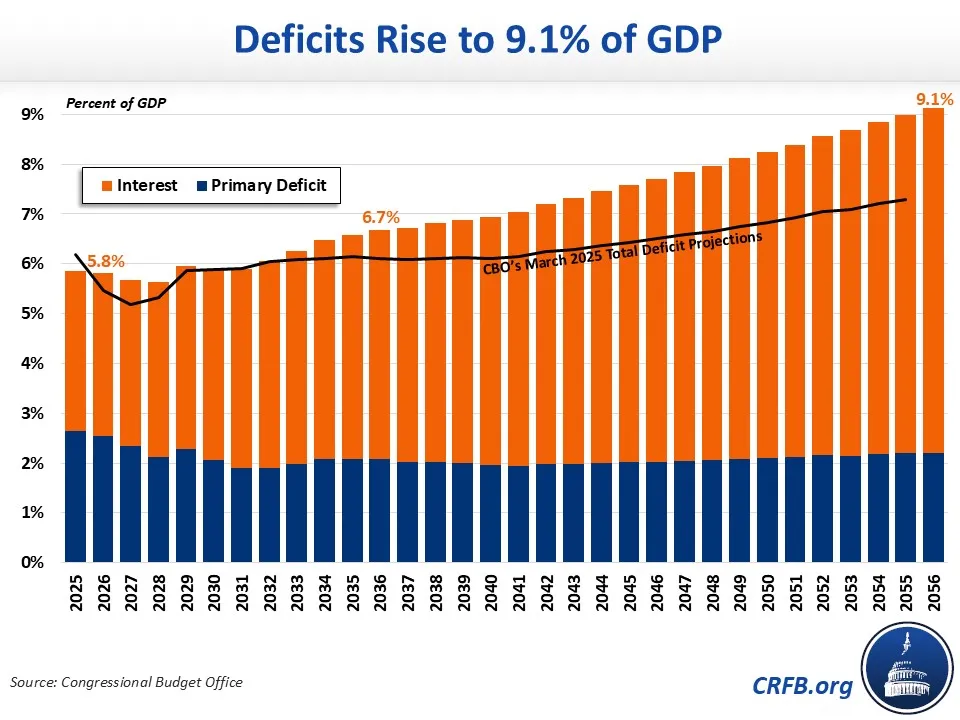
CBO’s latest long-term outlook shows a degrading fiscal picture. Although primary deficits remain relatively flat over the long term, rising interest costs on a large and growing debt will drive deficits to increasingly unsustainable levels over the coming decades. As debt grows and deficits rise, policymakers’ flexibility will erode – making it increasingly difficult to put the nation on a sustainable fiscal path. We encourage lawmakers to act on our fiscal problem immediately and avoid a fiscal crisis.