$1.5 Trillion Military Budget Would Add $5.8 Trillion to Debt Over Decade
Note: An update to this blog to incorporate an additional year of the budget window as well as higher interest rates can be found here.
In a post on Truth Social, President Trump called for increasing the Fiscal Year (FY) 2027 defense budget to $1.5 trillion, rather than $1 trillion he said he previously wanted to propose. We preliminarily estimate that this would increase defense spending by $5 trillion through 2035, adding $5.8 trillion to the national debt when interest is included.
To justify this increase, President Trump points to the substantial revenue being brought in by the tariffs enacted thus far in his second term, arguing that the tariffs would be sufficient to cover increased military spending, rebate payments, and deficit reduction. In reality, the military spending increase would be about twice as large as expected tariff revenue.
The Congressional Budget Office recently estimated current tariffs would raise $2.5 trillion of additional revenue through 2035, or $3 trillion with interest. On a dynamic basis, the revenue is likely to be somewhat smaller.
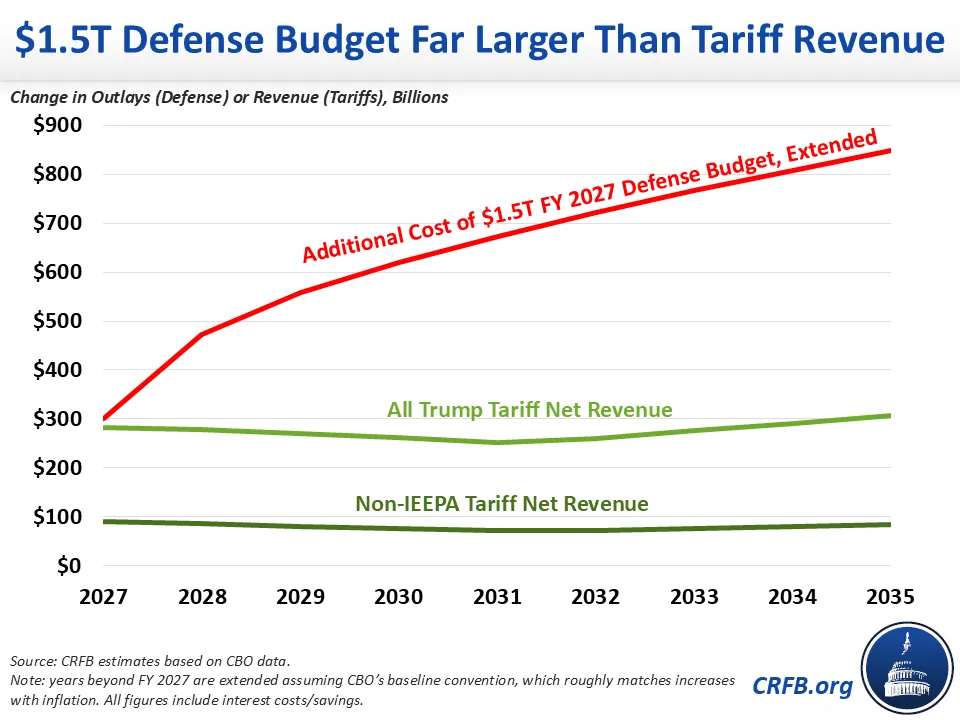
Importantly, the Supreme Court may soon rule that a substantial portion of the tariffs – those put in place via the International Emergency Economic Powers Act (IEEPA) – are illegal. In that case, total deficit reduction from the tariff revenue would be closer to $700 billion through 2035 on a conventional basis based on prior estimates, covering only about 15% of the cost of a defense hike. It is important to note that President Trump said that absent tariff revenue, military spending should total $1 trillion in 2027.
Given the $175 billion appropriated to the defense budget under the One Big Beautiful Bill Act (OBBBA), there is little case for a near-term increase in military spending. Any future increases that may be necessary should be fully paid for, ideally twice-over given our high and rising national debt, with new revenue or spending cuts. Policymakers should not rely on existing tariff revenue – without which deficits would be much higher – and even if they did it would fall far short of covering the costs of such a large defense spending increase.