Congress Could End Government Shutdown Drama Once and For All
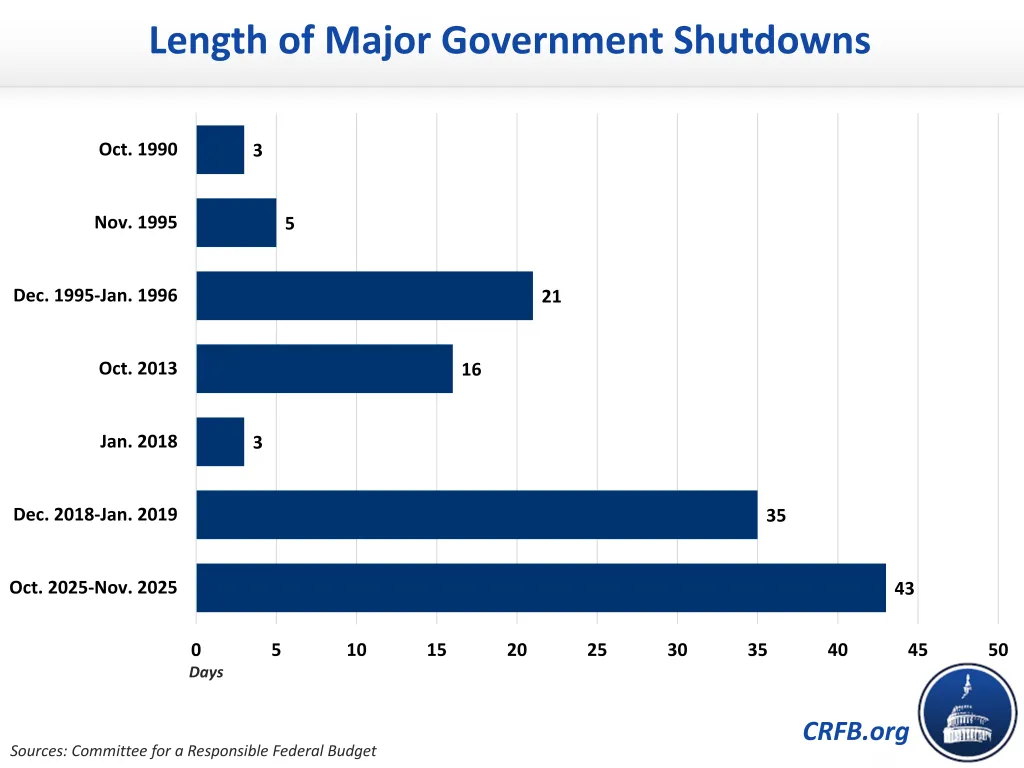
Government funding will expire on January 30, 2026, at which point agencies funded under six of the 12 appropriations bills currently operating under a continuing resolution (CR) will be required to shut down without further appropriations. This is the second time the government may shut down potentially this fiscal year, with the first resulting in the longest ever government shutdown at 43 days. Congress could instead end this practice of last-minute funding deadlines altogether.
Last year, House Budget Committee Chairman Jodey Arrington (R-TX), Representative Jimmy Panetta (D-CA), and a bipartisan group of 12 additional lawmakers, including Bipartisan Fiscal Forum Co-Chairs Scott Peters (D-CA) and Bill Huizenga (R-MI), reintroduced the Prevent Government Shutdowns Act (PGSA). The bill would authorize an automatic continuing resolution (auto-CR) at current spending levels until lawmakers can reach an agreement on appropriations and create other incentives for the timely completion of appropriations work. This, or a similar auto-CR, would represent a significant improvement to the current federal budget process and help support healthy appropriations negotiations without the risks and costs associated with a government shutdown.
The Committee for a Responsible Federal Budget has previously proposed the introduction of an auto-CR and written favorably of several versions of the proposal, including prior versions of the PGSA from Senators James Lankford (R-OK) and Maggie Hassan (D-NH). Below is an update to our 2023 piece on the PGSA. See here to learn more about government shutdowns.
There have been 21 “funding gaps” during the modern budget era when funds were not appropriated for at least one day. The most recent shutdown, which began on October 1, 2025, and ended on November 12, 2025, holds the record as the longest government shutdown at 43 days. The public feels the effects of government shutdowns in a variety of ways: Social Security and Medicare benefit verifications and card issuances cease, Environmental Protection Agency and Food and Drug Administration inspections are delayed, and Transportation Security Administration agents and air traffic controllers go unpaid, which has put a strain on air travel during previous shutdowns.
Government shutdowns also entail permanent fiscal and economic costs despite the temporary loss of services. The Congressional Budget Office (CBO) estimated that the October 2025 shutdown would result in a loss of $11 billion in real GDP, and a 2019 Senate report found that the government shutdowns in 2013, 2018, and 2019 cost taxpayers nearly $4 billion.
The PGSA addresses government shutdowns by automatically extending appropriations at current funding levels for two weeks at a time, preventing funding gaps and ensuring all government services are still able to operate even if lawmakers reach an impasse. It also creates incentives to prevent appropriation lapses altogether. The bill would prioritize appropriations work in Congress by prohibiting all other matters besides general appropriations measures from being considered while an auto-CR is in effect, which could only be waived by a two-thirds vote for a period of no more than seven days.
Official travel would be prohibited for Members of Congress – including their personal staff and Committee staff, as well as White House budget staff – if the October 1 appropriations deadline is not met, while taxpayer-funded travel allowances and other travel reimbursements would be cut off and daily mandatory quorum calls would be required. Senate nominations and certain program authorization legislation could only be considered after a period of 30 days.
Previously, the Prevent Government Shutdowns Act of 2020 was reported favorably by the Senate Committee on Homeland Security and Governmental Affairs by a vote of 10-2 (the two members voting "no" each had their own auto-CR bill). A similar measure introduced in 2021 did not advance after its introduction. In 2023, the bill was reintroduced in the Senate and received a vote as an amendment to a funding bill, which came close to passing.
Objections to auto-CRs center on the perceived lack of motivation to enact appropriations under such a process, as well as the undermining of the Congressional power of the purse and one of the major sources of leverage that lawmakers have. We have previously argued that auto-CRs reduce high-stakes brinkmanship to create space for holistic budgeting and provide incentives to complete a proper appropriations process, noting that states with auto-CR laws are just as likely to pass budgets on time as states without such laws. In addition, we have previously estimated the PGSA would have little-to-no negative fiscal impact, as any scored increase in mandatory spending would be offset by an equal reduction under discretionary spending.
Lawmakers have put forward many proposals for auto-CRs, some of which are discussed in more detail in our Better Budget Process Initiative paper. A bipartisan range of auto-CR proposals includes legislation that would continue to fund programs at levels close to the prior appropriated amount but vary on spending rates and incentives to appropriate. Most importantly, they would forestall the unnecessary costs of government shutdowns.
The PGSA would strengthen the budget process by encouraging the timely passage of appropriations legislation and mitigating the harmful effects of government shutdowns. Maya MacGuineas, president of the Committee for a Responsible Federal Budget, praised the introduction of the Prevent Government Shutdowns Act of 2025:
Government shutdowns can and should be avoided. Funding the government is one of lawmakers' most basic responsibilities, and failing to do so on time wastes taxpayer dollars, punishes federal workers, and negatively affects economic growth. By providing for an automatic continuing resolution if policymakers fail to enact appropriations bills on time, and requiring lawmakers to finish that task before considering other matters, the legislation would help to improve our broken budget process. I applaud Representatives Jodey Arrington (R-TX) and Jimmy Panetta (D-CA) for introducing the Prevent Government Shutdowns Act. This common-sense legislation would allow lawmakers to focus on long-term issues instead of responding to short-term self-imposed crises.
What's Next
-
Image
-
Image
-
Image